Learn · Welding
GTAW (TIG)
Part of Your First Welding Cert · step 5 of 24 · next: Choosing the Right Process
In learning paths: Your First Welding Cert
Assumes you know: Welding Fundamentals: Heat, Arc and the Weld Pool
Gas tungsten arc welding, TIG, separates the arc from the filler metal. A tungsten electrode in the torch carries the arc but does not melt into the weld; tungsten’s melting point is over 6,000 °F, so it survives the arc and just points it. You feed a bare filler rod into the pool with your other hand, argon flows from the torch cup to shield everything, and a foot pedal or torch control lets you adjust amperage while welding. Nothing burns except what you choose to melt.
Why it matters on the job
TIG is the precision process. It makes the cleanest, most controlled welds of any manual arc process: no slag, no spatter, no flux, full control of heat and filler independently. It is the process for stainless food and pharma tube, aerospace and aviation work, thin sheet, root passes on high-pressure pipe, and aluminum done beautifully. It is also the slowest process, with the least tolerance for dirty metal, so knowing when TIG is worth its time is part of knowing TIG.
Polarity is the heart of TIG
On TIG, polarity decides where the heat goes and what the arc does to the surface.
DCEN, electrode negative, is the setting for steel and stainless. Electrons stream from the tungsten into the work, and about two thirds of the arc heat lands in the workpiece. The work melts readily, the tungsten stays cool and sharp, and you get deep, narrow penetration. Steel, stainless, chromoly, titanium, copper: all DCEN.
AC is the setting for aluminum. Aluminum instantly grows an oxide skin, and that oxide melts around 3,700 °F while the aluminum under it melts at about 1,220 °F. Weld through the oxide and it fouls the pool. AC solves this by alternating: during the electrode-positive half of each cycle, current flowing out of the work blasts the oxide off the surface, a visible cleaning action that frosts the metal beside the pool; during the electrode-negative half, heat drives into the work. Modern inverters let you set the balance between cleaning and penetration.
DCEP alone is essentially unused for TIG. With the tungsten positive, most of the heat lands on the electrode; it overheats and balls at currents too low to weld anything substantial.
A concrete setup
Butt joint on 1/8 in mild steel: 3/32 in 2% lanthanated tungsten ground to a point, DCEN, machine set around 125 A on the pedal, following the old rule of about 1 A per 0.001 in of thickness. Argon at 15 to 20 cfh through a #6 or #7 cup, 1/16 in ER70S-2 filler. Hold a tight arc about one electrode diameter long, form a shiny pool, and dip the filler at the pool’s leading edge in a steady rhythm. The same machine on 1/8 in aluminum flips to AC, a balled or blunted tungsten, and roughly the same amperage with a faster pace, because aluminum pulls heat away fast.
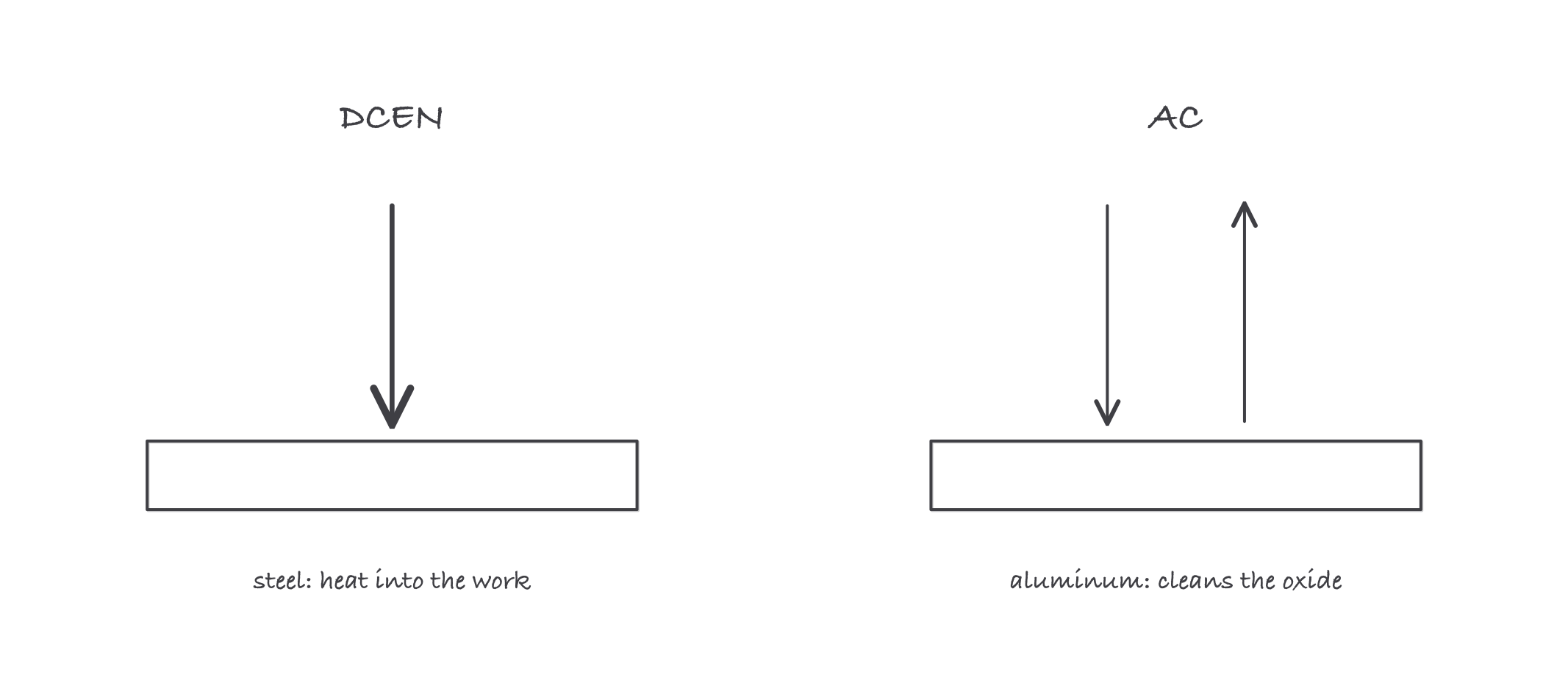
Where the heat goes: DCEN pours it into steel, AC trades half of each cycle for oxide cleaning on aluminum
Where it bites
- Touch the tungsten to the pool and everything stops. A dipped tungsten contaminates the electrode and the weld. Stop, regrind the point, and clip the contaminated filler tip. Welding on through it leaves tungsten inclusions an X-ray will find.
- TIG has zero tolerance for dirt. Oil, paint, moisture and oxide all end up as porosity or gray, ugly beads. Steel gets ground bright; aluminum gets a dedicated stainless brush and solvent. Cleanliness is a setup step, not a preference.
- More gas is not better gas. Argon flow set too high goes turbulent and drags air into the shield. Stay in the cup’s designed range and fix drafts instead of raising flow.
- Grinding direction matters on the point. Grind the tungsten lengthwise so the grind lines run toward the tip; radial grind marks make the arc wander.
- The pedal is a tool, not a cruise control. Heat needs vary along a joint as the part warms. Riding one amperage start to finish is how thin work gets blown through at the far end.
Verified requirements
| Where | Expires | Renewal | Continuing education |
|---|---|---|---|
| United States (federal) | No | Confirm with issuer | Confirm with issuer |
Information comes from issuing-authority sources. Confirm current rules, fees and eligibility with the authority before acting.