Learn · Welding
Welding Fume, Ventilation and Hexavalent Chromium
Assumes you know: Welding Fundamentals: Heat, Arc and the Weld Pool
Welding fume is metal that boiled off the arc and froze again in the air. The arc vaporizes electrode, base metal and whatever sits on the surface; that vapor meets cool room air an inch or two away and condenses into particles fine enough to stay airborne and to travel deep into the lungs. You are not breathing smoke from something burning. You are breathing the plate.
Why it matters on the job
The dose is invisible and it adds up over a career. A shift of stick welding on bare mild steel in an open bay is a different exposure from an hour of flux-core in a corner, and neither one announces itself: the plume looks the same. Ventilation is also the control you can change in five minutes, so it pays to know what the rules actually ask for before a safety manager or a compliance officer asks you.
The plume is a copy of your consumables
Whatever the arc melts ends up in the air above it (base metal, filler metal, flux, and any coating or plating on the surface). Change any one of those and you have changed the exposure, even though your hands are doing the same job. The same rod on clean plate and on coated plate is not the same day’s breathing.
This is why the rules that matter here are written around the material rather than around the process. Nobody regulates “welding fume” as a single substance. They regulate what is in it.
Chromium is regulated by name
Weld stainless, or run a chrome-bearing filler, and part of the chromium in the plume leaves the arc as hexavalent chromium, Cr(VI). It has its own OSHA standard: 29 CFR 1910.1026, which sets a permissible exposure limit of 5 micrograms per cubic meter of air as an 8-hour time-weighted average.
Read that standard’s scope and notice what it does not say. It covers “occupational exposures to chromium (VI) in all forms and compounds in general industry.” Welding is not named, and neither is stainless steel. The standard is about a substance; welding stainless is one of the ways that substance reaches your lungs. Construction work has its own Cr(VI) rule at 1926.1126, and this page does not restate its numbers.
OSHA does name stainless directly in one place a welder should know. Under 1910.252(c)(12), oxygen cutting of stainless steel “shall be done using mechanical ventilation adequate to remove the fumes generated.” No arc, no filler, no flux: still a ventilation requirement, because the chromium is in the plate.
Ventilation first, respirator second
The order is not a preference. Move the air, or capture the plume at the arc, before you put anything on your face.
For construction, 1926.353 states the trigger plainly: “Either general mechanical or local exhaust ventilation … shall be provided whenever welding, cutting, or heating is performed in a confined space.” Where that ventilation cannot be provided, the rule names the fallback, and it is specific: employees in the confined space “shall be protected by air line respirators.” Air supplied from outside the space rather than a filtering facepiece.
For respirators generally, 1910.134 puts a duty on the employer before anything is handed out: select “an appropriate respirator based on the respiratory hazard(s)” and on “a reasonable estimate of employee exposures.” A box of paper masks in the tool crib is not an estimate of anything.
One thing decides which of those citations covers you. Welding sits in two parts of 29 CFR: 1926 Subpart J for construction and 1910 Subpart Q for general industry, and the setting of the job picks between them rather than the machine you are holding. That is why the confined space trigger above is written 1926.353 while the figure in the next section is written 1910.252, and why a working welder needs both. The hot work lesson works through that split in full.
Worked example: does this bay need mechanical ventilation
For general industry, 1910.252(c)(2) puts numbers on it: mechanical ventilation is called for in a space of less than 10,000 cubic feet per welder, at a minimum rate of 2,000 cubic feet per minute per welder.
Take a fab bay 40 ft long, 30 ft wide, 14 ft to the ceiling, with two welders working in it.
- Floor area: 40 x 30 = 1,200 sq ft
- Volume: 1,200 x 14 = 16,800 cu ft
- Per welder: 16,800 / 2 = 8,400 cu ft
8,400 cu ft is under the 10,000 cu ft figure, so the bay is in scope, and the minimum rate is 2,000 cfm for each welder: 2 x 2,000 = 4,000 cfm.
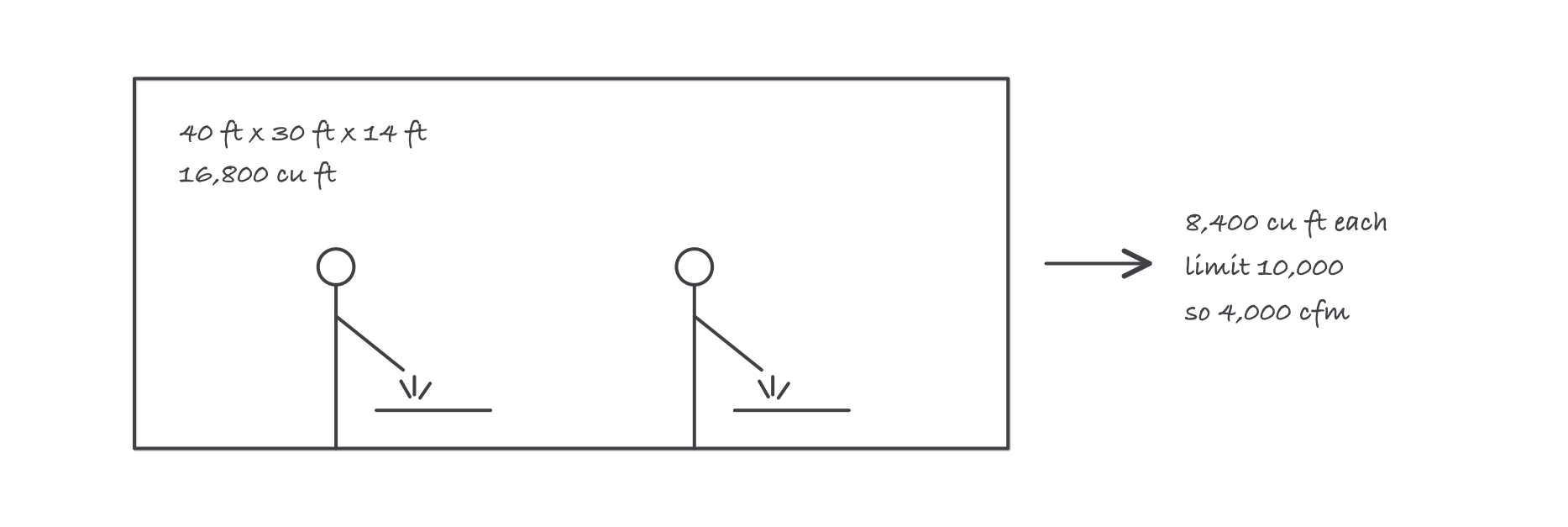
The room’s volume is fixed; the number of arcs in it is what moves you across the line
It helps to see what 4,000 cfm means in that specific room. Moving one bay volume takes 16,800 / 4,000 = 4.2 minutes, which is 60 / 4.2 = 14.3 air changes an hour.
Now walk a third welder in with a machine. Nothing about the building changed, but both sides of the calculation move: 16,800 / 3 = 5,600 cu ft each, and the minimum rate becomes 3 x 2,000 = 6,000 cfm. The bay that was ventilated adequately at lunchtime is not ventilated adequately at two o’clock.
Where it bites
- The two triggers are separate tests. The cubic-feet-per-welder figure in 1910.252(c)(2) and the confined-space trigger in 1926.353 ask different questions, and passing one says nothing about the other. A large open room can still be a confined space job when the work is inside a tank sitting in that room.
- A hood only captures near its mouth. Local exhaust pulls hard a short distance from the nozzle and very little beyond it, so the nozzle has to be repositioned every time the work moves. An extraction arm that stays where it was parked at the start of the shift is furniture.
- Cutting counts. Welders think of fume as an arc problem, and then take a cutting torch to a stainless fitting with no ventilation at all. The plate is the source, and 1910.252(c)(12) treats it that way.
- Oxygen is never ventilation. OSHA spends one sentence on this at 1910.252(c)(4)(v): “Oxygen shall never be used for ventilation.” Oxygen does not dilute a plume; it enriches the atmosphere, and oil, clothing and hair ignite readily in enriched oxygen. Blowing down a hot, smoky corner with the oxygen hose is a fire waiting for a spark, and there is always a spark.