Learn · Welding
WPS and PQR: How Procedures Work
Part of Your First Welding Cert · step 17 of 24 · next: Navigating AWS D1.1
In learning paths: Your First Welding Cert
Assumes you know: Reading Welding Symbols
A WPS is a recipe. A PQR is the lab report proving the recipe works. Welders are then tested to the recipe, and that paper chain, procedure qualified by test, welders qualified to the procedure, is how every welding code makes quality reproducible across different hands, shops, and years.
Why it matters on the job
On code work, the WPS taped to the machine is not a suggestion sheet. It is the document your weld will be judged against, the document the inspector audits, and the boundary of what you are qualified to do that day. Understanding how it earned its authority, through its PQR, turns the paperwork from bureaucracy into something you can read, question, and defend.
The WPS: a recipe with ranges
A Welding Procedure Specification lists everything needed to make a specific kind of weld repeatably: process, base metal type and thickness range, filler metal classification, position, joint design, preheat and interpass temperatures, electrical parameters, shielding, and technique. It speaks in ranges, not single numbers: amperage 110 to 140, thickness 1/8 to 3/4 in. Stay inside the ranges and the weld is being made the qualified way. Step outside any of them and, formally, it is not.
The PQR: the proof behind it
A Procedure Qualification Record is the frozen record of a test that was actually performed. Someone welded a test coupon following the proposed procedure, wrote down the values actually used, then cut the coupon into specimens: tensile pulls to prove strength, bend tests to prove soundness, more tests where the code demands them. The actual values and the lab results together form the PQR.
The PQR never changes. It is history: this coupon, welded this way, passed these tests on this date. The WPS is then written on top of it, with its ranges set as far as the code’s rules allow around what the PQR proved. One PQR can support several WPS documents, and one WPS can rest on several PQRs.
The welder: qualified to the procedure
The procedure proving out says nothing yet about you. A Welder Performance Qualification comes from you welding a test coupon following a WPS, with the result tested by bends or radiography. Pass, and you are qualified within limits the code derives from your test: process, position, thickness range, filler group. The division of labor is exact: the PQR proves the recipe, the WPQ proves the person, and the WPS is the recipe both point at.
Essential variables: when the paper expires
Codes sort procedure details into variables. The essential ones, things like process, base metal group, and thickness beyond qualified limits, define the qualification: change one outside its range and the WPS needs new qualification to cover it. Lesser, nonessential variables can be revised on the WPS without retesting. The variable tables live in the governing code, which is what the next two lessons teach you to navigate. Structural work adds one shortcut: AWS D1.1 offers prequalified procedures, pre-approved combinations that skip the PQR test if every limit is respected.
Worked example: one chain, start to finish
A shop lands a contract calling for FCAW on 1/2 in A572 Grade 50 steel, no prequalified option available. The chain:
- The shop welds a test coupon per the proposed procedure and sends it for tensile and bend tests. It passes: the record becomes PQR-107.
- The engineer writes WPS-12, its ranges built on what PQR-107 proved, citing it by number.
- Each welder on the job welds a performance coupon following WPS-12: pass, and their WPQ says so.
- On the floor, machines are set inside WPS-12’s ranges, and the inspector can trace every weld to all three documents.
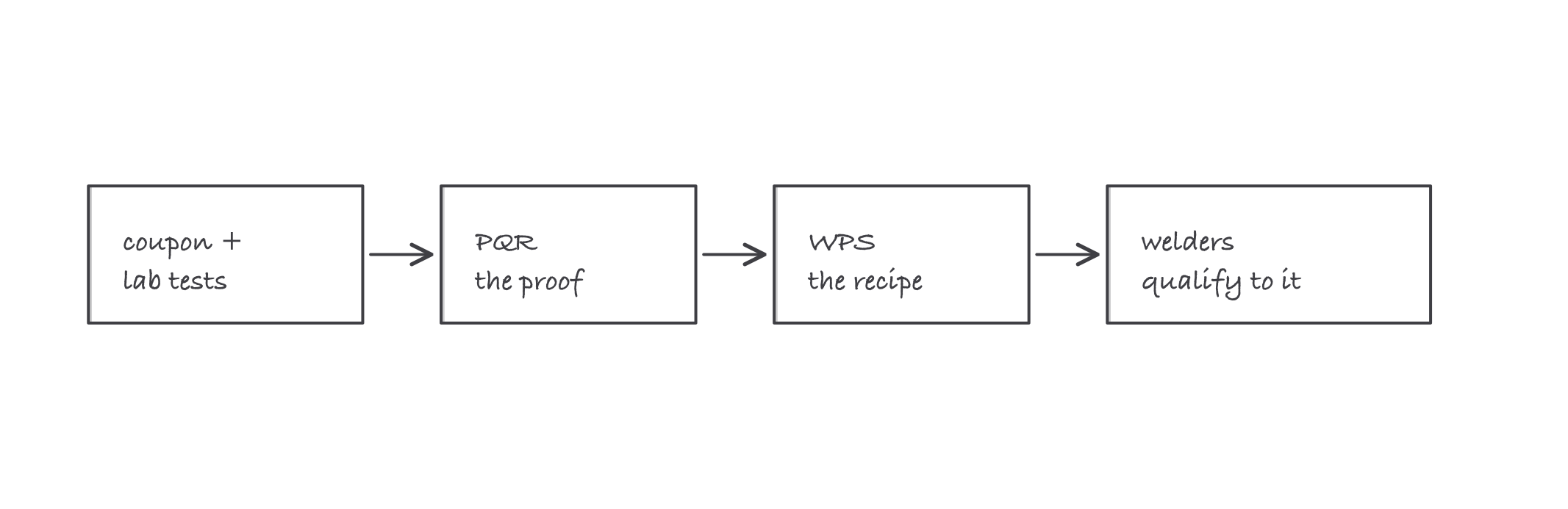
Proof, recipe, person: the test makes the PQR, the PQR backs the WPS, welders qualify to it
Where it bites
- Welding at the machine’s happy place instead of the WPS voids the work. If the joint needs settings outside the ranges, the answer is a procedure revision, not a quiet knob turn.
- A WPS without a PQR is a claim, not a qualification. Auditors ask for both, and shops fail audits over recipes nobody can prove. The exception is a properly limited prequalified WPS.
- Your qual has edges. Qualified on 3/8 in plate in the flat position does not mean qualified for overhead pipe. Read the ranges on your own WPQ; they are the actual credential.
- The PQR is not a work instruction. It records single actual values from one test day. Welders work to the WPS ranges built from it, never to the PQR directly.
Exam relevance
Inspector exams test this relationship relentlessly: which document is the record versus the specification, what qualifies whom, and what a change in an essential variable triggers. Welder candidates meet it practically: your qualification test is a performance qualification run to a WPS, and following that WPS exactly, settings, rod, position, is part of what is being examined.
Verified requirements
| Where | Expires | Renewal | Continuing education |
|---|---|---|---|
| United States (federal) | Yes | 9 years, with renewal applications required at years three and six after the initial activation date | 80 Professional Development Hours is one of four nine-year recertification routes; the others are retaking Part B Practical, passing an endorsement exam, or achieving Certified Radiographic Interpreter status |
| United States (federal) | No | Confirm with issuer | Confirm with issuer |
| United States (federal) | Yes | Confirm with issuer | Confirm with issuer |
Information comes from issuing-authority sources. Confirm current rules, fees and eligibility with the authority before acting.