Learn · Welding
SMAW (Stick)
Part of Your First Welding Cert · step 2 of 24 · next: GMAW (MIG)
In learning paths: Your First Welding Cert
Assumes you know: Welding Fundamentals: Heat, Arc and the Weld Pool
Shielded metal arc welding, stick welding, uses a consumable electrode: a steel rod coated in flux. The arc melts the rod into the joint while the burning flux makes its own shielding gas and lays a protective slag crust over the cooling weld. Everything the process needs travels in that one coated rod, which is why stick goes anywhere a lead will reach.
Why it matters on the job
Stick is the field process. It shrugs off wind that would strip a MIG gun’s shielding gas, runs off simple constant current machines and engine drives, and handles rusty, dirty, outdoor steel better than any wire process. Structural sites, pipelines, farm and repair work all lean on it. It is also the process most welders learn first, because it teaches arc length and puddle control with nothing automated.
Reading an electrode: E7018 decoded
Electrode classifications are a code you must be able to read. Take E7018, the workhorse structural rod:
- E means electrode.
- 70 is minimum tensile strength of the deposited weld metal: 70,000 psi, or 70 ksi.
- 1 is position: usable in all positions. A 2 here would mean flat and horizontal only.
- 8 describes the coating and current: low-hydrogen iron powder coating, runs on AC or DCEP.
The same grammar decodes any rod. E6010 is a 60 ksi, all-position, cellulosic rod that digs deep and runs on DCEP only; it is the classic open-root pipe rod. E6013 is a mild, easy-starting general purpose rod. The last two digits together always define the coating chemistry, and the coating defines the rod’s personality.
Low-hydrogen means low hydrogen
The 8 in E7018 carries a duty. Low-hydrogen rods exist to keep hydrogen out of the weld, because dissolved hydrogen cracks high-strength steel hours after the weld cools. The flux coating is baked dry, and it stays dry only if you store it right: sealed containers until opened, then a holding oven around 250 °F. Structural work limits how long an opened low-hydrogen rod can sit out in the air, commonly 4 hours for E7018 under AWS D1.1, before it must be re-baked or scrapped. A 7018 that has lived loose in a truck toolbox for a month is not a 7018 anymore.
Running it: a concrete setup
A typical first structural setup: 1/8 in E7018 on 1/4 in mild steel, machine set to DCEP at 110 to 140 A. Strike the arc like a match, hold an arc length about the diameter of the rod’s core wire, and travel with a slight drag angle of 10 to 15 degrees. The rod burns down, so your hand continuously feeds toward the work to keep arc length constant. Chip and wire-brush the slag off completely before any second pass. Amperage too low and the rod sticks; too high and the coating burns back and the puddle gets wild. The window is narrow enough that you tune by sound: a steady bacon sizzle is right.
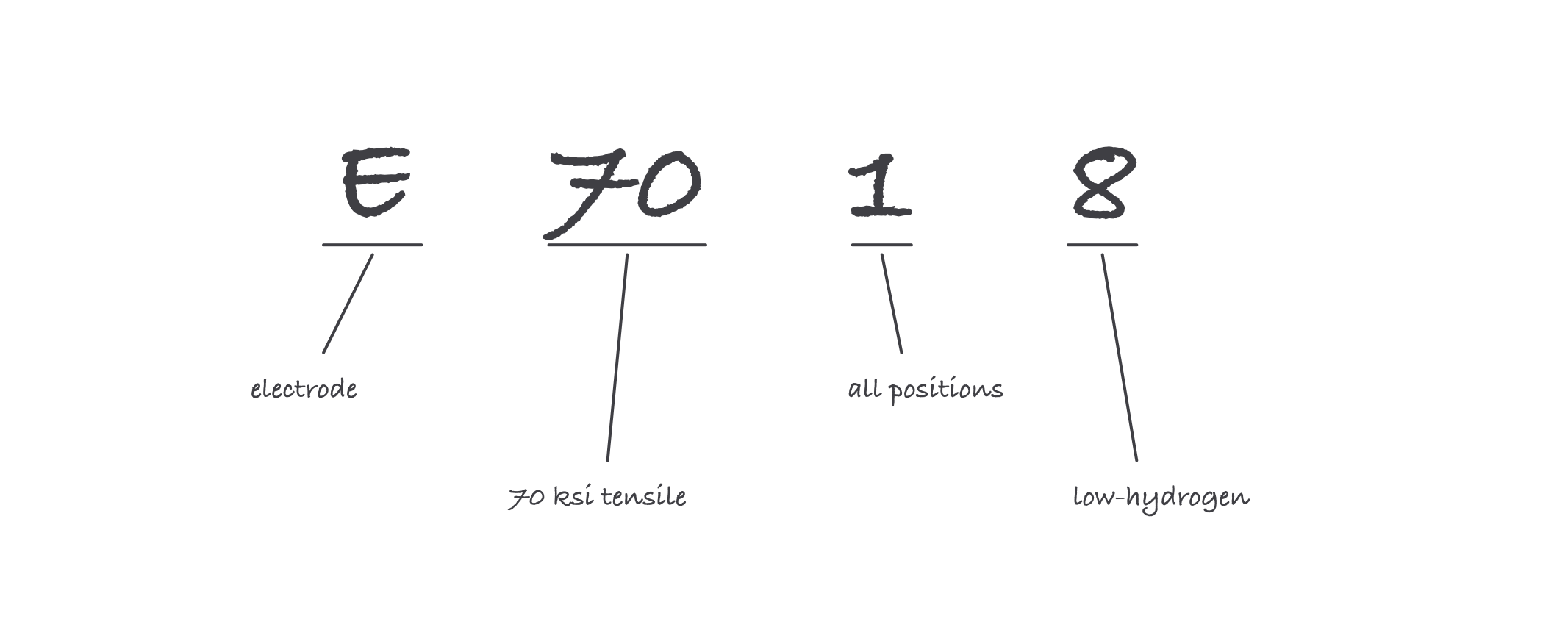
Four symbols, four facts: strength, position, coating, every rod decodes the same way
Where it bites
- Slag inclusions come from impatience. Slag left in a corner or between passes becomes a void inside the finished weld. Clean every pass like it will be inspected, because it may be.
- Wet 7018 makes cracked welds that look fine. Hydrogen cracking is delayed and often internal. Rod storage discipline is a weld-quality issue, not housekeeping.
- Restriking a used 7018 takes technique. The burned crater leaves a flux hollow at the tip; restrike slightly ahead of the crater and move back, or the first half inch runs porous.
- Not every machine runs every rod. Cellulosic rods like E6010 need a machine with the arc characteristics to support them; many small inverters list which rod classes they can run. Check before you blame your hands.
- Arc strikes outside the joint are defects. A careless tap of the rod on the base metal leaves a hard, crack-prone spot that codes treat as a flaw to be removed. Strike in the joint or on a run-on tab.
Verified requirements
| Where | Expires | Renewal | Continuing education |
|---|---|---|---|
| United States (federal) | No | Confirm with issuer | Confirm with issuer |
Information comes from issuing-authority sources. Confirm current rules, fees and eligibility with the authority before acting.