Learn · Welding
Heat Input and Distortion Control
Part of Your First Welding Cert · step 10 of 24 · next: Preheat and Interpass Temperature
In learning paths: Your First Welding Cert
Assumes you know: Welding Metallurgy Basics
Heat input is how much arc energy you pour into each inch of joint. It is one number, computed from three things you already control: voltage, amperage, and travel speed. That one number drives cooling rate, HAZ properties, and how badly the part warps, which makes it the most useful calculation in welding.
Why it matters on the job
Two masters pull on heat input from opposite directions. Too little and the joint cools fast: hard HAZ, cracking risk, and cold starts that leave lack of fusion. Too much and grains grow coarse, thin sections burn through, quenched and tempered steels lose their engineered properties, and the part distorts. Procedures on critical work often box the heat input in with a minimum and a maximum, and inspectors can recompute your number from a machine readout and a stopwatch. So can you.
The formula
In words first: heat input is arc power (volts times amps) converted to energy per minute, divided by how many inches of weld you covered in that minute.
Heat input (J/in) = (volts x amps x 60) / travel speed (in/min)
The 60 converts watts (joules per second) to joules per minute. Big numbers are usually quoted in kJ/in: divide by 1,000.
Worked example
You run GMAW at 24 V and 130 A, and you cover 10 inches of joint per minute:
- Arc power: 24 x 130 = 3,120 W, which is 3,120 joules every second.
- Per minute: 3,120 x 60 = 187,200 J each minute.
- Per inch: 187,200 / 10 = 18,720 J/in, or about 18.7 kJ/in.
Now slow down to 5 in/min with the same machine settings:
- 187,200 / 5 = 37,440 J/in, about 37.4 kJ/in.
Nothing changed on the machine, and the heat input doubled. Travel speed is the lever welders forget, and it is the one the formula punishes hardest. Dwelling, weaving wide, and creeping along all raise heat input without touching a knob.
Why welds distort
Weld metal goes in as liquid at its largest volume and then shrinks as it cools and contracts. Because the weld is anchored to cold base metal, that shrinkage pulls the whole part toward the weld:
- Transverse shrinkage pulls the plates together across the joint.
- Angular distortion folds the plates up toward the weld, because a fillet or a V-groove has more weld metal at the top than the bottom, so the top shrinks more.
- Longitudinal bowing sweeps a long member into a curve along the weld line.
More heat input means more expanded metal that must shrink, so hot slow passes distort more than the same weld made in quicker balanced passes.
Controlling it
- Do not overweld. A 1/4 in fillet where the print asks 3/16 adds roughly double the weld metal and all of its shrinkage for nothing.
- Balance around the neutral axis. Alternate sides of a double-sided joint so pulls cancel instead of stacking.
- Sequence the welds. Backstep (weld short segments toward the start point) and skip around a part rather than dragging one continuous bead end to end.
- Preset and restrain. Tack parts tilted slightly against the expected pull, or clamp them, knowing clamps trade movement for locked-in stress.
- Fewer trips through the fire. Every reheat cycle shrinks the joint again.
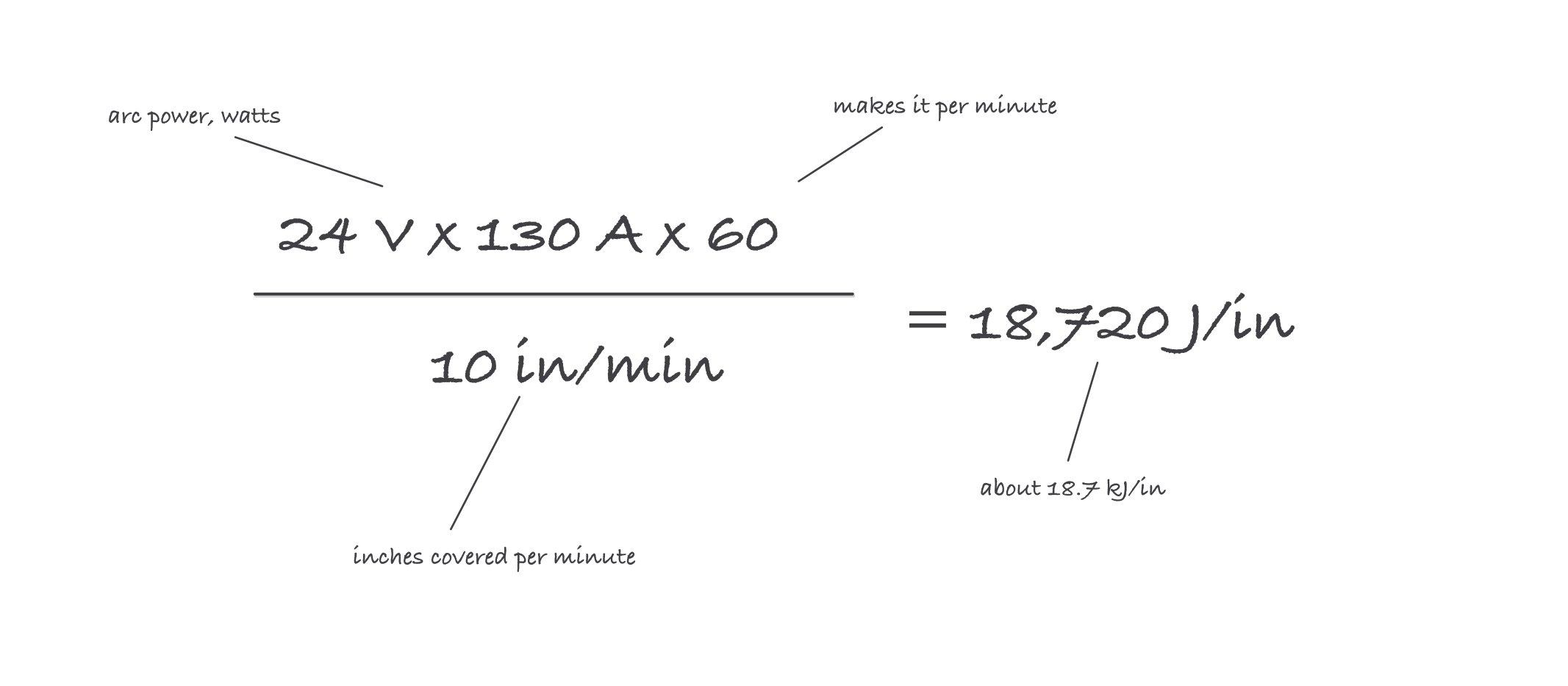
One number from three knobs: 24 V x 130 A x 60, over 10 in/min, is 18,720 J/in
Where it bites
- Clamping does not delete shrinkage, it relocates it. A rigidly clamped weld that cannot move builds residual stress instead, which can crack now or move the part later when the clamps come off.
- The stopwatch is part of your settings. Two welders with identical machines can differ in heat input by half, purely on travel speed and weave. If the WPS lists a travel speed range, it is not a suggestion.
- Straightening is a repair, not a plan. Flame straightening warped parts adds new heat cycles and new residual stress. Distortion is cheapest to control before the arc strikes.
- Low heat input has its own failure mode. Chasing minimal distortion with tiny cold passes on thick plate invites hard HAZ and lack of fusion. The window has two walls; know both numbers for the job.