Learn · Welding
Welding Fundamentals: Heat, Arc and the Weld Pool
Part of Your First Welding Cert · step 1 of 24 · next: SMAW (Stick)
In learning paths: Your First Welding Cert
An arc weld is an electric circuit with a deliberate gap in it. The machine pushes current out through the electrode lead, across an open arc, into the workpiece, and back home through the work clamp. The arc is where the circuit’s resistance concentrates, so the arc is where the heat appears: roughly 10,000 °F, hot enough to melt steel on contact and form a pool of liquid metal. Every arc process you will learn, stick, MIG, flux-core and TIG, is a different way of managing that one circuit and that one pool.
Why it matters on the job
Understand the circuit and the pool, and the four arc processes become variations on a theme instead of four separate trades. Troubleshooting also starts here: a popping, erratic arc is usually a circuit problem, not a technique problem. And every arc hazard you will be trained on, flash burn, shock, fumes, comes straight from what the circuit and the pool physically are.
The welding circuit
Four parts, always:
- The machine converts shop power into welding current: high amperage at low voltage, typically 20 to 30 V at anywhere from 40 to 300 A.
- The electrode lead carries current to the electrode, whether that electrode is a stick, a wire, or a tungsten.
- The arc jumps the gap between electrode and work. Air is a poor conductor, so forcing current through it releases intense heat and ultraviolet light.
- The work clamp completes the loop. No clamp, no circuit, no arc.
Amperage is your main heat control. More amps means a hotter arc, deeper penetration into the base metal, and a faster-growing pool. Voltage relates to arc length: a longer arc needs more voltage to sustain.
The pool and its shielding
The weld pool is molten steel, and molten steel is chemically greedy. Left open to air, it absorbs oxygen and nitrogen, and the weld freezes full of porosity and brittle compounds. So every arc process shields the pool. Stick and flux-core burn a flux that blankets the pool with gas and a solidifying slag crust. MIG and TIG pour a shielding gas, argon, CO2 or a blend, over the pool from the torch. The shielding method is the single biggest personality difference between processes: it decides where each one can work and what it can weld.
Constant current vs constant voltage
Machines come in two flavors. Constant current (CC) machines hold amperage steady while voltage floats with your arc length; stick and TIG run on CC, because your hand controls the arc gap. Constant voltage (CV) machines hold voltage steady while amperage floats; MIG and flux-core run on CV, because a motor feeds wire at a set speed and the machine self-corrects the burn-off to match. Plug the wrong process into the wrong machine type and the arc fights you the whole way.
Polarity
Direct current flows one way, and which way matters. DCEN (electrode negative) sends the bulk of arc heat into the work on most processes. DCEP (electrode positive) shifts heat and gives digging or cleaning behavior depending on process. AC alternates between the two every cycle. Each process and each electrode has a correct polarity, printed on the box. Wrong polarity gives you spatter, poor penetration, or a destroyed electrode, and it is one of the first things to check when an arc runs badly.
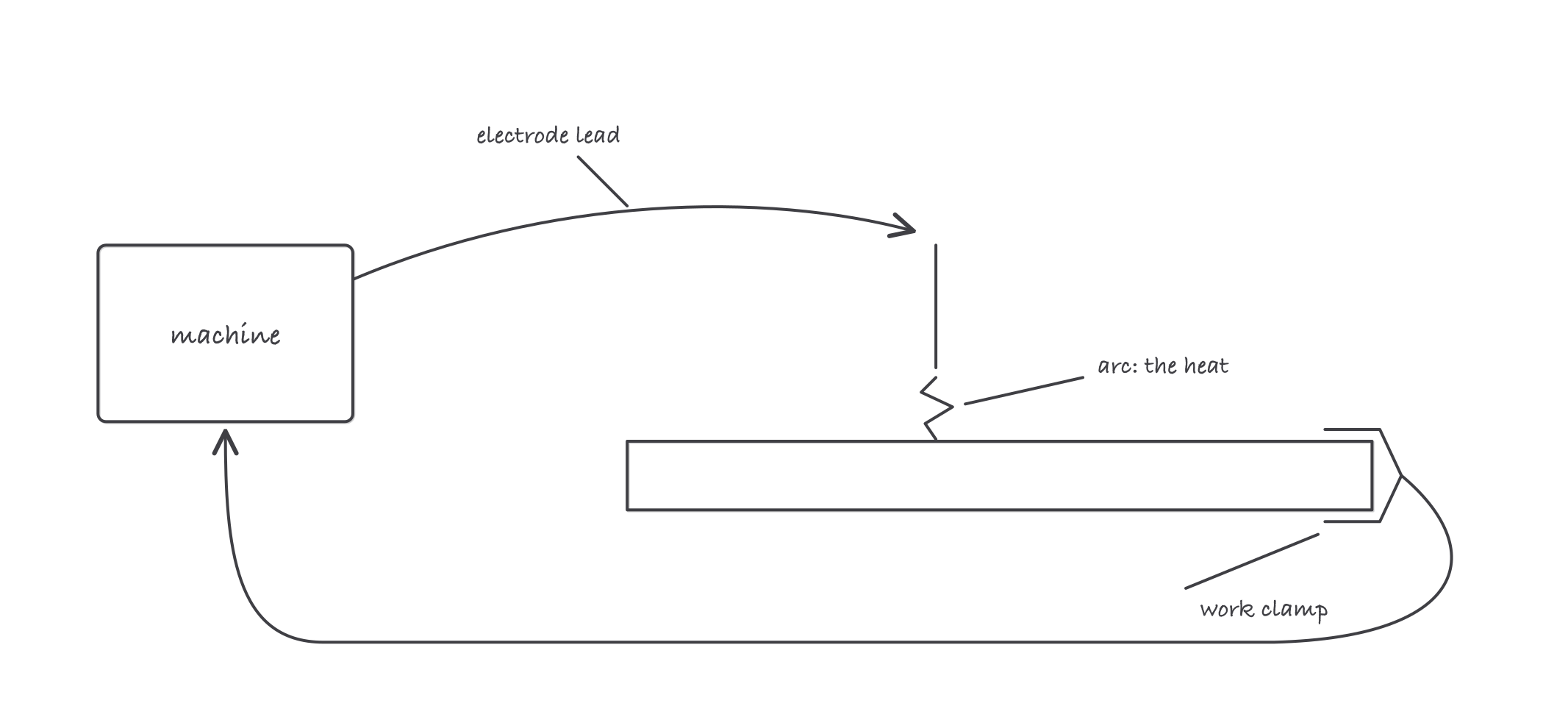
The welding circuit: the arc is the gap where the heat lives, and the work clamp closes the loop
Where it bites
- A bad work connection ruins good technique. A clamp on rust, paint, or mill scale makes an erratic, popping arc and can arc at the clamp itself. Clamp to bright metal, close to the joint.
- Arc flash is a UV burn, not just glare. The arc emits enough ultraviolet to sunburn skin and burn corneas in seconds, including for anyone watching nearby without a shaded lens. Cover skin, use the right filter shade, and never strike an arc while someone is exposed.
- Fumes rise straight into a bent-over face. The plume off the pool carries metal oxides you should not breathe. Position your head out of the plume and use ventilation or extraction, especially on coated or stainless material.
- Voltage is low, but shock is real. Wet gloves, damp ground, and a body between electrode and work complete the circuit fine. Stay dry and insulated.
Verified requirements
| Where | Expires | Renewal | Continuing education |
|---|---|---|---|
| United States (federal) | No | Confirm with issuer | Confirm with issuer |
Information comes from issuing-authority sources. Confirm current rules, fees and eligibility with the authority before acting.