Learn · Welding
Arc Eye, Filter Shades and Welding PPE
Assumes you know: Welding Fundamentals: Heat, Arc and the Weld Pool
Arc eye is a sunburn on the surface of your eye. Ultraviolet light from the arc burns the outer layer of the cornea, and like any sunburn it does not hurt while it is happening: the pain arrives hours later, usually in the middle of the night, feeling like sand under the lids. That delay is the whole problem. Nothing tells you at the time that you are taking a dose.
Why it matters on the job
Hot metal burns on contact. A falling cylinder lands where you can see it. Fume smells. Radiation from the arc does none of that, and it reaches people who never picked up a stinger: the helper holding the other end, the fitter walking past, whoever is working on the far side of the bay without a screen between them and you.
The arc emits more than light
An arc puts out ultraviolet, visible light and infrared at the same time. Each does something different, and a filter has to handle all three.
Ultraviolet is what burns the cornea and what sunburns bare skin under a shirt you thought was enough. Visible light is the part that blinds you to the puddle if it is not attenuated, and the part you have to keep enough of to actually see what you are doing. Infrared is heat, and there is more of it as the current in the arc climbs.
This is why “shade” is a specification and not a preference. A filter shade number describes how much of that radiation the lens stops, and each step up the scale is darker than the one below it.
How the shade tables work
OSHA answers the shade question directly rather than pointing elsewhere. For construction, 1926.102 states that “Table E-1 shall be used as a guide for the selection of the proper shade numbers of filter lenses or plates used in welding,” and Table E-1 is printed inside the regulation itself. It runs from shade 2 at the light end (soldering) up to shade 14 (carbon arc). General industry carries the same duty at 1910.133(a)(5).
The point people get wrong is the role of ANSI. Both standards cite ANSI/ISEA Z87.1, but at 1926.102(b)(1) and 1910.133(b)(1), and what it governs there is how the eye protection is built and tested, not which shade you pick. The shade numbers come from OSHA’s own table. The regulation is free to read, which beats trusting a chart taped to a machine by someone who left the shop years ago.
Reading it is a two-axis lookup. Find the operation first (shielded metal arc, gas metal arc, gas tungsten arc, torch brazing, plasma cutting), then find your electrode diameter or current range within that row, and read the minimum shade across. Two welders doing the same process land on different rows when their amperage differs.
Shade climbs with amperage for a physical reason. The power in an arc is its voltage times its current, so pushing more current through the same arc puts out more radiation for the lens to stop. The table’s minimums track that, and it is stated as a minimum: going darker than the table while you can still see the puddle clearly is allowed, going lighter is not.
Worked example: how far is far enough for a bystander
Treat the arc as a small source radiating into the open, with no reflecting surfaces nearby. Intensity then falls with the square of the distance, which is the same rule as any point source of light.
A helper stands 4 ft from the arc. Move that helper to 12 ft.
- Distance ratio: 12 / 4 = 3
- Intensity ratio: 1 / 3² = 1/9
Nine times less at 12 ft, from a move of 8 ft.
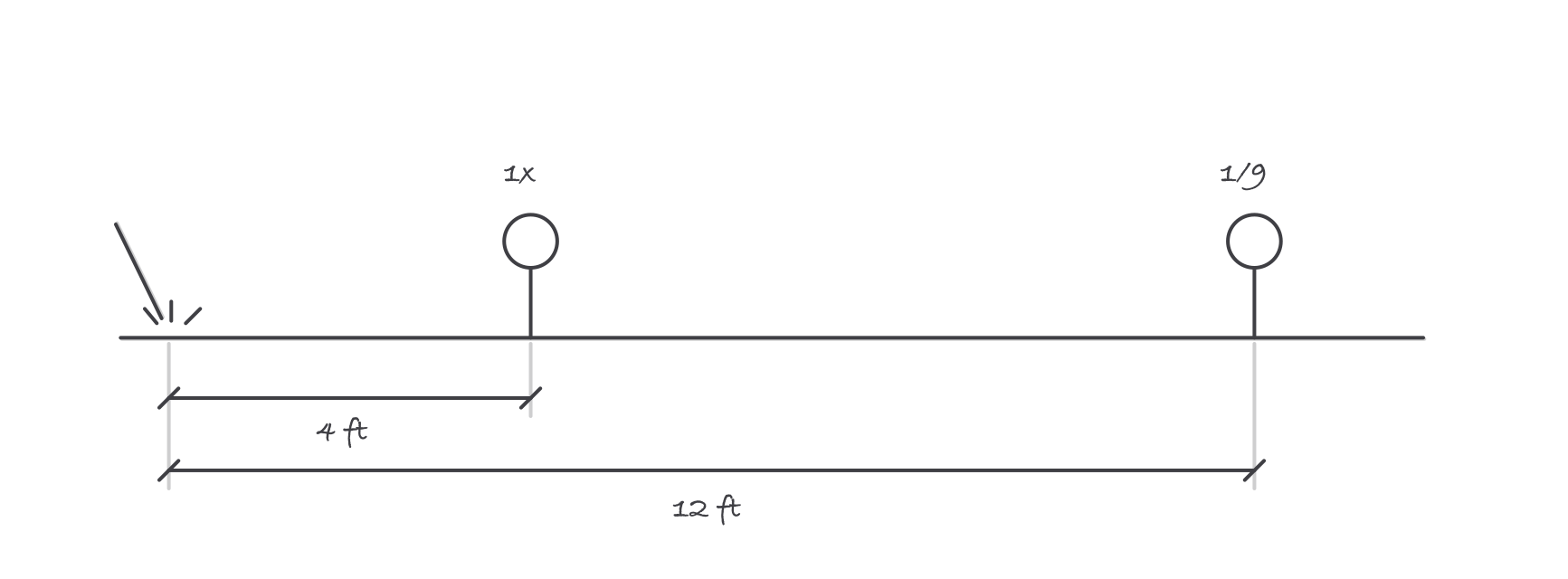
Tripling the distance cuts the dose to a ninth, which is a large gain early and almost nothing later
Now run it the other way and the limits of distance show up. To get down to 1/100 of the intensity at 4 ft, you need the square root of 100, which is 10, times that distance: 10 x 4 = 40 ft. Buying the first factor of 9 cost 8 ft of floor. Buying the rest costs 28 ft more, and most bays do not have it.
That arithmetic is the argument for screens. Distance works well for the first few steps and then stops paying, so the practical control for everyone who is not under a hood is a barrier between them and the arc. It also assumes no reflections, and a bright wall a few feet behind the work breaks that assumption entirely.
The rest of the kit
The filter is one part of eye and face protection, and 1926.102 and 1910.133 are the standards that govern the whole of it. The hood shields your face; safety glasses under it are what stop a chipped slag flake while the hood is up.
Everything else follows from the same fact about ultraviolet: it burns skin the way sun does, through gaps rather than through cover. Cuffs down, collar closed, no gap at the wrist, no bare forearm on a summer afternoon. Leathers matter over the top of that for spatter, and clothing that melts belongs nowhere near hot work.
Where it bites
- ANSI does not pick your shade. OSHA’s own Table E-1 does, at 1926.102, with the same duty at 1910.133(a)(5). ANSI/ISEA Z87.1 is cited by both, for how the device is constructed and tested.
- The lookup is indexed by the work, not by the helmet. Change process, electrode diameter or amperage and you have changed rows. An auto-darkening lens dialed in on Monday for one job is dialed in for that job only.
- The injury has no warning signal. There is no pain and no bright flash of alarm at the moment of exposure, which is exactly why a single quick tack with the hood up feels free. The bill arrives around bedtime.
- The people who did not strike the arc take the dose too. Anyone in line of sight is exposed, and they have no idea when you are about to strike. Screen the work, say something before the arc lights, and remember that a bright wall behind you will put light where nobody thought to screen.