Learn · Welding
Navigating AWS D1.1
Part of Your First Welding Cert · step 18 of 24 · next: ASME Section IX Basics
In learning paths: Your First Welding Cert
Assumes you know: WPS and PQR: How Procedures Work
AWS D1.1, the Structural Welding Code for steel, is a thick book that nobody reads cover to cover. The working skill is navigation: knowing what kind of question you are holding and which part of the book answers that kind of question. Learn the map once and the code stops being intimidating and starts being an index.
Why it matters on the job
D1.1 governs most welded structural steel in US buildings and general construction. When a foreman asks what preheat a joint needs, whether a weld’s undercut passes, or whether a welder is allowed to make a weld, the answer is in the book, and the person who can find it in two minutes is worth more than the person who can quote half of it from memory. It also matters what D1.1 is not: bridges, aluminum, sheet steel, and stainless each have their own code in the same family, and pressure work belongs to a different world entirely, covered in the next lesson.
The map: parts by function
Skip memorizing numbers; carry the functions. D1.1 is organized into major parts, each answering one kind of question:
- General requirements define scope and terms: what steel, what thickness range, what the words mean.
- Design is engineer territory: how welded connections are sized. Welders rarely open it; inspectors sometimes do.
- Prequalification lists pre-approved joint details and procedure limits. Stay entirely inside them and a WPS needs no qualification testing: the famous shortcut of structural work.
- Qualification carries the rules from the WPS and PQR lesson: how procedures are qualified by test, how welders qualify, positions, coupons, and the ranges a test earns.
- Fabrication is the workmanship chapter: preheat requirements, electrode storage and exposure limits, distortion control, repairs. Most day-to-day welder questions land here.
- Inspection holds who inspects, how, and the acceptance criteria tables: undercut limits, porosity limits, profile requirements.
Around the parts sit the tables, figures, and annexes, and this is the real secret: the tables and figures carry the code. Prequalified joint details are drawings; preheat is a lookup by steel group and thickness; acceptance criteria are tables split by loading type. Navigation mostly means finding the right table.
Worked example: two questions, two paths
Question 1: What preheat does 3/4 in A572 Grade 50 need? Classify it: nobody is being tested and nothing is being accepted or rejected, so it is a workmanship question. Path: Fabrication part, preheat table, find the row for the steel’s group, read across to the thickness column. Then the reality check: if the job has a WPS, the WPS already answered this, and it governs.
Question 2: Is 1/32 in of undercut on this weld acceptable? That is an acceptance question: Inspection part, visual acceptance criteria table. Before reading any number, answer the fork the table is built on: is the structure statically or cyclically loaded? The limits differ, and quoting the wrong column is the classic navigation error.
Two questions, two different parts, and neither required reading a single chapter start to finish.
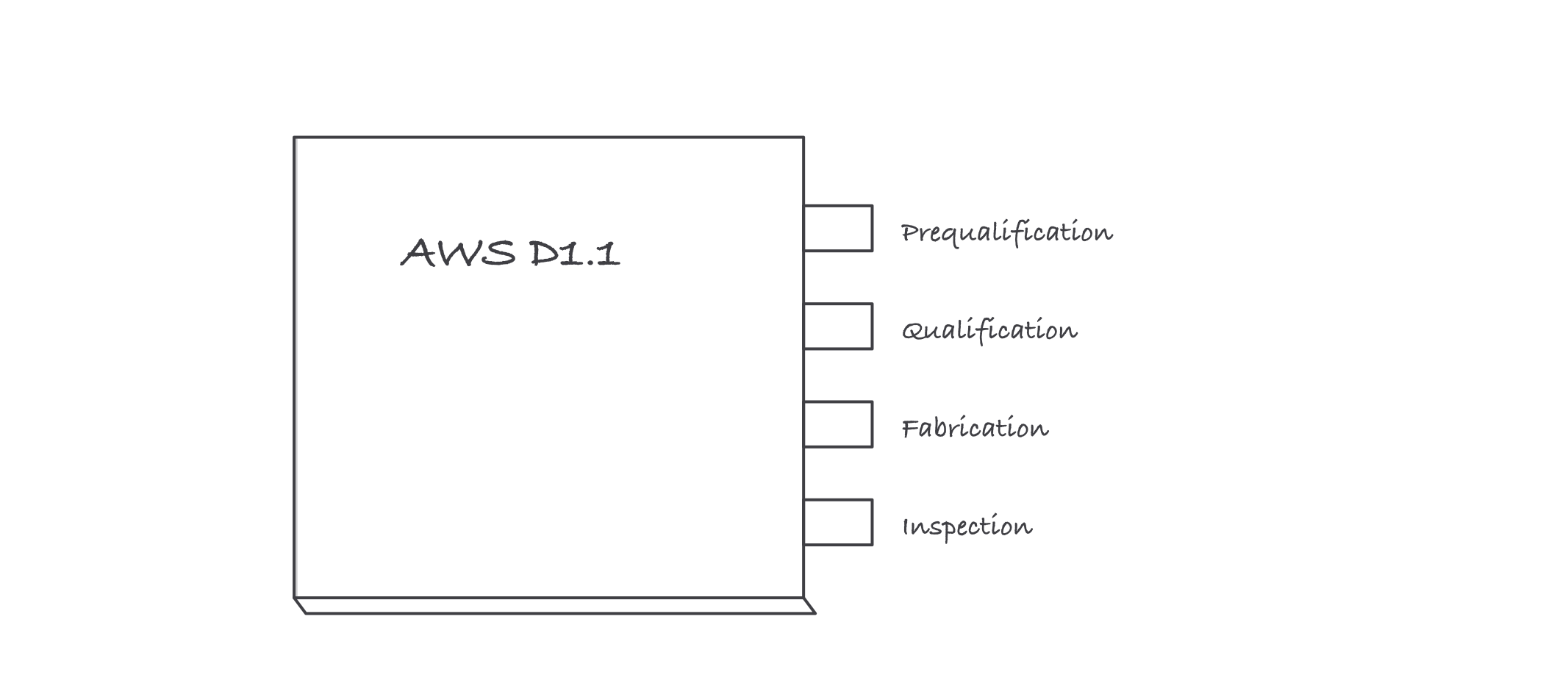
Carry the map, not the memorized numbers: each tab answers one kind of question
Where it bites
- The job’s documents outrank your memory of the code. Contract drawings and the WPS may be stricter than D1.1’s floor. Navigation includes checking what governs this job, not just what the book allows.
- Statically versus cyclically loaded is a fork in the acceptance tables. The same weld can pass in a building column and fail in a structure that vibrates. Know which regime your job is in before quoting limits.
- Prequalified does not mean unregulated. The shortcut exists only inside its fences: listed processes, joint details, and limits. One detail outside the fence and the procedure needs full qualification testing.
- Editions change. The contract names which edition governs, and tables move between editions. Quoting last cycle’s page at this cycle’s job is a small mistake with expensive versions.
Exam relevance
The CWI exam’s code book portion is an open-book navigation race: candidates who know which part holds which kind of table pass, and candidates who page through linearly run out of clock. Welder qualification testing under D1.1 runs on the Qualification part’s rules, so the positions and ranges on your papers trace to it. For both, the practice drill is the same: take a question, name its kind, name the part, then open the book.
Verified requirements
| Where | Expires | Renewal | Continuing education |
|---|---|---|---|
| United States (federal) | Yes | 9 years, with renewal applications required at years three and six after the initial activation date | 80 Professional Development Hours is one of four nine-year recertification routes; the others are retaking Part B Practical, passing an endorsement exam, or achieving Certified Radiographic Interpreter status |
| United States (federal) | No | Confirm with issuer | Confirm with issuer |
Information comes from issuing-authority sources. Confirm current rules, fees and eligibility with the authority before acting.