Learn · Welding
Oxy-Fuel Cutting
Part of Your First Welding Cert · step 7 of 24 · next: Plasma Cutting
In learning paths: Your First Welding Cert
Oxy-fuel cutting does not melt steel apart. It burns it. Heat the steel to its kindling temperature, around 1,600 °F, then hit it with a jet of pure oxygen, and the iron itself ignites: it oxidizes violently, releases its own heat, and the oxygen stream blows the molten oxide out of the cut. The torch starts a chemical fire in the metal and then steers it. That is why the process is officially oxygen cutting, and why understanding it as combustion, not melting, predicts everything it can and cannot do.
Why it matters on the job
An oxy-fuel rig is cheap, portable, and needs no electricity, which keeps it on every fab site, scrap yard, and service truck. It cuts thick sections that stall small plasma machines; industrial torches handle steel measured in feet, not inches. It also heats, bends, and gouges. But because the process is oxidation, it has a hard boundary you must know before you drag the cart over: it cuts carbon steel and low-alloy steel, and essentially nothing else.
Why carbon steel only
The process works because iron oxide melts at a lower temperature than the steel around it, so the oxygen jet can flush the oxide out while the walls of the cut stay solid. Stainless steel breaks the chemistry: its chromium forms an oxide that melts far above the base metal and sits in the cut like a lid. Aluminum does the same; its oxide melts around 3,700 °F, nearly three times the melting point of the metal. Copper and brass shed heat too fast to hold kindling temperature. On all of these the torch just makes an expensive puddle. Cutting them takes plasma, which is the next lesson.
The torch and the cut
A cutting torch runs two systems through one head:
- Preheat flames, a ring of small fuel-oxygen flames, bring the steel edge to kindling temperature. With acetylene, a neutral preheat flame burns around 5,600 °F.
- The cutting oxygen jet, released by the lever, is a separate stream of high-purity oxygen down the center. It does the cutting; the preheat only starts and sustains the reaction.
Bring the edge to a bright cherry heat, squeeze the lever, and when the spark stream punches through, move at a speed that keeps the cut just ahead of the reaction. The slot the jet leaves is the kerf, and you lay out cuts to put the kerf on the scrap side of the line. A typical setup for 1/2 in plate with acetylene: a #1 or #2 cutting tip, oxygen around 40 psig, fuel gas per the tip chart. The tip chart is the authority; pressures rise with thickness and tip size.
One rule stands above the charts: acetylene is never used above 15 psig. Free acetylene becomes unstable and can decompose explosively above that pressure. Regulators and gauges mark the limit; respect it regardless of what the cut seems to want.
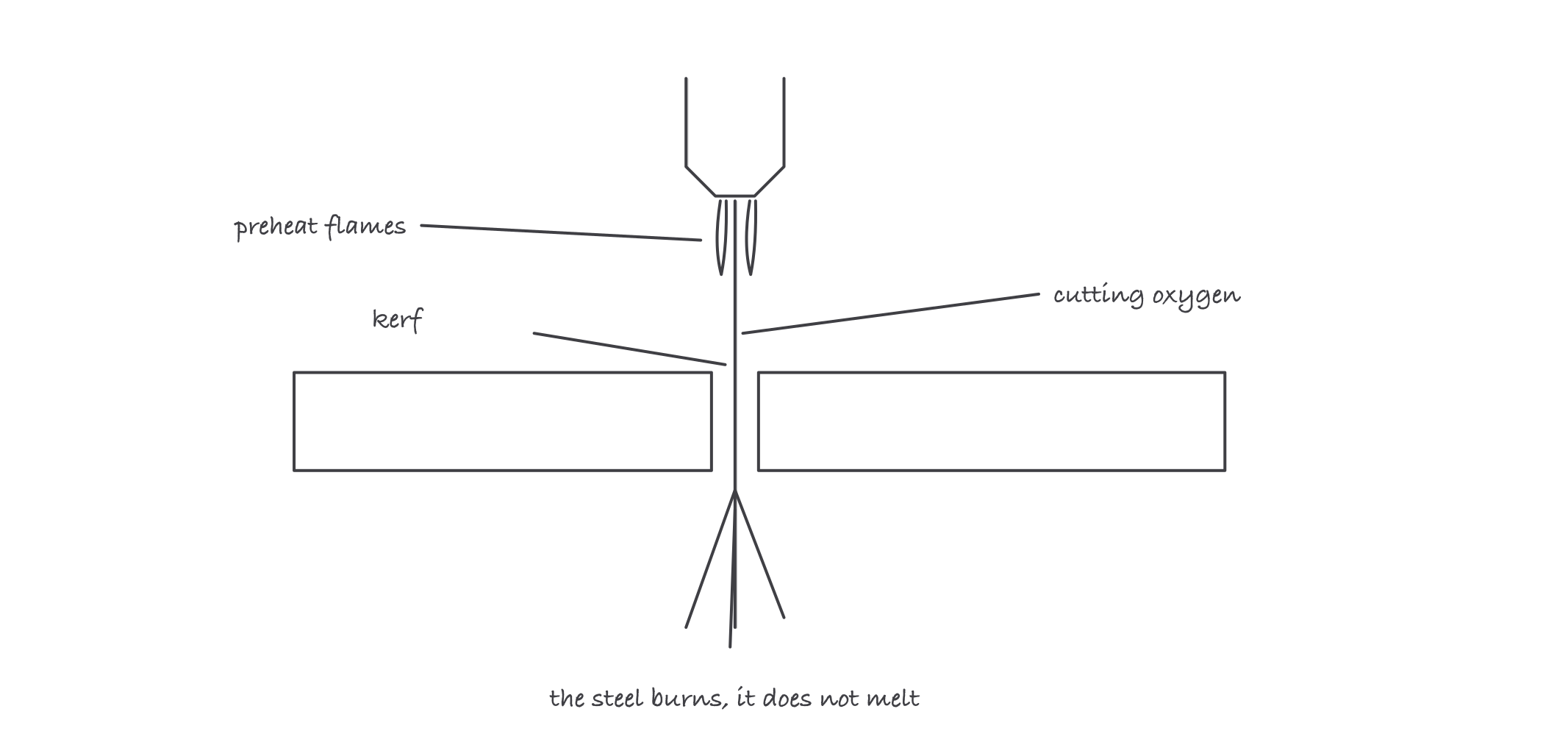
Preheat starts the fire, the oxygen jet burns the steel and blows the cut clear: combustion, not melting
Where it bites
- The hollow-container rule is absolute. Never cut or heat a drum, tank, pipe or any closed vessel until you know what it held and it has been cleaned, vented, or inerted. Residue you cannot see, even years old, turns a container into a bomb. No exceptions for “it’s been empty forever.”
- Flashback is the rig’s own failure mode. A flame burning back inside the torch or hoses can reach the regulators and cylinders. Use flashback arrestors and check valves, purge lines before lighting, and shut down in the manufacturer’s sequence every time.
- Oxygen is not compressed air. Pure oxygen makes oil and grease explosively flammable, so keep fittings oil-free, and never use oxygen to dust off clothes or a workbench. Oxygen-saturated clothing turns a spark into a torch.
- Sparks travel farther than you think. The cutting stream throws molten slag many feet. Clear or shield anything combustible below and behind the cut, and know where your fire extinguisher is; a fire watch is standard on hot work.
- A dirty tip ruins straight cuts. Spatter-clogged preheat holes and a scored oxygen bore make the jet flutter and the kerf wander. Clean tips with the proper tip drills, not a random wire.
Verified requirements
| Where | Expires | Renewal | Continuing education |
|---|---|---|---|
| United States (federal) | No | Confirm with issuer | Confirm with issuer |
Information comes from issuing-authority sources. Confirm current rules, fees and eligibility with the authority before acting.