Learn · Welding
GMAW (MIG)
Part of Your First Welding Cert · step 3 of 24 · next: FCAW (Flux-Core)
In learning paths: Your First Welding Cert
Assumes you know: Welding Fundamentals: Heat, Arc and the Weld Pool
Gas metal arc welding, MIG, feeds a bare solid wire through a gun at a set speed while shielding gas flows around it from the nozzle. The machine holds a constant voltage, the wire is both electrode and filler, and the arc regulates itself. Pull the trigger and the process runs continuously for as long as you hold it, which is why MIG owns production welding.
Why it matters on the job
MIG is the highest-productivity manual process in most shops: no rod changes, no slag to chip, easy to learn to run. Fab shops, manufacturing lines and auto work run on it. But its shielding gas blows away in wind, so it is a shop process first, and the way its metal transfers across the arc changes completely with voltage and gas. A MIG welder who does not understand transfer modes is guessing.
Transfer modes: how the wire crosses the arc
The wire has to become weld metal somehow, and there are two transfer modes you must know cold.
Short-circuit transfer runs at low voltage, roughly 16 to 19 V, on gas blends heavy in CO2, commonly 75% argon / 25% CO2 or straight CO2. The wire physically touches the pool many times per second; each touch shorts the circuit, the current spike melts the wire tip off, and the arc re-lights. That crackling cycle keeps heat input low, so short-circuit welds thin sheet without blowing through and works in all positions because the small pool freezes fast. The cost: low heat means shallow penetration.
Spray transfer runs at high voltage, roughly 24 V and up, and demands an argon-rich gas, at least 80% argon, commonly 90% argon / 10% CO2. Above a transition current, around 190 A for 0.035 in steel wire, the wire never touches the pool: it tapers to a point and streams across the arc as a fine mist of droplets. The arc hums instead of crackles, penetration is deep, deposition is fast, and there is almost no spatter. The cost: the pool is big, hot and fluid, so spray on steel is restricted to flat and horizontal positions.
Between the two sits globular transfer, an erratic, spattery middle zone of large droplets. It is a place you pass through while tuning, not a place to weld.
A concrete setup
Lap joint on 1/8 in mild steel, in position: 0.035 in ER70S-6 wire, 75/25 gas at 25 to 30 cfh, roughly 18 V and 280 to 320 ipm of wire feed speed, which lands near 140 to 160 A. Stickout about 3/8 in, slight push angle. On MIG you set wire feed speed and voltage; amperage is a result, not a dial. Same joint in 3/8 in plate, flat position: switch to 90/10 gas, raise to roughly 25 V and enough wire speed to pass the spray transition, and the arc goes silent and pours.
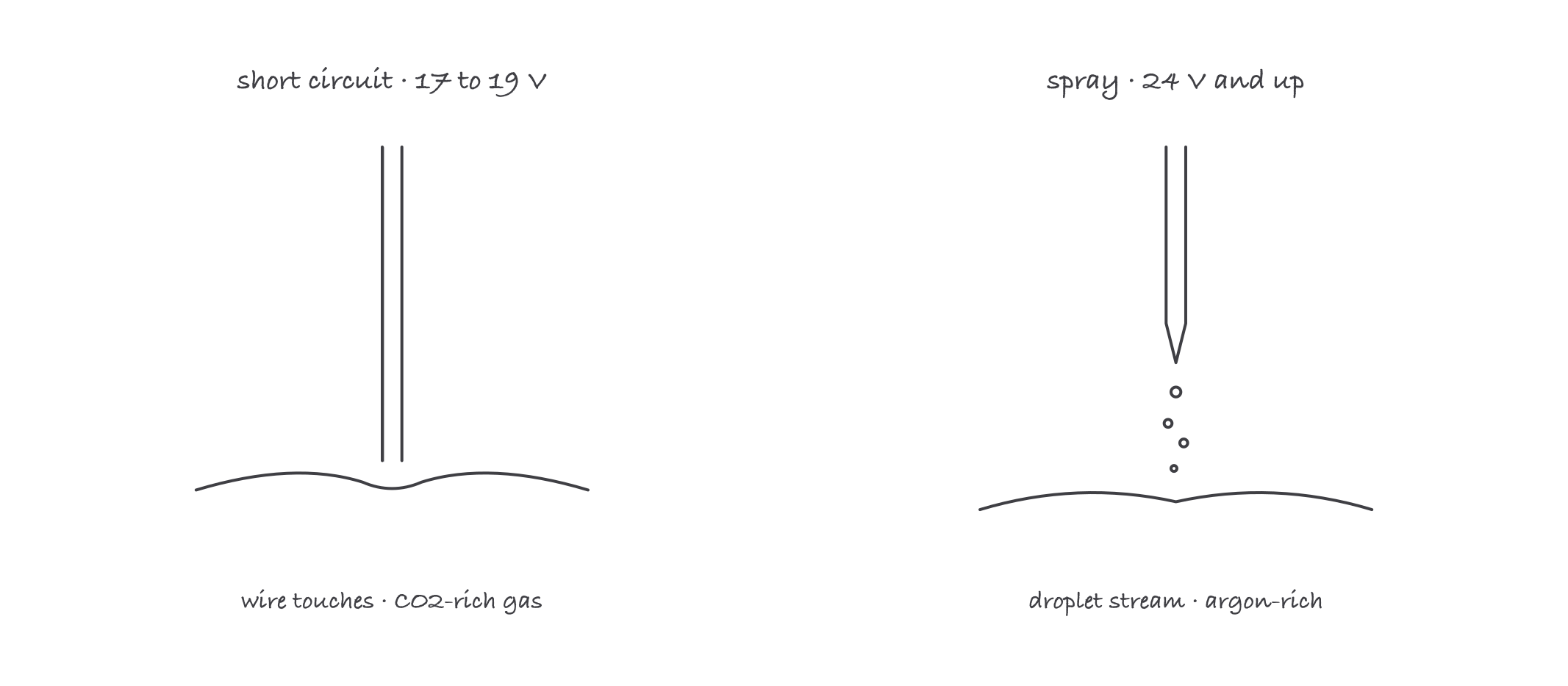
Voltage and gas pick the transfer mode: touching and crackling on the left, streaming and humming on the right
Where it bites
- MIG is the easiest process to do badly and have it look good. Short-circuit on thick plate lays a pretty bead with almost no fusion under it: cold lap. The weld peels off under load. Match the mode to the thickness; thick sections want spray or another process entirely.
- Wind kills the shield. A light breeze is enough to strip the gas and fill the weld with porosity. Outdoors means windbreaks, or a self-shielded process instead.
- Gas problems mimic technique problems. An empty cylinder, a kinked hose, spatter-clogged nozzle, or flow set too high (pulling air into the shield by turbulence) all make porosity. Check the gas train before you change your hands.
- Spray in a vertical joint is a trap. The pool obeys gravity, not the data sheet. If a procedure calls for out-of-position MIG on steel, it will be short-circuit or pulse, never conventional spray.
- The transition current is per wire and per gas. Change wire diameter or blend and the spray threshold moves. Set the machine by the chart for what is actually loaded, not by memory.
Verified requirements
| Where | Expires | Renewal | Continuing education |
|---|---|---|---|
| United States (federal) | No | Confirm with issuer | Confirm with issuer |
Information comes from issuing-authority sources. Confirm current rules, fees and eligibility with the authority before acting.