Learn · Welding
Filler Metal Selection
Part of Your First Welding Cert · step 12 of 24 · next: Weld Defects and Discontinuities
In learning paths: Your First Welding Cert
Assumes you know: Welding Metallurgy Basics
The filler metal is half the chemistry of your finished weld. The puddle is a blend of melted base metal and melted filler, so choosing a rod or wire is choosing what the weld will be made of: its strength, its toughness, and whether it belongs in that joint at all.
Why it matters on the job
Most days the WPS or the shop’s stock decides for you. But the welder who understands why that wire is on the machine catches the expensive mistakes: the stainless job someone loaded carbon wire for, the quenched and tempered plate about to be welded with a rod that undoes its heat treatment, the low-hydrogen rod that spent a week loose in a truck. Filler selection is also a favorite topic on written exams and quality audits, because the classification numbers make it testable.
Rule one: match the strength
Filler classifications lead with tensile strength. E7018 and ER70S-6 both deposit weld metal with at least 70 ksi minimum tensile strength; E6010 deposits at least 60 ksi. The design logic is simple: the weld should be at least as strong as the base metal it joins, so you pick a classification whose number meets or beats the base metal’s specified tensile strength.
Matching means meeting the spec, not maximizing the number. Grossly overmatching filler on a lower-strength steel concentrates strain in the softer base metal, and on high-strength steels the engineer may deliberately specify an undermatching filler. On code work the choice is engineering territory, written into the WPS.
Rule two: match the chemistry and the service
Strength is not the only property that has to survive the puddle:
- Stainless steels take stainless fillers matched to the grade, and joints between stainless and carbon steel take a dissimilar-metal filler designed for the dilution.
- Aluminum has its own filler families, chosen for crack resistance and strength rather than simple matching.
- Toughness at low temperature is its own requirement: two fillers with the same tensile number can behave very differently when the structure lives at -40 F.
- Weathering steels in exposed service take fillers that match corrosion behavior, not just strength.
The pattern: every service condition the base metal was selected for, the filler has to honor too.
Rule three: match the process and the position
The classification tells you what the filler needs to run. An E7018 needs a stick machine and low-hydrogen handling. An ER70S-6 needs shielding gas. An E71T-1 flux-cored wire brings its position rating in its number, the 1 meaning all-position, just as the 1 in E7018 does. Read the classification the way the SMAW lesson decodes E7018: the grammar carries strength, position, and coating or gas in a few characters.
Worked example: a filler for outdoor structural fillets
The job: 3/8 in fillet welds on A36 structural steel, outdoors, stick welding. Reason it through:
- Strength. A36 has a specified minimum tensile strength of 58 ksi. The standard 70 ksi electrode class meets it with sensible margin: E70XX.
- Service and metallurgy. Structural work under restraint favors low-hydrogen practice, which points to the 18 coating: E7018.
- Position and current. The 1 in E7018 covers all positions, and the rod runs on the AC or DCEP the site machines supply.
- Condition. Low-hydrogen only counts if the rods came from a sealed container or holding oven.
Each step is checkable, which is exactly what an auditor or examiner will do with it.
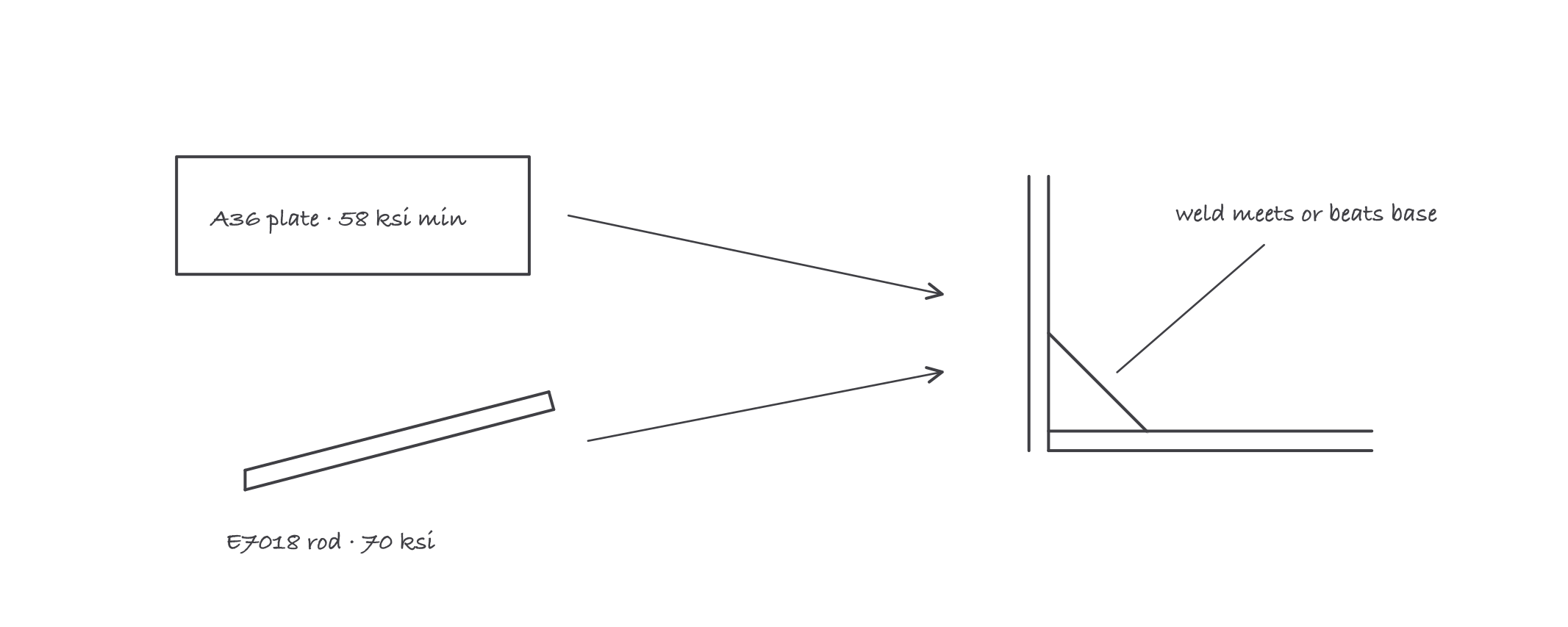
The first check every time: filler class meets or beats the base metal spec
Where it bites
- A bigger number is not a better rod. Overmatching is a design decision, not a favor. Put the classification the WPS names in the machine, nothing else.
- Dissimilar joints take their own filler. Welding stainless to carbon steel with either metal’s normal filler builds a brittle, crack-prone mix. That joint has its own answer; look it up.
- Two 70-class fillers are not interchangeable. Coating type, hydrogen level, and toughness ratings all live behind the same leading digits. Swapping filler classification without approval can void the procedure.
- Storage is part of selection. A low-hydrogen rod that lived open on the truck is no longer the electrode its number claims. Condition counts as much as classification.