Learn · Welding
Preheat and Interpass Temperature
Part of Your First Welding Cert · step 11 of 24 · next: Filler Metal Selection
In learning paths: Your First Welding Cert
Assumes you know: Welding Metallurgy Basics
Preheat is a head start on cooling. You warm the joint before striking an arc so the finished weld and its HAZ cool slowly instead of quenching against cold steel. Interpass temperature is the same idea kept alive through a multi-pass weld: the temperature of the joint each time the next pass goes down.
Why it matters on the job
Preheat does three jobs at once:
- It slows the cooling rate, so a hardenable steel’s HAZ transforms to something tough instead of brittle martensite.
- It buys time for hydrogen to escape. Hydrogen dissolved in hot weld metal diffuses out while the joint stays warm, instead of being trapped when the weld snaps cold.
- It dries the joint. Moisture, frost, and condensation are hydrogen sources; preheat burns them off before the arc arrives.
Hydrogen cracking needs three legs: hydrogen in the weld, a hard microstructure, and stress. It shows up hours or days after welding, often under a surface that passed inspection. Low-hydrogen electrodes and rod oven discipline attack the hydrogen leg. Preheat attacks two legs at once, hydrogen and hardness, which is why thick or high-carbon work demands both together.
When preheat is required
The joint needs preheat when cooling will be fast or the steel is sensitive, and the flags are easy to spot:
- Thick sections. Mass is a heat sink; the same bead that behaves on 1/4 in plate quenches itself on 1 in plate.
- Higher carbon or alloy content. A carbon equivalent creeping past roughly 0.40 means the HAZ hardens readily (the weld metallurgy lesson shows the calculation).
- High restraint. Heavy, rigid joints cannot shrink freely, so stress, the third leg, is guaranteed.
- Cold steel. Winter work multiplies everything above; many codes forbid welding on steel below a stated floor temperature and require warming it first.
The actual number is not yours to guess. It comes from the WPS, which takes it from code tables driven by steel grade and thickness. Your job is to apply it and prove it.
Worked example: applying 150 F preheat
The WPS for a 1 in structural joint calls for 150 F minimum preheat and a 550 F maximum interpass. A sound sequence:
- Mark a band about 3 in each side of the joint. Codes require the surrounding metal brought to temperature, not just the groove face.
- Heat the band with a rosebud or strip heaters, moving evenly, then let it soak so the heat travels through the thickness.
- Check with a 150 F temperature-indicating crayon on the side away from the torch. The stick melting there means the metal is at least 150 F through, not just flame-licked on the surface.
- Between passes, check again before each restart. Below 150 F: reheat. Approaching 550 F: wait.
Interpass has a ceiling too
Minimum interpass keeps the slow-cooling protection alive pass after pass. But some materials also set a maximum: quenched and tempered steels and austenitic stainless lose toughness or corrosion resistance if the joint stays too hot too long. On those jobs the joint is held inside a window, and a fast multi-pass rhythm can bust the top of it just as surely as a cold morning busts the bottom.
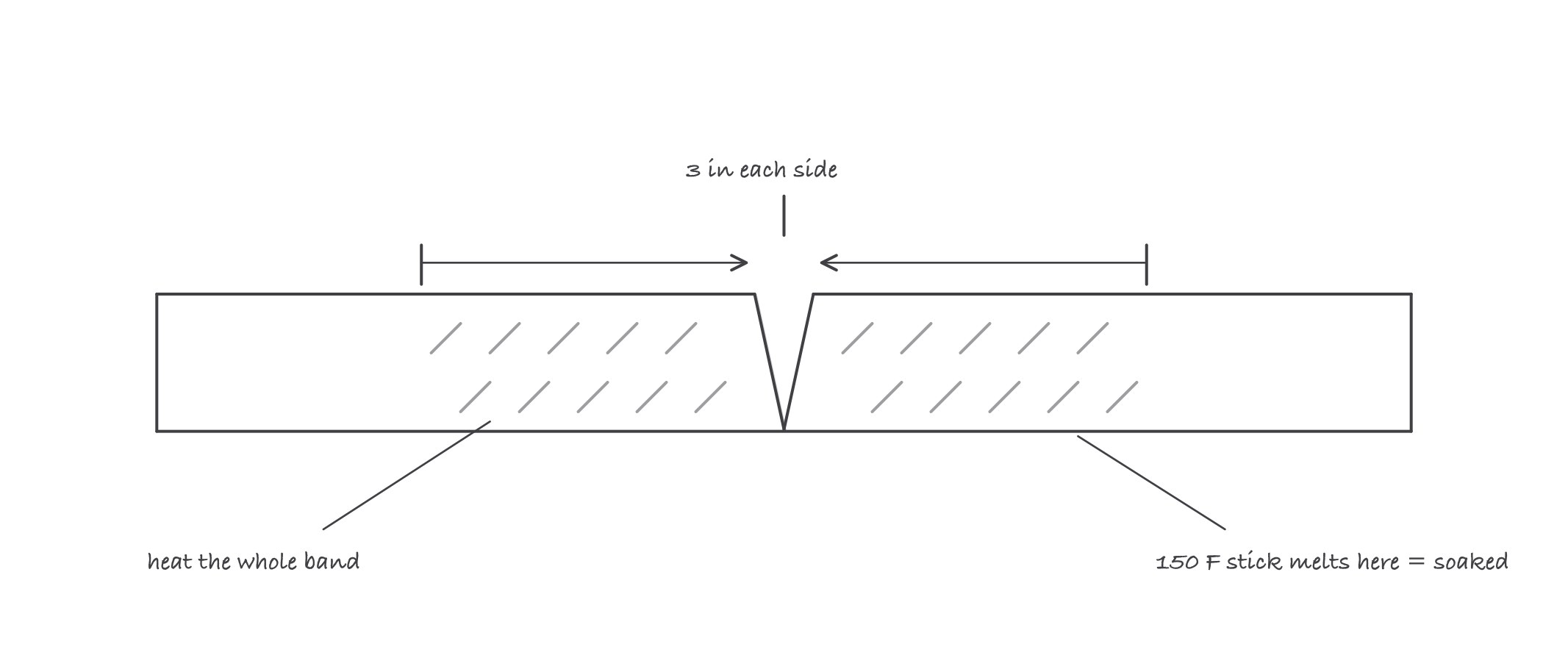
Heat a band each side, let it soak, prove it with a temp stick on the far side
Where it bites
- Surface hot is not soaked. Steel conducts heat fast, so a flame-warmed surface reads hot while the core is still cold. Heat, wait, then measure away from where the flame played.
- Preheat evaporates during lunch. A joint that sat through a break is back to ambient. Recheck and reheat before restarting, every time, or the restart pass gets the quench the preheat was bought to prevent.
- The crayon only tells you its own number. A 150 F stick melting says at least 150 F. Proving you are under a 550 F interpass ceiling needs a stick or pyrometer reading near that number, not the preheat stick.
- Preheat is not a substitute for dry rods. Warm steel with damp low-hydrogen electrodes still pumps hydrogen into the weld. The rod oven and the torch are two halves of one hydrogen defense.