Learn · Carpentry
Site Layout and Squaring
Part of Carpenter, Frame to Finish · step 3 of 30 · next: Levels, Lasers and Transits
In learning paths: Carpenter, Frame to Finish
Assumes you know: Construction Math for Carpenters
Site layout is where the building stops being a drawing and becomes a rectangle of string in the dirt. Everything built afterward inherits whatever shape you leave here, which is why layout is measured to the sixteenth on a job where nothing else will be.
Why it matters on the job
An out-of-square foundation cannot be fixed later, only compensated for, and the compensation lands on every trade after you. Walls get furred, floors get shimmed, cabinets get scribed, and the roof plane fights you all the way to the ridge. The error also grows: a foundation 1 in out of square across 36 ft becomes a visible taper in a 40 ft cabinet run.
Start from a line you did not invent
Layout begins from a reference established by someone with legal authority over it: the surveyor’s stakes, the property pins, the setback line on the site plan. Confirm the setbacks before you pull a single string, because a building placed correctly but too close to a line is a building that has to move.
From that reference you establish a building line, usually the front wall face. Every other line on the site is squared and measured from it.
Batter boards keep the lines alive
Corner stakes get destroyed the moment the excavator arrives. Batter boards are horizontal boards on stakes set back several feet outside the excavation, with the string lines carried across them and their positions kerfed or nailed. When the hole is dug, the strings come off, the machine works, and the strings go back exactly where they were.
Set batter boards level to each other and you get a second benefit: the strings define a level reference plane as well as a horizontal position.
Two squaring checks, and you need both
The 3-4-5 method proves one corner. Measure 3 units along one leg, 4 along the other, and adjust until the diagonal between those points reads 5. Use large multiples for accuracy: 6-8-10 or 12-16-20 rather than literal feet, because a small triangle magnifies its own error over the length of a wall.
Equal diagonals prove the whole rectangle, with one condition attached. Equal diagonals alone do not prove square, because a trapezoid can have equal diagonals too. They prove a rectangle only once you already know that both pairs of opposite sides are equal. Check the sides, then check the diagonals, and the shape is settled.
Worked example: squaring a 24 by 36 building
- Set the front building line and mark the two front corners 36 ft apart.
- Square off each end roughly, using 12-16-20, and set the two rear corners 24 ft back.
- Confirm the sides: both 36 ft dimensions equal, both 24 ft dimensions equal.
- Calculate the diagonal: the square root of (24² + 36²) = the square root of (576 + 1,296) = the square root of 1,872 = 43.2666 ft.
- Convert: 0.2666 × 12 = 3.20 in, and 0.20 × 16 = 3.2 sixteenths, so the target is 43 ft 3 3/16 in.
- Measure both diagonals. Shift the rear corners along the rear line until both diagonals read 43 ft 3 3/16 in with the sides still correct.
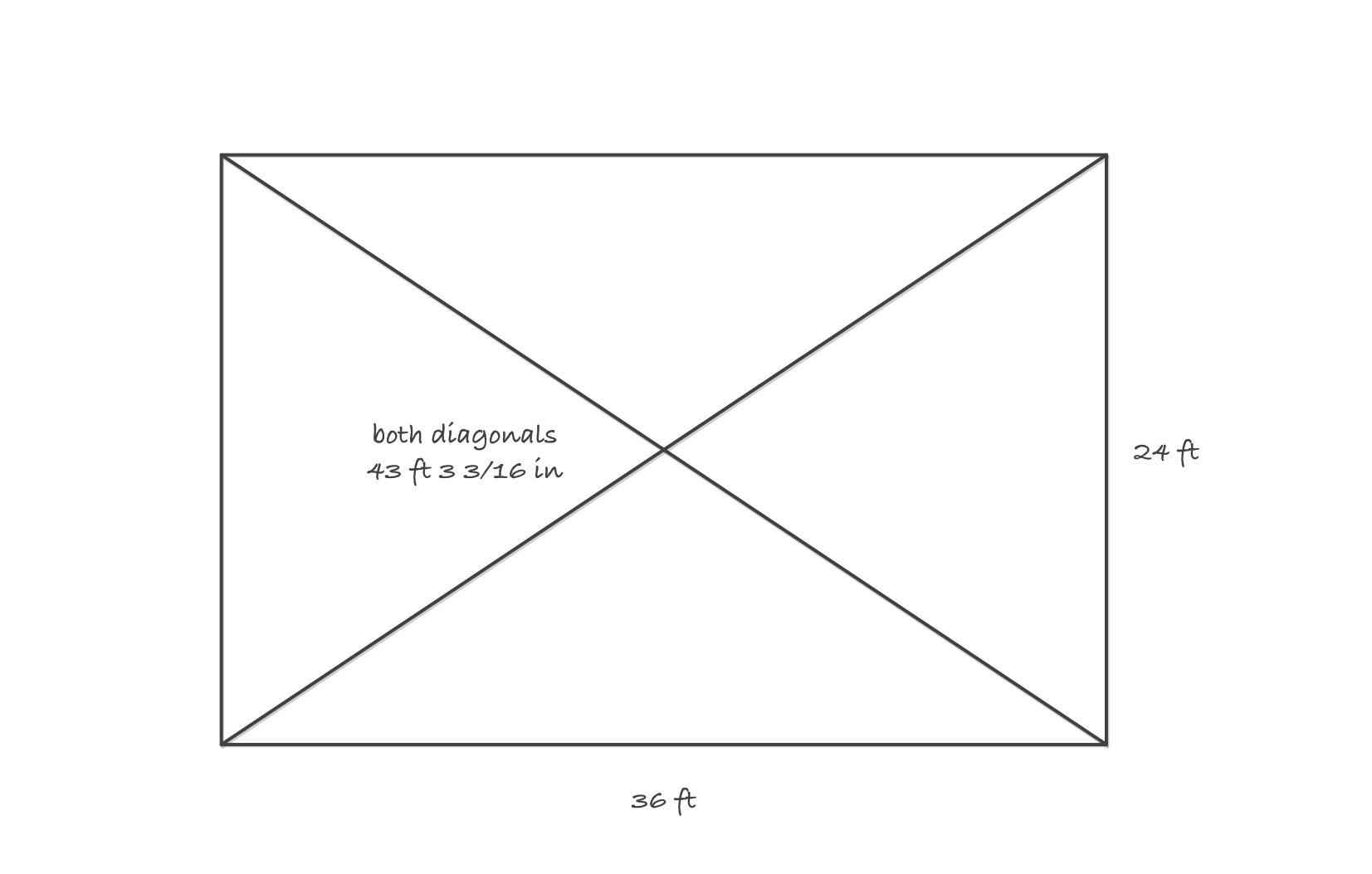
Sides equal and diagonals equal: only both together prove a rectangle
Note what you did not do: you did not trust a framing square held at a corner. A 16 in square extended over 36 ft multiplies whatever error it holds by 27.
Where it bites
- Tape sag is real over long pulls. A 100 ft tape hanging in the middle reads long. Support it, keep consistent tension on every pull, and use the same tape for both diagonals. Two tapes that disagree by 1/8 in will have you chasing a square that is already square.
- Equal diagonals alone are not proof. Check the opposite sides first.
- Measure from the same corner every time. Cumulative measurement from the last mark collects error; measuring from one fixed point does not.
- Layout is to the outside of the foundation, or the inside, or the framing line, and you must know which. Concrete crews and framers reference different faces. Agree on it out loud before the strings go up.