Learn · Carpentry
Nail Gun Safety
Part of Carpenter, Frame to Finish · step 21 of 30 · next: Saw Safety and Guarding
In learning paths: Carpenter, Frame to Finish
A pneumatic nailer drives a fastener faster than your hand can move out of the way, and the trigger the gun was set up with is what decides how likely an injury is. OSHA puts the injury risk on a multi-shot contact trigger at twice that of a full sequential trigger doing the same work.
Why it matters on the job
Nail guns send about 37,000 people a year to emergency departments in the United States, and 68 percent of those visits involve workers, roughly 25,160 a year. The figure that should stop a first-year carpenter cold is narrower than that: in research OSHA cites, 2 of every 5 residential carpentry apprentices were injured by a nail gun over a four-year period. That is 40 percent of a cohort, from one tool.
Two triggers, two behaviors
Contact trigger, often called a bump trigger. Hold the trigger down and the gun fires every time the nose is depressed. Bump the nose along the work and nails come out as fast as you can move. The order of the two actions does not matter.
Full sequential trigger. The nose is pressed to the work first, then the trigger is pulled, in that order, for every single nail. Release both to reset.
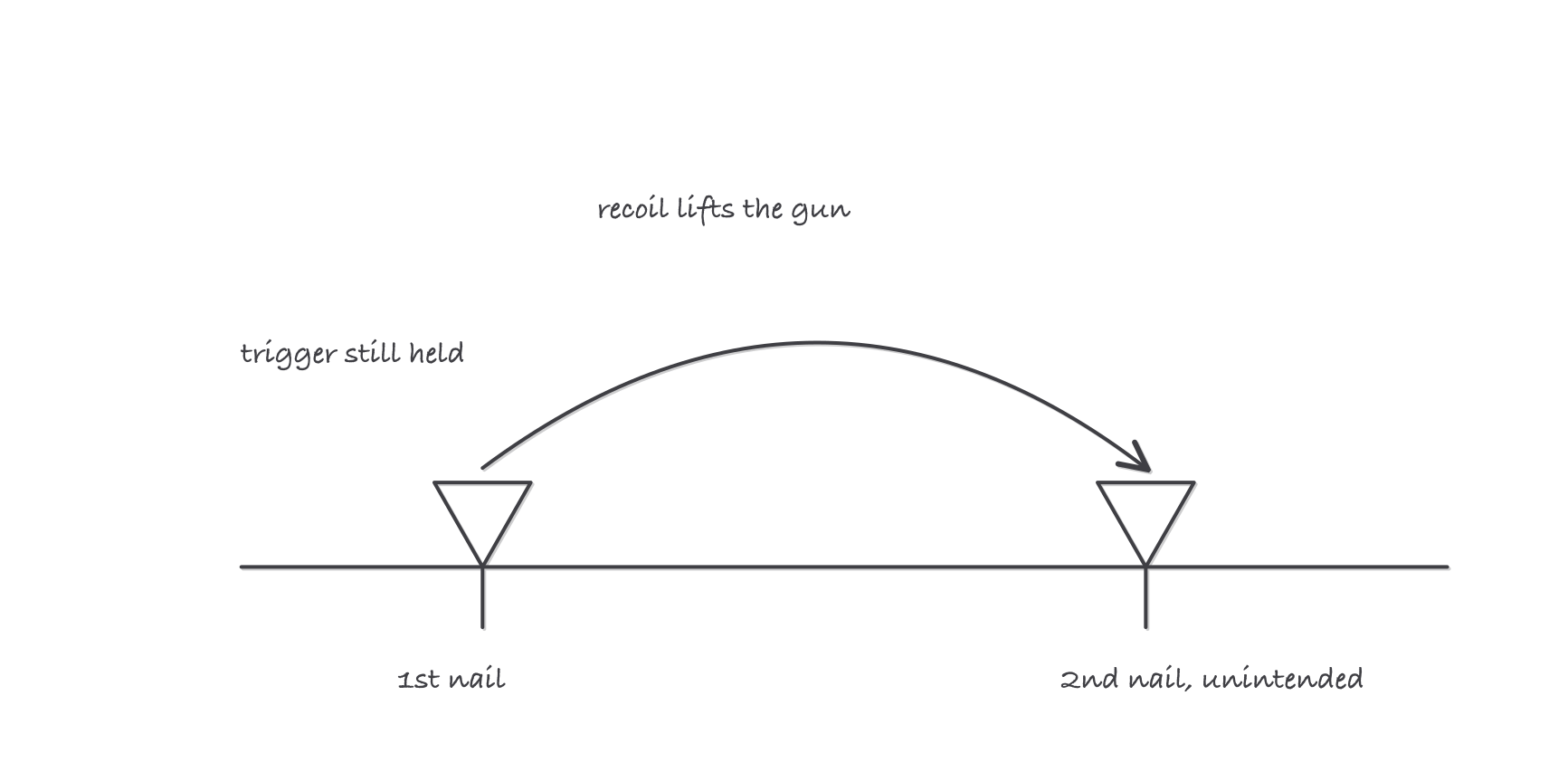
The double fire a contact trigger allows, and the reason a sequential trigger makes the order mandatory
The failure mode is specific. On a contact trigger, the gun recoils, the nose bounces back onto something (the work, your leg, a coworker’s hand) while your finger is still holding the trigger, and a second nail leaves the tool with no intent behind it. Double fires and unintended fires are the mechanism. The sequential trigger removes it by making the order mandatory.
This is not a safety setting somebody left switched off. It is the operating mode of the trigger the gun was built with or fitted with, and changing it is a purchasing decision as much as a jobsite one.
The six steps
OSHA and NIOSH’s joint guide for construction contractors (publication 3459, 2011) sets out six things a contractor does about nail guns.
- Use full sequential trigger nailers.
- Provide training.
- Establish nail gun work procedures.
- Provide personal protective equipment.
- Encourage reporting and discussion of injuries and close calls.
- Provide first aid and medical treatment.
Five of the six cost attention. Only the first one costs money.
Where it bites
- The nose contact is the only interlock the tool has. Taping it, wiring it, or holding it against your body defeats the entire safety design of a nail gun.
- Apprentices carry the exposure. The 2 in 5 figure is specifically residential carpentry apprentices, the people with the least time on the tool and the most nails to drive in a day.
- Steps five and six sit together for a reason. An unreported near miss is a procedure nobody fixed, and a puncture that got shrugged off on the tailgate is a medical decision made by the wrong person.
- Toe-nailing is the high-risk cut. Driving at an angle on a fresh piece is where the nose slips, the nail skews out of the stock, and the gun jumps. Slow down for it whichever trigger you are holding.