Learn · Carpentry
Stair Layout and Construction
Part of Carpenter, Frame to Finish · step 9 of 30 · next: Engineered Lumber and Trusses
In learning paths: Carpenter, Frame to Finish
Assumes you know: Floor Systems
A flight of stairs is one division carried out carefully. You measure the total rise once, divide it by a whole number of risers, and every cut after that comes from the answer. The craft is in measuring the right thing and in refusing to round.
Why it matters on the job
Stairs are the most inspected assembly a carpenter builds and the one people feel with their feet. A flight where one riser differs from its neighbors is a tripping hazard that no amount of finish work hides, and it is the first thing an inspector checks with a tape.
Stairs are also unforgiving of arithmetic. A wall that is off gets shimmed and a rafter that is short gets recut, but a stringer laid out from a wrong number is a scrapped 16 ft board and a lost afternoon.
Total and unit are different words
Total rise is the vertical distance from one finished floor to the next finished floor. Unit rise is the height of one step. Total run is the horizontal distance the flight covers. Unit run is the depth of one tread, measured nosing to nosing.
Confusing total with unit is the classic stringer error, and it always traces back to one division rather than to a bad measurement.
Two relationships hold in every flight:
- Number of risers = total rise ÷ unit rise, and the count must be a whole number.
- A flight between two floors has one more riser than it has treads, because the top floor surface acts as the last tread.
Measure to the finished surfaces
Total rise is finished floor to finished floor, not subfloor to subfloor. If tile is going down upstairs and hardwood downstairs, those thicknesses change your total rise, and you have to know them before you cut. Ask, in writing, and note the answer on the stringer stock.
Worked example: laying out a flight
Finished floor to finished floor measures 109 1/2 in. Treads will run 10 in.
- Try 14 risers: 109.5 ÷ 14 = 7.8214 in per riser.
- Try 15 risers: 109.5 ÷ 15 = 7.3 in per riser, an exact number and a gentler step.
- Take 15 risers, which gives 15 − 1 = 14 treads.
- Total run: 14 × 10 = 140 in = 11 ft 8 in. Confirm on the drawing that 11 ft 8 in of floor is actually available, because this is where flights get redesigned.
- Stringer length along the diagonal: the square root of (109.5² + 140²) = the square root of (11,990.25 + 19,600) = the square root of 31,590.25 = 177.74 in, or 14 ft 9 3/4 in. Order 16 ft stock.
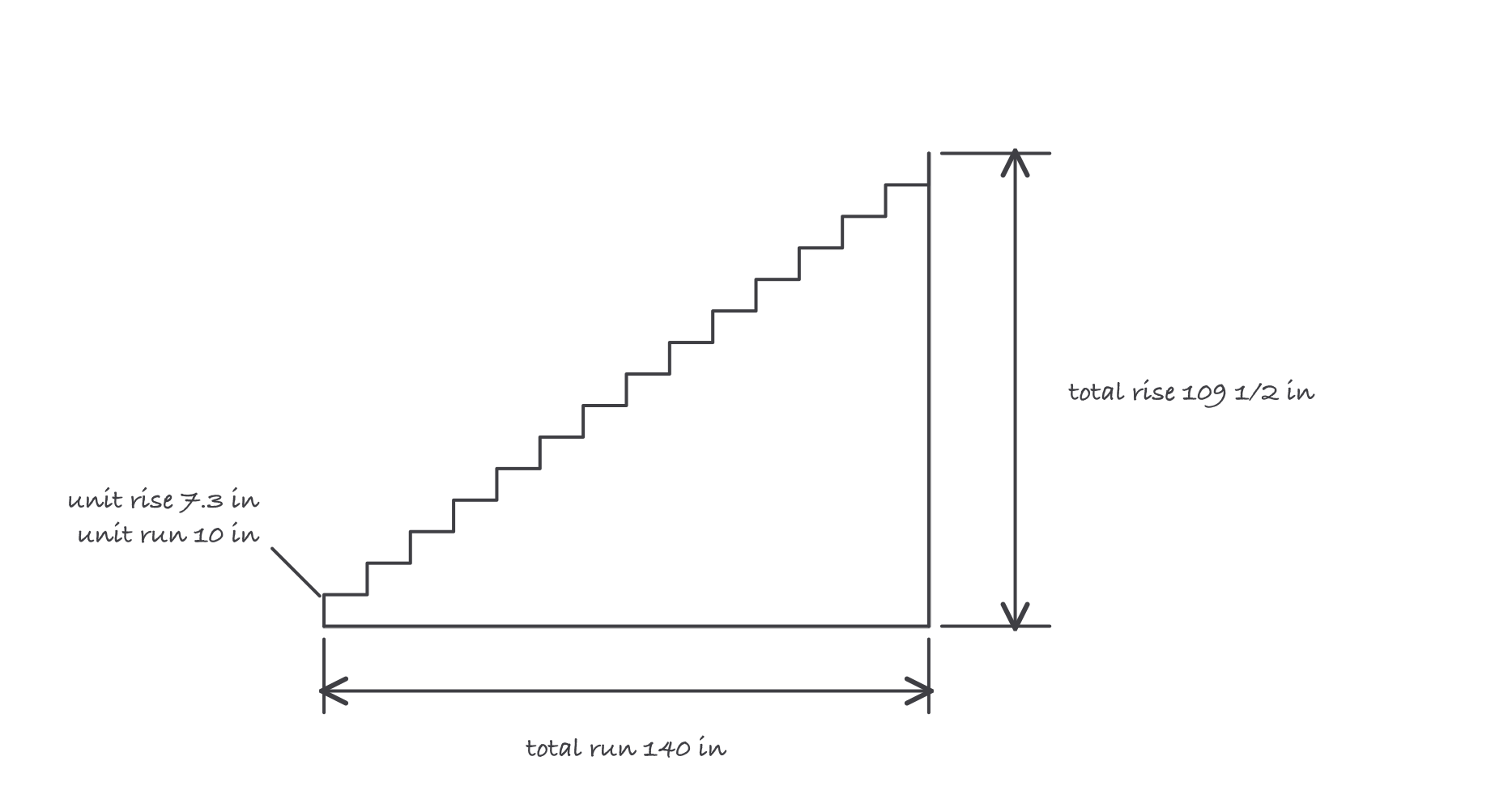
One step is the whole flight in miniature: divide the total rise into equal parts and the rest follows
Both riser counts are arithmetically valid. Which ones are legal is a separate question: your adopted code sets a maximum riser height, a minimum tread depth, a minimum headroom and a tolerance on how much risers may vary within one flight. Look those up in the edition your jurisdiction has adopted before you commit to a number, every time.
Dropping the stringer
Cut the stringer to the numbers above and the bottom step comes out one tread thickness too tall, because the stringer sits on the floor while every other tread sits on a cut. The correction is to shorten the bottom of the stringer by the thickness of one tread.
With a 1 in tread, the bottom riser cut becomes 7.3 − 1.0 = 6.3 in. Once the 1 in tread is fastened on, that first step measures 7.3 in like all the others. Forget the drop and every riser in the flight is right except the first one, which is exactly the defect an inspector looks for.
Where it bites
- Measuring the total rise to the subfloor. Finish flooring changes it at both ends, and nobody discovers this until the treads are on.
- Rounding the unit rise to a friendly fraction. Round 7.3 in to 7 5/16 in on all 15 risers and you have moved the top of the flight by 15 × 0.0125 = 0.1875 in, which is 3/16 in of error dumped into the last step. Carry the decimal through and let the arithmetic land where it lands.
- Forgetting that treads are one fewer than risers. Count the risers, not the steps you can see.
- Cutting the stringer before checking headroom. A flight can be perfect underfoot and still fail because of the floor opening above it, and headroom is measured from the tread nosing.