Learn · Carpentry
Construction Math for Carpenters
Part of Carpenter, Frame to Finish · step 1 of 30 · next: Blueprint Reading
In learning paths: Carpenter, Frame to Finish
Four kinds of arithmetic cover almost every calculation a carpenter makes: fractions on a tape, feet-and-inches that carry at 12, areas and volumes for ordering material, and one right triangle. None of it is difficult. All of it is unforgiving, because the result gets cut into wood.
Why it matters on the job
Material orders, layout marks, stair divisions and rafter lengths all come out of this arithmetic, and every one of them costs money when it is wrong. The difference between a carpenter who calculates confidently and one who does not is measured in trips back to the supply house.
It is also the part of the trade you can practice anywhere, which is why apprenticeship related-instruction leans on it early.
Fractions are what the tape speaks
A standard tape divides the inch into sixteenths. Longer marks mean larger fractions: the longest mark between whole inches is the half, the next longest are quarters, then eighths, then the shortest are sixteenths.
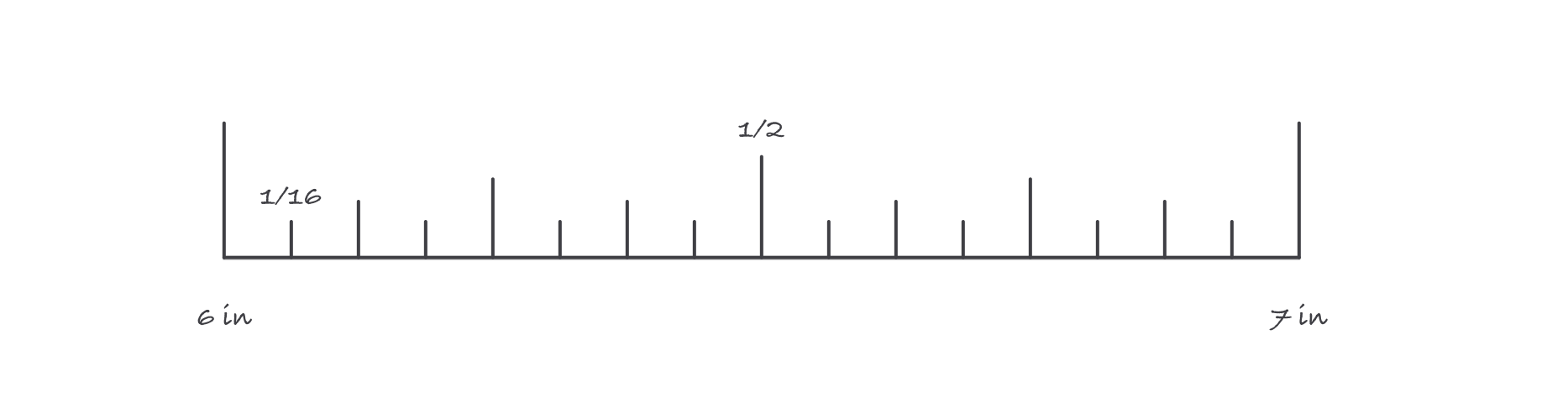
Tick height is the code: the tallest mark between inches is the half, and the shortest is a sixteenth
To add fractions, put them over a common denominator first. 3/8 + 1/4 becomes 3/8 + 2/8 = 5/8. To convert to decimal for a calculator, divide: 5/8 = 0.625. To go back, multiply by 16 and read the numerator: 0.625 × 16 = 10, so 10/16, which reduces to 5/8.
Keep one habit: convert once, calculate in decimals, and convert back only at the end. Converting back and forth mid-problem is where errors enter.
Feet and inches carry at 12
This is ordinary arithmetic with an unusual base, and the mistake is always the same: carrying at 10 out of habit.
Add 6 ft 9 1/2 in to 4 ft 8 3/4 in:
- Inches: 9.5 + 8.75 = 18.25 in.
- 18.25 in is more than 12, so carry: 18.25 − 12 = 6.25 in, and add 1 ft.
- Feet: 6 + 4 + 1 = 11 ft.
- Result: 11 ft 6 1/4 in.
Decimal feet are a separate notation and a separate trap. 12.5 ft is twelve and a half feet, which is 12 ft 6 in, not 12 ft 5 in. Multiply the decimal part by 12 to get inches: 0.5 × 12 = 6.
Area and volume for ordering
Area in square feet governs sheet goods, siding and roofing: length times width, then divide by the coverage of one unit.
Volume for concrete is ordered in cubic yards, and there are 27 cubic feet in a cubic yard (3 × 3 × 3). Thickness given in inches becomes feet before you multiply.
A slab 24 ft by 30 ft, 4 in thick:
- Thickness in feet: 4 ÷ 12 = 0.3333 ft.
- Volume: 24 × 30 × 0.3333 = 240 cu ft.
- Cubic yards: 240 ÷ 27 = 8.889 cu yd.
- Order more than the calculation, because subgrade is never perfectly flat and a short truck is far worse than a little waste.
One right triangle does the rest
For any right triangle, a² + b² = c². Every diagonal, every rafter and every squaring check is that formula wearing a different hat.
A layout 12 ft by 16 ft has a diagonal of the square root of (12² + 16²) = the square root of (144 + 256) = the square root of 400 = 20 ft exactly. That is the 3-4-5 triangle scaled by four, which is why 3-4-5 and its multiples turn up everywhere in layout.
Where it bites
- 12.5 ft is not 12 ft 5 in. This confusion has ruined a lot of material.
- Sixteenths compound. An eighth of an inch lost per stud is 1 in over eight bays. Pull every measurement from the same end of the work, never cumulatively from the last mark.
- The tape’s hook slides on purpose. It moves by the thickness of the hook so that inside and outside measurements both read true. A hook that is bent, not sliding, is a tape to throw away.
- Round at the end, not in the middle. Carry the full decimal through a multi-step calculation. Rounding each step and then multiplying by fifteen risers or twenty joists is how small errors become visible ones.