Learn · Carpentry
Levels, Lasers and Transits
Part of Carpenter, Frame to Finish · step 4 of 30 · next: Framing Fundamentals
In learning paths: Carpenter, Frame to Finish
Assumes you know: Site Layout and Squaring
Every leveling tool answers the same question: where is horizontal? What separates them is the distance over which you can trust the answer. Choose a tool that is too short for the distance and you stop measuring level and start amplifying an error.
Why it matters on the job
Level, plumb and elevation are the three references the whole building hangs on, and each one is set with a tool that has a working range. Foundations, floor systems, door heads, cabinet runs and suspended ceilings all inherit whatever plane you established, and an error set at the start does not stay small.
The tools, shortest reach first
Spirit level, 2 ft to 6 ft: a straightedge with sealed vials of liquid and a bubble. Horizontal vials read level, vertical vials read plumb. It is the fastest tool and the shortest, and it is only as good as the surface it bridges.
Water level: a long clear tube filled with water, open at both ends. Water finds its own level, so the two water surfaces are at the same elevation regardless of what is between them. It works around corners and through rooms with no line of sight, costs almost nothing, and cannot be knocked out of calibration by dropping it.
Line and cross-line laser: projects a level line or a pair of crossed lines onto walls. Self-leveling within a limited tilt range. Best indoors and at short to medium range.
Rotary laser: spins a beam into a level plane over a whole site, read with a handheld detector on a grade rod. This is the tool for footings, slabs and long exterior runs.
Builder’s level and transit: optical instruments on a tripod, leveled by hand with foot screws, sighted onto a graduated rod. A builder’s level reads one level plane. A transit does that and also tilts, so it can carry a vertical line and turn angles. Slower than a laser and completely dependent on operator technique.
The reversal check takes thirty seconds
Set the level on a surface, note exactly where the bubble sits, then pick it up and set it back down in the same spot rotated end for end. A true level reads identically both ways. If the bubble moves, the tool is out, and the truth is halfway between the two readings.
Do this to every new level, every dropped level, and any level whose reading you are about to build a day’s work on.
Worked example: how far a small error travels
Say a 24 in level reads 1/32 in out over its own length, which is small enough that you would never see it.
- You extend that reading across a 20 ft room: 20 × 12 = 240 in.
- How many level lengths is that? 240 ÷ 24 = 10.
- The error scales with the distance: 10 × 1/32 = 10/32 = 5/16 in across the room.
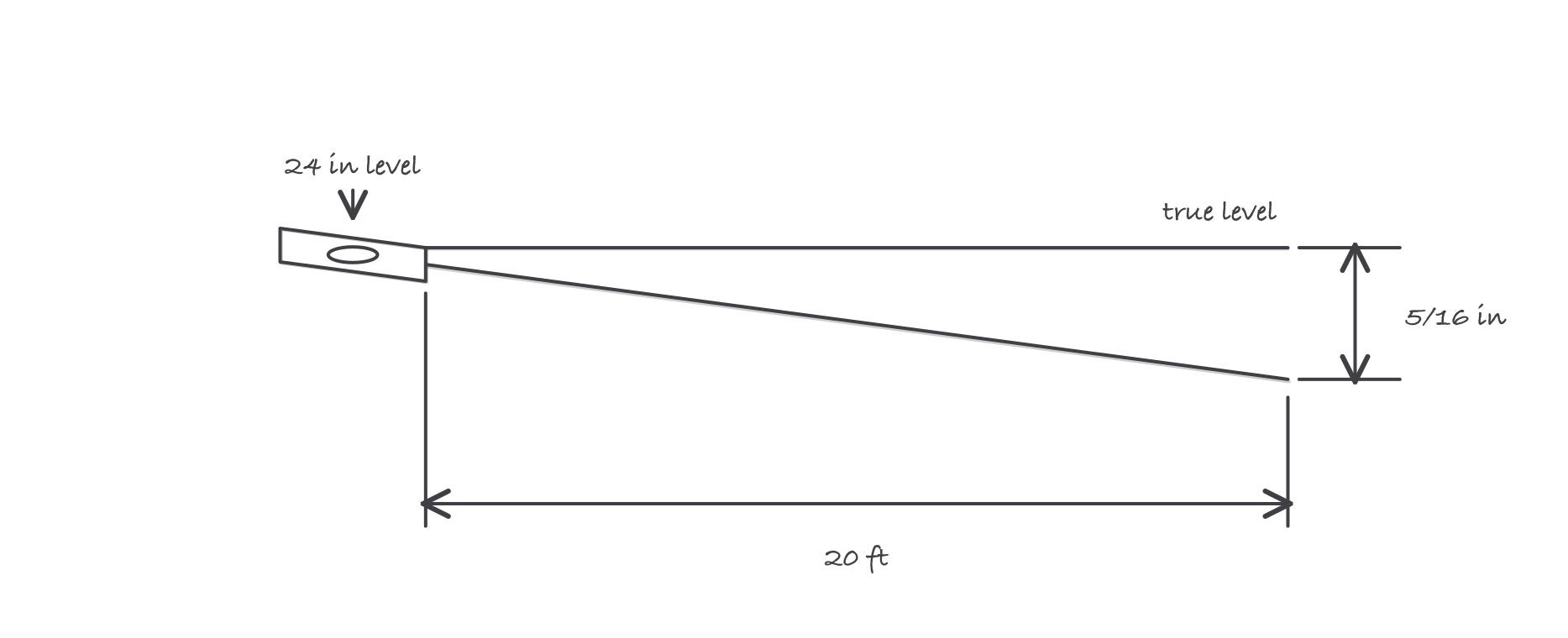
A 1/32 in error in a 24 in level becomes 5/16 in across a 20 ft room
5/16 in is a visible slope in a countertop and a gap you can see under a door. This is the entire argument for using a tool whose reach matches the work: check a room with something that spans the room.
Where it bites
- Level, plumb, square and racked are four different checks. Level is horizontal. Plumb is vertical. Square is 90 degrees between two members. Racked means the assembly has gone to a parallelogram, which you catch with diagonals and not with a level at all.
- A self-leveling laser outside its range is a confident liar. These instruments compensate only within a small tilt, and set up on ground beyond that they can project a plane that is not level. Get the tripod roughly level first and confirm the instrument indicates it is compensating.
- Accuracy specifications are per distance. A tool rated at some accuracy over 100 ft is not that accurate at 300 ft. Read the specification with its distance attached, and shorten the setup rather than stretching the tool.
- Work everyone off one benchmark. Pick a single reference elevation, mark it permanently, and have every crew carry their heights from it. Two crews with two benchmarks produce a building that does not meet in the middle.
- A laser dot has width, and the width matters at range. Mark to the same edge of the beam or the center of the detector every time, not to whichever side is convenient.