Business · Carpentry
Getting Into a Carpentry Apprenticeship
Part of Carpenter, Frame to Finish · step 26 of 30 · next: Do Carpenters Need a License
In learning paths: Carpenter, Frame to Finish
You get into a carpentry apprenticeship by applying to a sponsor, not to a school. A sponsor is whoever holds the registered program: an employer, an employer association, a joint labor-management committee, or a union local. The sponsor sets the entry requirements, runs the selection, and employs you from the first day.
*Learn the Trades is a free study resource. We are not a licensing body, an authorized training provider, or an exam administrator. Reading this page does not award any card, license, or certification. Always verify requirements with the issuing authority linked in the sources.*Why it matters on the job
The most expensive mistake in this trade is paying tuition for something you could have been paid to do. Registered apprenticeships hire you and pay you while you learn. Private carpentry courses charge you and end in a certificate no sponsor is obliged to recognize. The two are advertised with almost identical words, which is not an accident.
Finding registered programs
Carpenter is listed as a registered apprenticeable occupation under SOC code 47-2031.00 on apprenticeship.gov, and that occupation listing is the canonical place to start. Registration runs through either the US Department of Labor’s Office of Apprenticeship or a State Apprenticeship Agency depending on your state, and both produce a registered apprenticeship. Do not discount a program because it describes itself as “state-registered.”
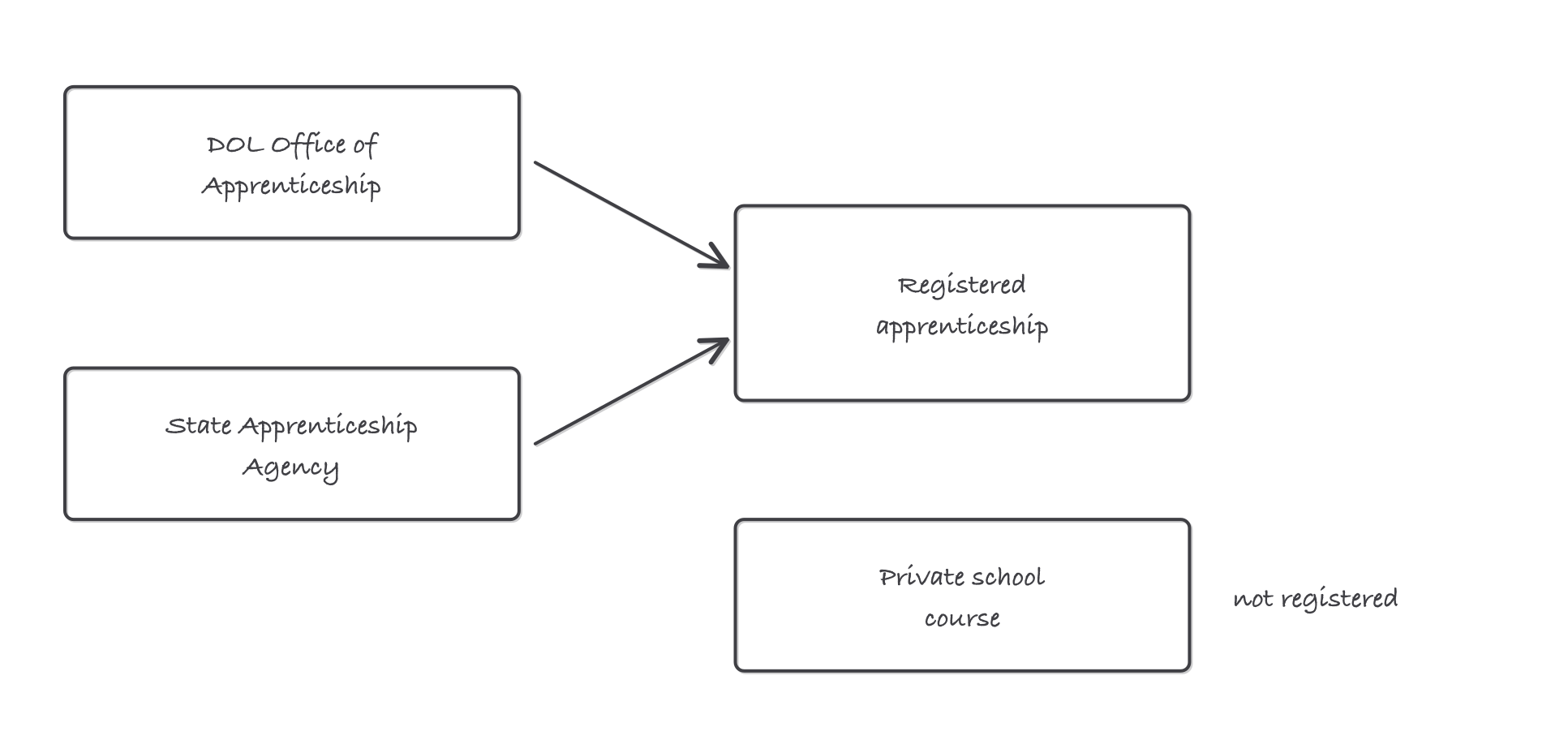
Two roads into the same credential, and one box that connects to neither
Beyond the federal listing, sponsors are local. Carpenter training centers, regional councils, general contractors running their own registered programs, and state agencies all publish openings themselves, and many accept applications only during announced windows.
What sponsors ask for
Entry requirements are set per program, so treat what follows as the shape of the question rather than a checklist. Sponsors commonly want proof of age, a high school diploma or equivalent, reliable transportation to jobsites that move week to week, the physical capacity for the work, and a commitment to attend related instruction on a fixed schedule. Selection methods vary and are published by the sponsor; some rank applicants using an entry assessment and an interview.
The five questions to ask before you sign
- Is this program registered, and with whom? Ask for the registering agency by name. A registered program answers that in one sentence.
- May I see the standards? The registered standards state the term, the on-the-job and classroom requirements, and the wage progression.
- Who employs me, and from when? In a registered apprenticeship you are an employee earning a wage while you learn.
- What does related instruction cost me? Tuition arrangements vary by sponsor. Get the answer in writing.
- What do I hold at the end? The answer should be the completion credential from a registered program.
Where it bites
- Pre-apprenticeship is a real thing and it is not an apprenticeship. Some are excellent bridges run by legitimate organizations. None of them is the registered program itself, and finishing one does not enroll you in one.
- Trainee and helper are payroll titles. They carry no registration and no credential, whatever the pay stub says.
- Windows close. Many sponsors take applications for a few weeks a year. Find out when yours opens long before you need it.
- Geography decides more than you would like. Sponsors register programs where they have work. The nearest carpentry program may be in the next county, and the sponsor expects you to reach the jobsite rather than the office.
Verified requirements
| Where | Expires | Renewal | Continuing education |
|---|---|---|---|
| United States (federal) | Confirm with issuer | Confirm with issuer | Confirm with issuer |
Information comes from issuing-authority sources. Confirm current rules, fees and eligibility with the authority before acting.