Learn · Carpentry
Residential Fall Protection
Part of Carpenter, Frame to Finish · step 20 of 30 · next: Nail Gun Safety
In learning paths: Carpenter, Frame to Finish
Assumes you know: Fall Protection for Carpenters
Residential construction gets its own paragraph in the fall protection standard, 1926.501(b)(13), and it is not a lower standard. It is the same 6 feet, with one narrow exit: where conventional fall protection is infeasible or would create a greater hazard, the employer may work to a written fall protection plan instead.
Why it matters on the job
That exit gets abused. Crews hear the word residential and assume harnesses are optional on houses. OSHA’s position runs the other way. Conventional protection is the default on a house exactly as it is on a deck, and the plan is an exception you have to justify in writing before you use it, not a box you tick afterward.
What counts as residential construction
OSHA Instruction STD 03-11-002, issued December 16 2010 and effective June 16 2011, rescinded the older STD 03-00-001 and set a two-part test. Both parts have to be true.
- The end use of the structure is a dwelling.
- The structure is built using traditional wood frame construction materials and methods.
Fail either one and 1926.501(b)(13) does not apply to your work. Two examples make the line clear.
- A wood-framed medical office fails part one. The framing is identical to a house. The end use is not a dwelling.
- An apartment building framed in light-gauge steel fails part two. The end use is dwellings. The materials and methods are not traditional wood frame.
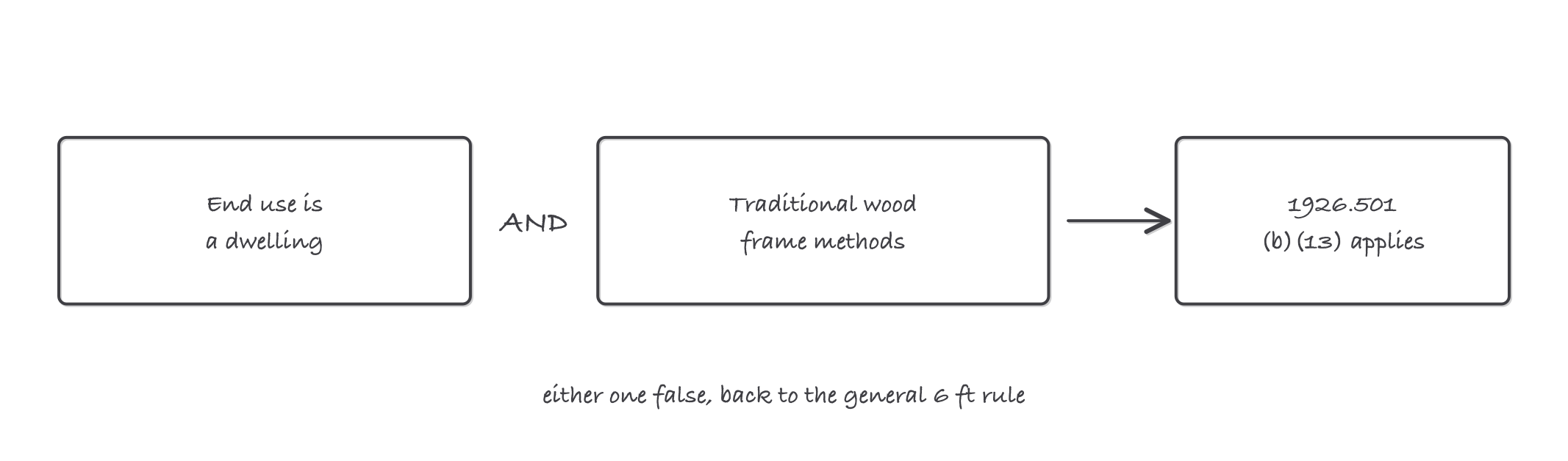
Both conditions or neither: one failure puts the job back under the general 6 foot rule
Conventional protection comes first
Conventional fall protection means the three systems from 1926.501(b)(1): guardrails, safety nets, and personal fall arrest. OSHA’s residential guidance also accepts fall restraint, a system rigged so the worker physically cannot reach the fall hazard.
Restraint and arrest are different jobs. Arrest catches you after you have fallen. Restraint keeps you from reaching the edge at all, and it only counts as restraint if the rigging actually stops you short. A lanyard long enough to let you reach the edge is a fall arrest system that somebody has mislabeled.
When the written plan applies
Only where conventional protection is infeasible or creates a greater hazard, and infeasibility is a demonstration rather than an opinion. The employer has to be able to show it, per task and per location.
The plan itself is governed by 1926.502(k), which sets what the document has to contain and who prepares it. Read that paragraph before you write one. A plan that does not meet 502(k) is not a defense.
Where it bites
- Residential in speech is not residential construction in the standard. Everyday usage covers anything somebody lives in. The two-part test is narrower, and it is the test that decides which rule you are working under.
- The plan is written before the work. A document reconstructed after an inspection is evidence of the wrong thing.
- Infeasible is not the same as inconvenient, slower, or unfamiliar. Roof brackets, scaffolds, guardrails on rakes and gables, and anchor points in the sheathing all exist, and their existence is what makes most infeasibility claims fail.
- The two-part test is checked per structure, not per company. A framing crew can be inside 1926.501(b)(13) on Monday’s house and outside it on Tuesday’s light-gauge job, with the same people and the same tools.