Learn · Carpentry
Building Code Basics for Carpenters
Part of Carpenter, Frame to Finish · step 17 of 30 · next: IRC or IBC: Which Code Applies
In learning paths: Carpenter, Frame to Finish
The IRC and the IBC are model codes. The International Code Council writes and publishes them; it does not enforce them anywhere. What governs your job is the edition your state or municipality formally adopted, together with every local amendment attached to it, and that can be several cycles behind the newest book on the shelf.
Why it matters on the job
“The code says” is the most confidently wrong sentence on a jobsite. Two carpenters can be right about the same detail in two counties. The only question that settles the argument is which document the inspector standing in front of you is enforcing, and that document has a year on the cover and a local amendment list attached to it.
How a model code becomes your code
- ICC publishes. New editions of the I-Codes come out on a recurring cycle; 2021 and 2024 are recent ones.
- A state adopts. A legislature or state code council adopts an edition, usually with statewide amendments, and usually well after publication.
- A jurisdiction amends. Counties and cities may add local amendments on top, commonly for wind, seismic, snow load or wildland fire exposure.
- An inspector applies it to your work, alongside the approved plans and any variance already granted on this project.
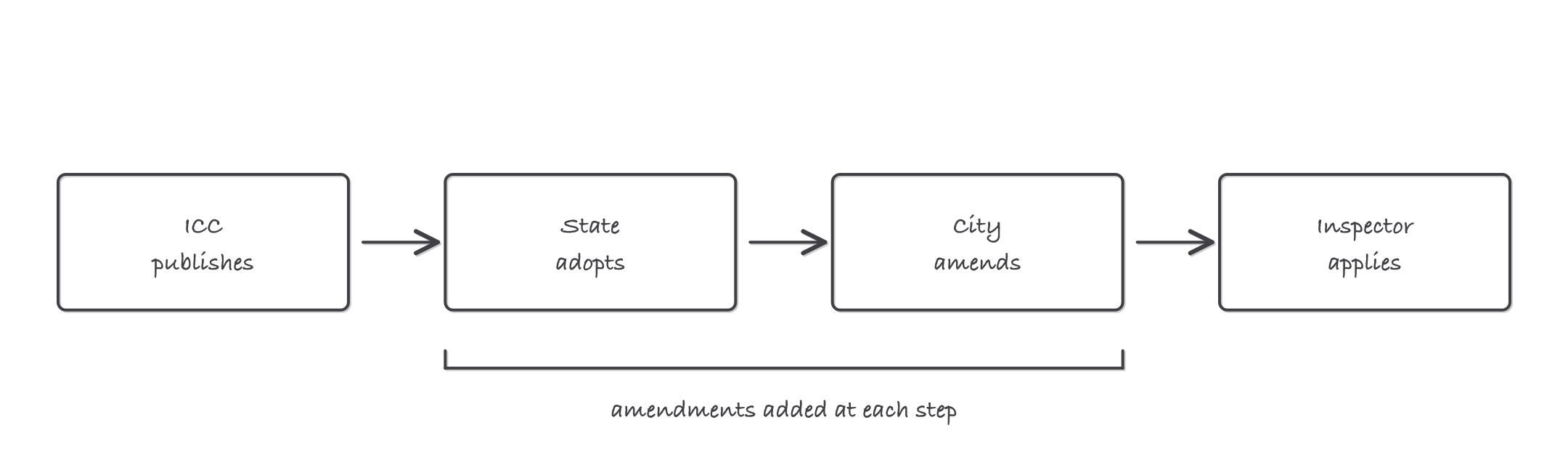
Every step can add amendments, and no step can be skipped
Nothing jumps the queue. A brand-new edition published this year has no authority over your framing until your jurisdiction adopts it.
The rule about numbers
Never carry a span, a header size, a fastening schedule or any other numeric limit out of a code book into a note, a text message, or a lesson like this one. Three reasons, all expensive. The values change by edition. They change again by local amendment. And they sit behind ICC’s license, which makes a copied table a legal problem stacked on top of a structural one.
Look the number up in the adopted book every time, and write the edition next to it on the plan so the next person knows what you looked at.
Finding out what actually applies
Your building department publishes its adopted codes, usually on a page called something like “codes in effect” or “adopted codes,” with the local amendment list beside it. Read that page before the first day of framing on any job in a jurisdiction you have not worked before.
On a plan set, the code data block on the cover sheet names the edition the building was designed to. If it disagrees with the department’s page, that is a question for the designer before it becomes a question for the inspector.
Where it bites
- Model code is not adopted code. The IRC on your phone is a reference. The adopted edition is the law.
- Amendments are where the local knowledge lives. High-wind coastal counties, seismic regions and heavy-snow areas amend framing and fastening provisions specifically, which is exactly the material a carpenter touches all day.
- Approved plans govern until they are corrected. Build to them and flag the conflict in writing. Field-fixing a code conflict without a revision is how a carpenter ends up owning a designer’s mistake.
- Old work was legal when it was built. Existing framing that does not meet today’s book is not automatically a violation, and whether it has to come up to the current edition is a determination for the code official rather than an assumption for you.