Learn · Carpentry
Form Pressures and Failure Prevention
Part of Carpenter, Frame to Finish · step 13 of 30 · next: Door and Window Installation
In learning paths: Carpenter, Frame to Finish
Assumes you know: Wall and Column Forms
Fresh concrete behaves like a heavy liquid, and a liquid pushes sideways in proportion to its depth. That single fact explains where forms fail (near the bottom), when they fail (early), and what makes them fail (placing faster than the design allowed).
Why it matters on the job
“Concrete is heavy” is the usual explanation, and it is the wrong one. Weight alone would not tell you why the same form that held yesterday blows out today with the same mix and the same ties. Placement rate, temperature and the mix’s setting behavior are what changed, and those are the variables a foreman controls.
Pressure grows with depth, not with volume
For a liquid, pressure at any depth is the unit weight times the depth above that point. Normal-weight concrete is conventionally taken at about 150 lb per cubic foot, with the exact figure coming from the mix design.
So at 4 ft below the surface of fresh concrete, the lateral pressure is 150 × 4 = 600 lb per square foot. At 8 ft it is 150 × 8 = 1,200 lb per square foot. The distribution is a triangle: zero at the top, maximum at the base.
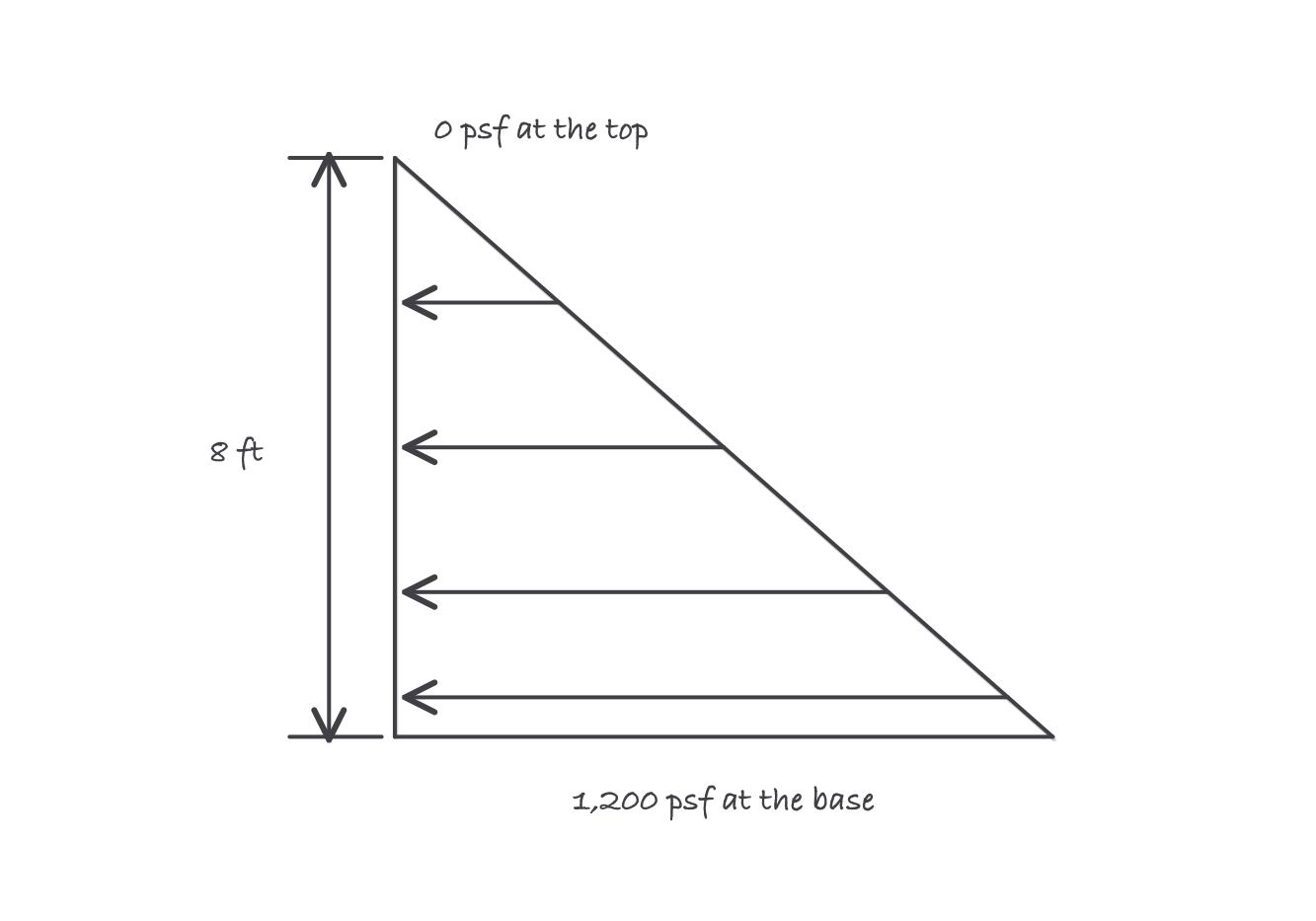
Full liquid head: pressure rises with depth, so the bottom of the form is always the loaded end
Worked example: full liquid head on an 8 ft wall
- Pressure at the base: 150 lb/cu ft × 8 ft = 1,200 lb per sq ft.
- Pressure at the top: 150 × 0 = 0.
- Average pressure over the height: (0 + 1,200) ÷ 2 = 600 lb per sq ft.
- Total lateral force on a 1 ft wide strip of form: 600 × 8 = 4,800 lb per foot of wall length.
Multiply that by a 40 ft wall and the two faces are being pushed apart by roughly 192,000 lb. That is what the ties are holding.
Now the qualification that matters most: 4,800 lb per foot is the full liquid head, and it is an upper bound rather than the design value. Concrete stiffens as it sets. If placement is slow enough and the concrete warm enough, the lower lifts have begun to set before the upper ones arrive, and the set portion stops transmitting the head above it. Design pressures for real pours are usually lower than full liquid head for exactly this reason.
The placement rate is part of the design
The formwork designer chose tie and waler spacing against an assumed rate of placement and an assumed concrete temperature. Those assumptions are instructions to the crew, not background information.
Push the rate above what was assumed and you have quietly redesigned the form to a higher pressure than it was built for. Three conditions push actual pressure toward full liquid head:
- Fast placement, which does not give the lower concrete time to set.
- Cold concrete, which sets more slowly.
- Retarders, superplasticizers and self-consolidating mixes, which keep the concrete fluid longer by design.
Vibration is a fourth factor. Vibrating re-liquefies concrete that had begun to stiffen, so over-vibrating or plunging the vibrator deep into a previous lift raises the pressure right where it is already highest.
What the standard requires
Under 29 CFR 1926.703, shoring and bracing on shored formwork are inspected by a competent person before, during and after placement.
Two rules from that same standard deserve to be memorized:
- No adjustment after placement begins. Once concrete is going in, nobody works on the shoring.
- Forms and shores stay until strength evidence supports removal. The concrete must have gained enough strength to support itself and any load placed on it, determined by an approved method rather than by the schedule.
Reading a form that is about to fail
The warnings are visible and they come in order: grout leaking at a panel joint, the form face bellying between studs, walers visibly bowing, ties stretching or their hardware creaking, and bracing lifting or shifting at the ground.
The correct response is the same at every stage. Stop placing, clear everyone out from under and beside the form, and let the concrete set where it is. Nobody goes back in to add a brace to a form that is already moving, because the failure will not wait for them to finish.
Where it bites
- Blowouts happen at the bottom and early. If you are watching the top of the form, you are watching the wrong end.
- The same form does not hold at any rate. The ties and walers were sized against an assumed placement rate. Changing pumps or crew size changes that rate.
- Shore, reshore and backshore are three different things with three different sets of duties. Using the wrong word in a conversation about who may remove what is how the wrong thing gets removed.
- Column forms are the fast-pour case. Full height goes in quickly, so column bases see close to full liquid head routinely, and clamp spacing at the base reflects that.
- A form is not “proven” by having held before. It held at that rate, that temperature, that mix and that height of pour. Change one and the previous result stops being evidence.