Business · Carpentry
Do Carpenters Need a License
Part of Carpenter, Frame to Finish · step 27 of 30 · next: The Framing and Carpentry Contractor License
In learning paths: Carpenter, Frame to Finish
Most states issue no carpenter license at all. There is no exam you sit to become a licensed carpenter the way an electrician sits for a journeyman electrician license. What exists instead is a contractor license, held at the business level by whoever contracts for and sells the work, and that is a different question from the one most people are asking.
*Learn the Trades is a free study resource. We are not a licensing body, an authorized training provider, or an exam administrator. Reading this page does not award any card, license, or certification. Always verify requirements with the issuing authority linked in the sources.*Why it matters on the job
Search for a carpenter license and you will find schools willing to sell you one. Reframe the question before you spend a dollar. The useful question is never whether carpenters need a license. It is who is selling this work, and what the state requires of the seller.
An employed carpenter swinging a hammer for a licensed contractor typically needs no personal license at all. The contractor holds the license. You hold your skills, your safety training, and whatever industry credentials you chose to earn.
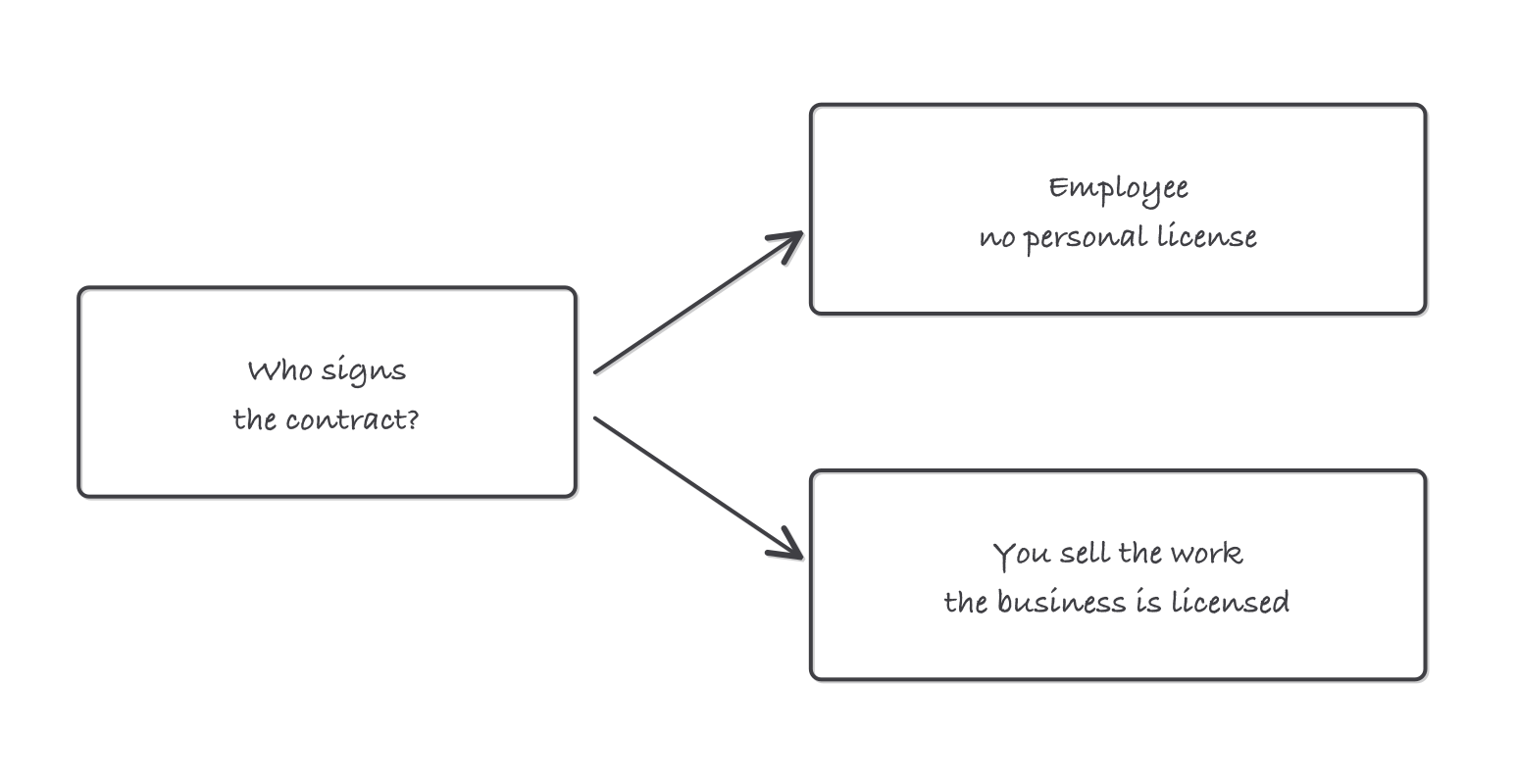
Ask who signs the contract, and the licensing question answers itself
Four different things people call a license
Journeyman carpenter is a status
In electrical and plumbing, journeyman is a state license with an exam behind it. In carpentry it is a classification. It means you completed an apprenticeship and work unsupervised at full scale and full rate, and the people who recognize it are your union, your employer, and the next employer. No state was verified as issuing a journeyman carpenter license.
Write and say journey-level or journeyman as a status. The word turns into a claim the moment it sits next to the word license.
Three regimes, similar words
States handle contracting in three broadly different ways, and the vocabulary overlaps enough to mislead.
Licensing with a trade exam. California licenses contractors through the CSLB. A C-5 Framing and Rough Carpentry license requires documented experience, a trade exam, and a law and business exam.
Licensing without a carpentry classification. Oregon requires a Construction Contractors Board license of anyone doing construction work for compensation, and carpentry is named in the covered activities. There is no carpentry trade exam, because there is no carpentry classification. The requirement is the license itself.
Registration, thresholds, or neither. Other states register contractors rather than license them, or require nothing below a project-value threshold. Never generalize one state’s regime to another.
Where it bites
- “No license required” is not “no rules.” Permits, inspections, insurance, workers compensation and local business registration all still apply, and none of them is a carpenter license.
- No school can hand you government permission to work. A certificate proves you finished something. It does not authorize anything.
- Employee or contractor is the whole question. The moment you contract directly with a homeowner you have moved into the regime that does require a license in many states, whatever your skill level was the day before.
- Check the state you are standing in, on that state’s own site. Third-party licensing guides go stale within a year, and most of them are selling something.
Verified requirements
| Where | Expires | Renewal | Continuing education |
|---|---|---|---|
| United States (federal) | Confirm with issuer | Confirm with issuer | Confirm with issuer |
| United States (federal) | No | Confirm with issuer | Confirm with issuer |
| United States (federal) | No | Confirm with issuer | Confirm with issuer |
Information comes from issuing-authority sources. Confirm current rules, fees and eligibility with the authority before acting.