Business · Carpentry
The Carpentry Apprenticeship
Part of Carpenter, Frame to Finish · step 23 of 30 · next: Running Crews
In learning paths: Carpenter, Frame to Finish
A registered carpentry apprenticeship is a job. You are hired and paid from the first day. Part of your working life is structured on-the-job learning under a journey-level carpenter, with related classroom instruction running alongside it. At the end you hold a completion credential the Department of Labor describes as portable and nationally recognized.
*Learn the Trades is a free study resource. We are not a licensing body, an authorized training provider, or an exam administrator. Reading this page does not award any card, license, or certification. Always verify requirements with the issuing authority linked in the sources.*Why it matters on the job
Carpentry is learned by doing the work under somebody who already knows it. A registered apprenticeship is the only version of that arrangement with a written training plan behind it, a wage schedule that steps up as your skill does, and a credential at the end that means the same thing to the next employer as it did to the last.
What registered actually means
Registered means the program is registered either with the US Department of Labor’s Office of Apprenticeship or with a State Apprenticeship Agency. Roughly half the states run their own agency and the rest register through the DOL directly. Both routes produce a registered apprenticeship, and both end in the same nationally recognized completion credential. Carpenter, SOC 47-2031.00, is listed as a registered apprenticeable occupation on apprenticeship.gov.
A course you pay a private school for is none of this, however the marketing is worded. No employer, no wage, no registration, and no completion credential.
The two halves
Every registered apprenticeship runs the same two components at the same time.
On-the-job learning. You work for the sponsor’s employer doing production work, supervised by a journey-level carpenter, against a written list of competencies the program has to cover.
Related technical instruction. Classroom or online coursework covering the theory the job never teaches you in a sensible order: layout math, blueprint reading, code, materials and safety.
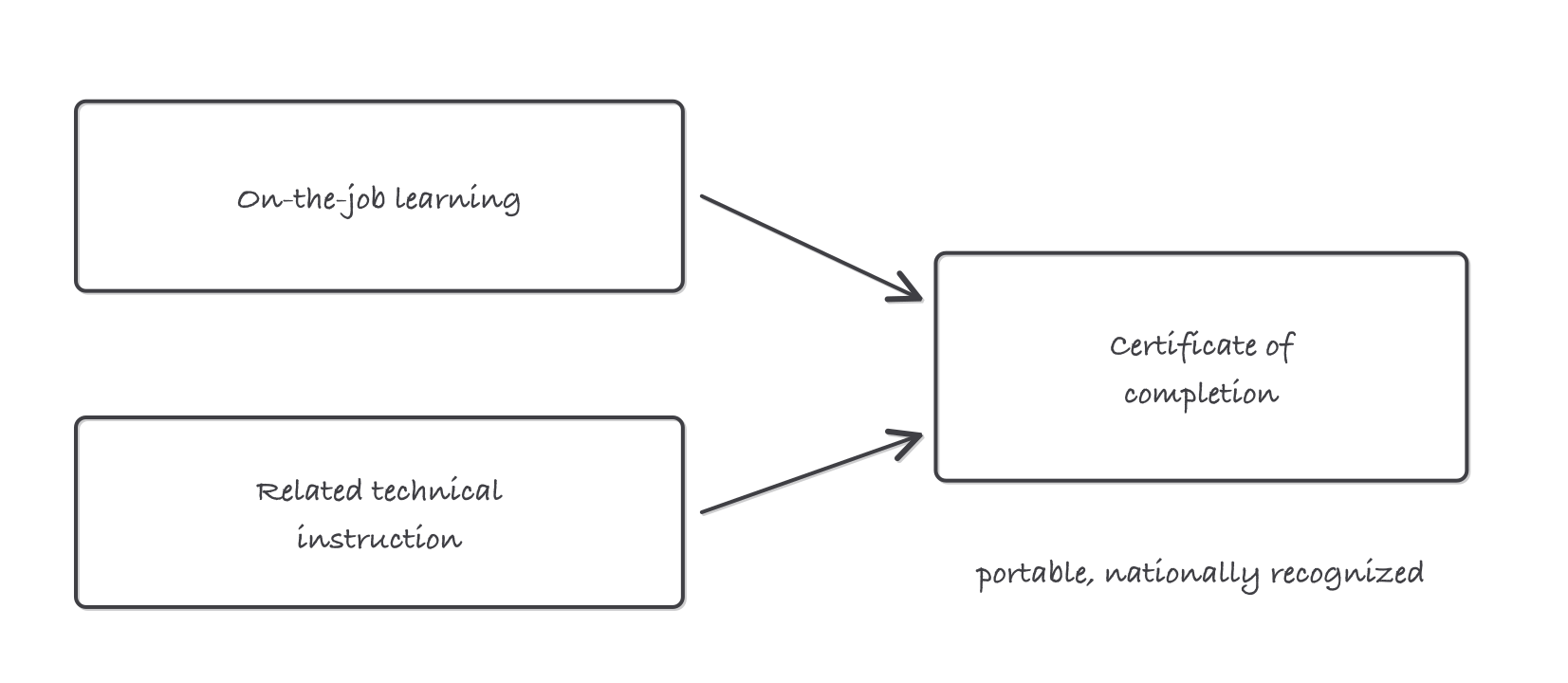
Both halves run at once, and the completion credential comes from finishing both
The hours attached to each half are set by the sponsor, and BLS says plainly that apprenticeship requirements differ by program and region. Ask the sponsor for the registered standards of the program you are applying to. Those standards state the term, the hour requirements and the wage progression in writing, which is exactly why you want them before you accept a place.
What you finish with
Where it bites
- Journeyman in carpentry is a status, not a license. Finishing an apprenticeship makes you journey-level, meaning you work unsupervised at full scale and full rate. In electrical and plumbing, journeyman is a state license with an exam behind it. In carpentry it is a classification your sponsor and your employers recognize.
- The hours belong to the sponsor, not to the industry. Any article quoting one number for the carpentry apprenticeship is describing one program. Get your program’s standards in writing and work from those.
- The wage schedule is written down before you start. Read it, and find out what triggers each step in your program, because in many programs classroom progress matters as much as time on the tools.
- Keep your own records. Hours worked, competencies signed off, classes completed. Sponsors keep records too, and sponsors and employers both change over a multi-year term.
Verified requirements
| Where | Expires | Renewal | Continuing education |
|---|---|---|---|
| United States (federal) | Confirm with issuer | Confirm with issuer | Confirm with issuer |
| United States (federal) | Confirm with issuer | Confirm with issuer | Confirm with issuer |
Information comes from issuing-authority sources. Confirm current rules, fees and eligibility with the authority before acting.