Learn · Carpentry
Fall Protection for Carpenters
Part of Carpenter, Frame to Finish · step 19 of 30 · next: Residential Fall Protection
In learning paths: Carpenter, Frame to Finish
Six feet is the trigger. Under OSHA 29 CFR 1926.501, a carpenter working on a walking or working surface with an unprotected side or edge 6 feet or more above a lower level must be protected by a guardrail system, a safety net system, or a personal fall arrest system. The height is measured down to the lower level, not to the ground, so a deck 6 feet above a basement slab counts even though the slab is below grade.
Why it matters on the job
Falls kill more construction workers than anything else does. OSHA’s fall protection in construction page still carries the 2016 BLS count of 991 construction deaths, 38.7 percent of them from falls. Carpenters live on exactly the geometry the standard was written for (open deck edges, unsheathed floor systems, roof framing, and stair and chase openings), and the exposure arrives on the first morning of the frame.
The four sections of Subpart M
Subpart M of 29 CFR 1926 is four sections, and knowing which one answers which question ends most jobsite arguments before they start.
- 1926.500 covers scope, application and definitions.
- 1926.501 is the duty section, meaning when protection is required.
- 1926.502 is the criteria section, meaning what a compliant guardrail, net or arrest system has to be.
- 1926.503 is training, covering what the employer must teach and the record it must keep.
Most disputes are 501 questions answered with 502 opinions. Somebody asks whether protection is required here, and gets told that a harness is fine. Ask the duty question first.
The trigger and the three choices
At 6 feet above a lower level on an unprotected side or edge, 1926.501(b)(1) gives three ways to comply: a guardrail system, a safety net system, or a personal fall arrest system. Which one you use is the employer’s call. Whether you use one is not.
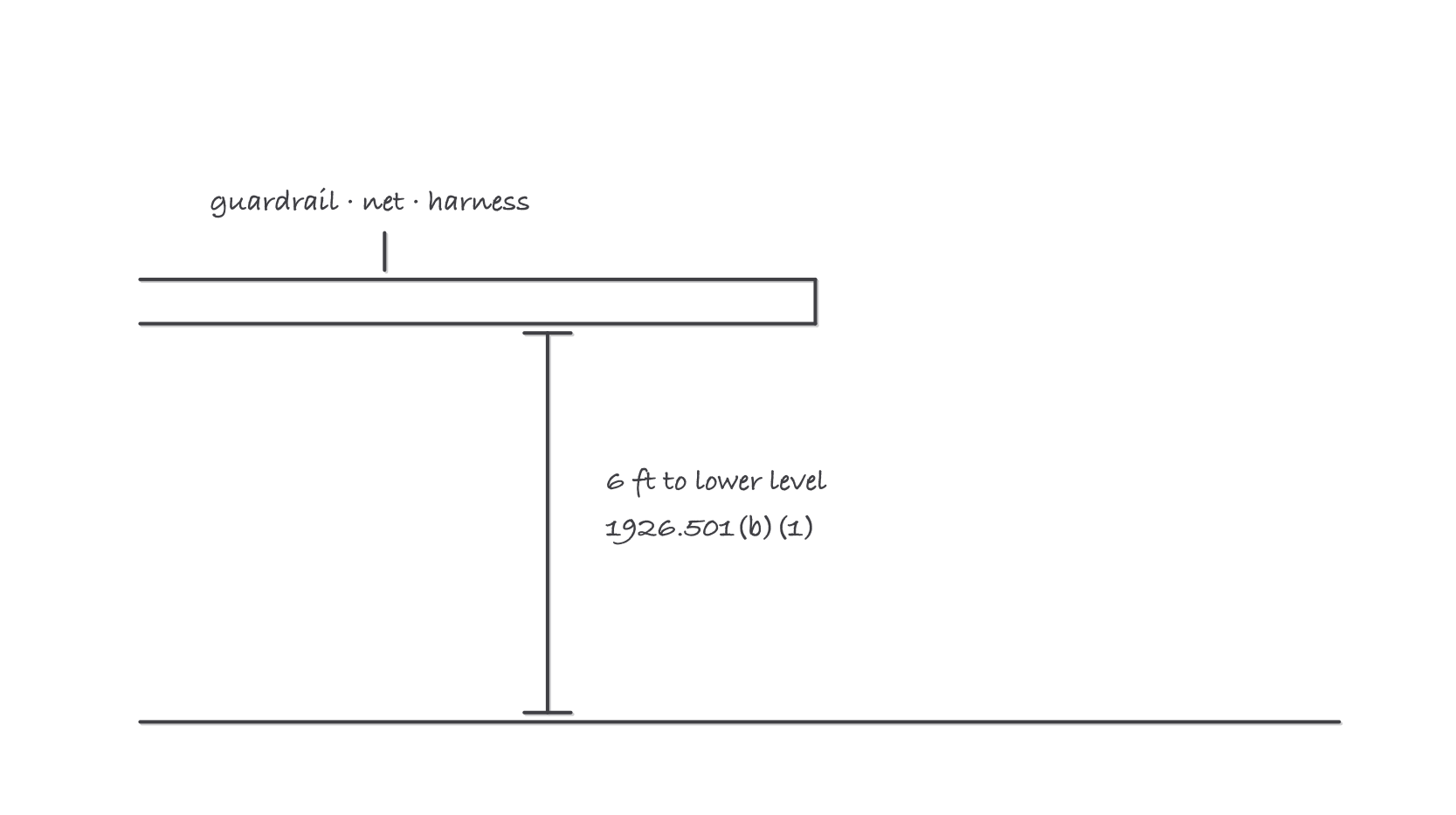
The measurement runs from the walking surface to the lower level, and the standard that sets it is a construction standard
Holes carry three separate duties
1926.501(b)(4) treats a hole as three duties, and framers routinely satisfy one and forget the other two. You must be protected from falling through the hole, and a skylight counts as a hole for this purpose. You must be protected from stepping into or tripping in it. And anyone below must be protected from objects falling through it. A stair opening covered against a fall still needs that third duty answered before drywall stock lands on the deck above.
Where it bites
- Never quote a height without its standard. 6 feet is 1926, construction. General industry under 1910 triggers at 4 feet, and steel erection has heights of its own. Carpenters work under 1926, and the number changes the moment the conversation drifts to another part.
- A cover is a fall protection system with criteria of its own in 1926.502. Loose sheathing laid over an opening meets none of them.
- Protection is required by the exposure, not by the schedule. The rail goes up before the deck gets walked, not after somebody notices.
- Residential wood framing has a paragraph of its own in 1926.501(b)(13), and it is narrower than everyday speech suggests. The next lesson covers the two-part test that decides whether you are in it.