Learn · Carpentry
Saw Safety and Guarding
Part of Carpenter, Frame to Finish · step 22 of 30 · next: The Carpentry Apprenticeship
In learning paths: Carpenter, Frame to Finish
A portable circular saw with a blade over 2 inches in diameter must carry a guard above the base plate and a guard below it, and the lower guard must return automatically to covering the blade the instant the saw is withdrawn from the work. That is 29 CFR 1926.304(d), and it is routinely defeated.
Why it matters on the job
The lower guard is the only thing between a coasting blade and your leg in the seconds after a cut. A wedged, wired or zip-tied guard turns every cut into a one-handed walk to the next mark with an exposed blade still spinning at the end of your arm. The tool does not need to fail for that to cost you a leg.
What 1926.304 actually says
Three parts of the construction standard matter to a carpenter.
- (a) Disconnect. Every fixed power-driven woodworking tool has to have a disconnect switch that can be locked in the off position, or a control handle that can be removed. That is the provision that makes lockout possible on a shop saw or a fixed miter station.
- (d) Guarding. Portable circular saws with a blade over 2 inches in diameter carry guards above and below the base plate, and the lower guard returns automatically to the covering position when the saw is withdrawn from the work.
- (f) Standards. The section incorporates ANSI O1.1-1961, Safety Code for Woodworking Machinery, by reference.
Kickback starts in the kerf
Kickback is a reaction, and it has one cause. The kerf closes on the blade, the blade can no longer clear its own cut, and the motor’s torque has to go somewhere. It goes into the saw, which climbs the kerf and drives back along the line of cut toward you.
Three things close a kerf, and all three are decisions you made before the blade touched wood.
- The offcut sags. A piece supported only at the ends folds into the cut as you approach the middle. Support both sides, or support the keeper and let the offcut fall free.
- The stock releases internal stress. Wet or crowned lumber can pinch as soon as it is opened, particularly ripping. Watch the kerf, and use a wedge in a long rip.
- The workpiece moves. A board on two horses that starts to twist takes the kerf with it.
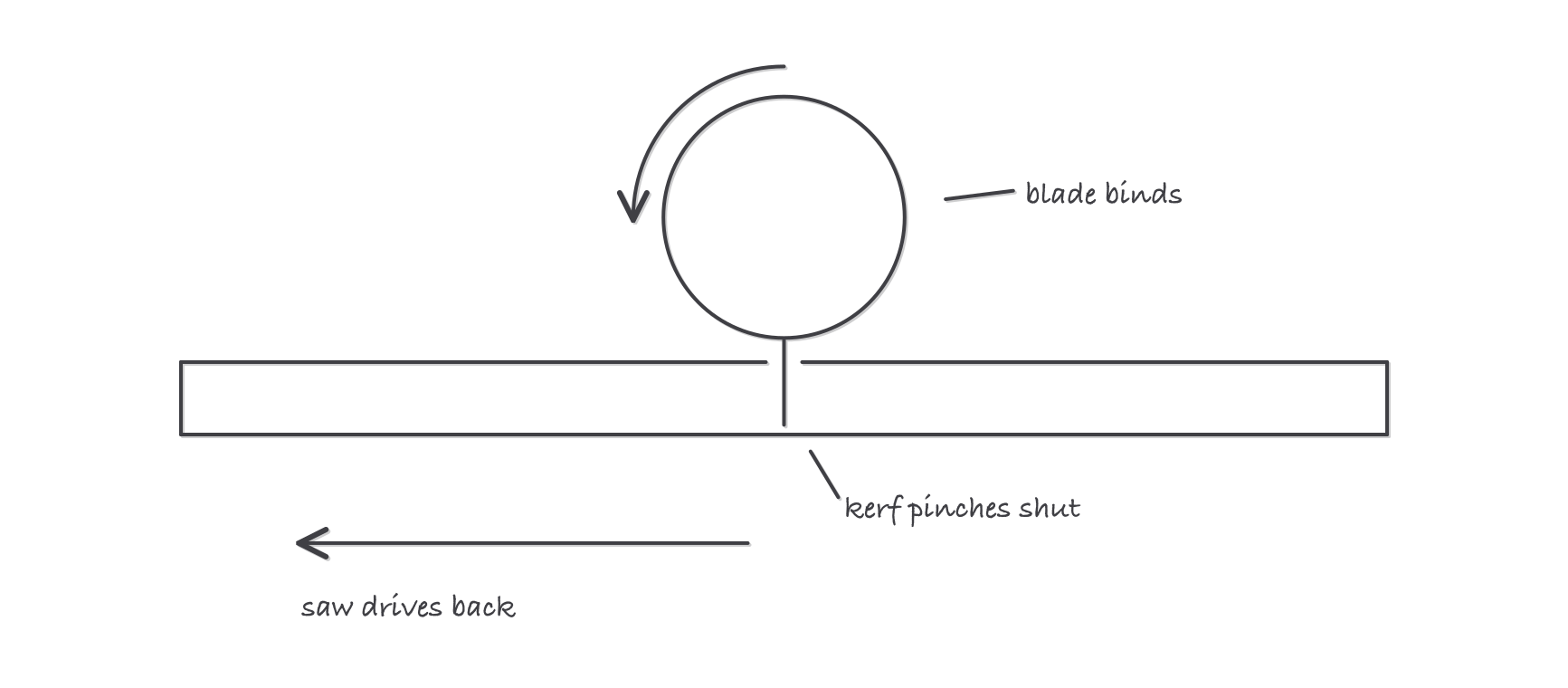
Pinch the blade and the torque has nowhere to go but backward along the cut
Feed pressure is the multiplier. A dull blade or a blade fighting a bind makes you push, and pushing is what turns a small bind into a saw arriving at your body.
Where it bites
- 1926.304 is the construction standard, and 1910.213 is not yours. OSHA’s woodworking eTool is written against 1910, general industry. The table saw specifics people find online come from there. On a jobsite the answer comes from 1926.
- Lifting the guard with the lever is normal use. Blocking it open is the violation. Plunge cuts and steep bevel starts need a hand on the retract lever. The requirement is that the guard returns on its own when the saw leaves the work.
- The dangerous moment is after the cut, not during it. The blade coasts for several seconds. That is the window the lower guard covers, and the window a defeated guard leaves open.
- A guard that sticks is a guard about to be removed. Pitch and sawdust in the pivot are why guards get zip-tied. Clean the pivot and the temptation goes away.