Learn · Industrial Maintenance
Root Cause Failure Analysis
Part of Maintenance Tech to CMRP · step 24 of 30 · next: The CMRP Certification
In learning paths: Maintenance Tech to CMRP
Assumes you know: Predictive Maintenance: Vibration, Thermal, Oil
Root cause failure analysis is the discipline of continuing to ask why after the machine is running again. The part that broke is a finding, not an answer. Analysis is finished when you have reached a cause you can actually remove, and removing it stops the failure from coming back.
*Learn the Trades is a free study resource. We are not a licensing body, an authorized training provider, or an exam administrator. Reading this page does not award any card, license, or certification. Always verify requirements with the issuing authority linked in the sources.*Why it matters on the job
Every maintenance department has a machine that eats couplings, a pump that goes through seals, a drive that keeps tripping. Those are not bad-luck assets. They are unfinished analyses, and the department pays for them again every few months in parts, overtime and lost production.
Analysis is also what turns a technician into a lead. Anyone can be taught to replace a bearing. The person who can say why this bearing keeps failing, and prove it, is the person the plant builds its schedule around.
Three depths of cause
Any failure can be explained at several levels, and each level supports a different fix.
The physical cause is what happened to the metal. The bearing was overloaded, the seal ran dry, the shaft fatigued, the winding overheated. This is the level a good teardown reaches, and it is where most investigations stop.
The human cause is the action or decision that produced the physical cause. Something was installed, adjusted, operated or left out. Reaching this level requires care, because it is where investigations turn into blame and stop producing information.
The systemic cause is the reason that action seemed correct at the time: a procedure with no tolerance in it, a spare that was never specified, training that never covered the task, a schedule that made the shortcut the only way to hit the number. This is the level where fixes hold, because it is the only level that also covers the next person.
Stop at the physical cause and you replace parts better. Reach the systemic cause and you stop needing to.
The chain, and where to break it
The working technique is a chain of causes, built by asking why of each link and testing each answer against evidence. Five whys is the usual name for the drill, and the number is not the point. You stop when you reach a cause you have the authority and the means to remove, and when removing it would have prevented the failure.
Two tests keep a chain honest.
- Every link needs evidence. A link supported by “it must have been” is where analyses go wrong, and everything downstream of it is a story.
- Read the chain backward before you accept it. If the last cause had not been true, would the next one still have happened? Walk it back to the failure. If any step does not hold in that direction, the chain has a gap.
Worked example: the pump that eats bearings
A process pump has been through three outboard bearings in 14 months. The third failure takes the pump out on a Sunday.
Why did the pump fail? The outboard bearing seized. Physical evidence: the teardown shows the outer race brinelled and the rolling elements discolored from heat.
Why did the bearing fail? The shaft was running misaligned. Evidence: the dial indicator readings taken before the pump was disturbed show offset well outside the tolerance for the coupling and the speed, and the wear pattern on the coupling element matches the direction of the offset. The alignment check also finds one foot 15 thousandths high, so tightening the hold-down bolts had been pulling the frame out of shape every time the pump was reassembled.
Why was it misaligned? The written installation procedure for this pump says “align coupling” with no tolerance, no soft foot check, and no requirement to record the final readings. Three different technicians did the job three different ways, each of them correctly by the procedure they were given.
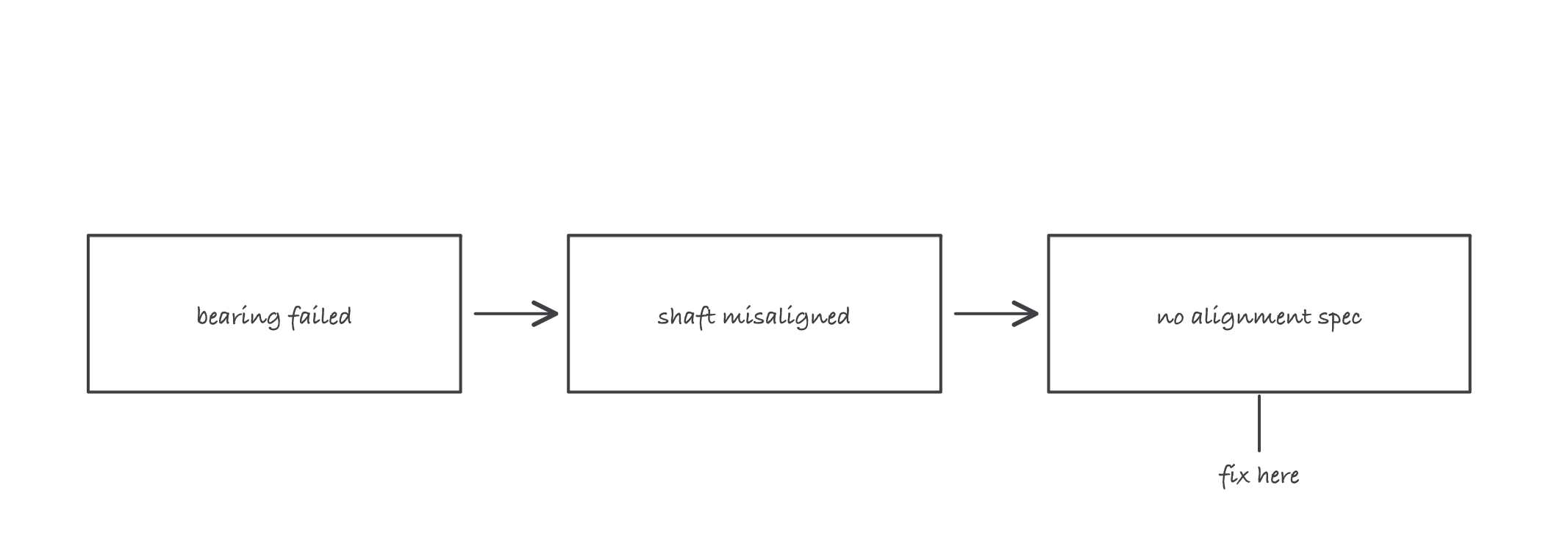
Three links, three possible fixes: only the last one stops the fourth bearing
Now price the three fixes.
Stopping at link one buys a better bearing, and the fourth failure arrives on the same schedule. Stopping at link two aligns this pump correctly, which is a real improvement and lasts until the next rebuild. Fixing link three (a procedure that specifies the alignment tolerance, requires the soft foot check first, and requires the final readings to be recorded) fixes this pump, every other pump on that procedure, and every technician who has not been hired yet.
Three bearings in 14 months is a failure every 4.7 months. The purpose of the analysis is to make the next interval unmeasurable.
Where it bites
- “Operator error” is not a root cause. It is a place investigations stop when they become uncomfortable. A person made an error, and the analysis question is what made that error possible and what will catch the next one.
- Evidence gets thrown in the scrap bin during the repair. The failed part, the fracture face, the old lubricant, the readings before anything was disturbed: these are the whole case, and they exist for about an hour after the breakdown. Photograph, bag and label before the pressure to restart wins.
- Not everything gets a full analysis. Set a trigger (cost, safety consequence, repeat count, production loss) and apply it. Attempting deep analysis on every work order means doing it properly on none of them.
- An analysis without a closed action is a document. The deliverable is a changed procedure, a changed specification, a changed part, or changed training, with an owner and a date. Findings alone change nothing.
- Verify the fix with the same measurement that found the fault. If a vibration trend exposed the problem, the trend is what proves the correction held. Declaring victory at restart is how the same failure gets investigated twice.
Verified requirements
| Where | Expires | Renewal | Continuing education |
|---|---|---|---|
| United States (federal) | Yes | 3 years | 50 course hours per 3-year cycle, drawn from two or more of the recertification activity categories; recertification application due within 90 days of the expiration date or the exam must be retaken |
| United States (federal) | Yes | 3 years | 50 course hours per 3-year cycle, drawn from two or more of the recertification activity categories; recertification application due within 90 days of the expiration date or the exam must be retaken |
Information comes from issuing-authority sources. Confirm current rules, fees and eligibility with the authority before acting.