Learn · Industrial Maintenance
Couplings
Part of Maintenance Tech to CMRP · step 9 of 30 · next: Lubrication Fundamentals
In learning paths: Maintenance Tech to CMRP
Assumes you know: Shaft Alignment
A coupling connects two shafts so torque crosses from one to the other. A flexible coupling does a second job on top of that: it accommodates the small misalignment that remains after the machine has been aligned properly. The second job is where the trade’s arguments start, because accommodating misalignment and permitting misalignment are two different things.
Why it matters on the job
The coupling is the one component that touches both machines, so it is the first thing blamed and the last thing at fault. When a coupling element chews itself up in three months, the coupling is telling you about the alignment, the shock loading, or the fit of its hubs. Replace the element without reading it and you have bought yourself a repeat.
Couplings are also where torque, misalignment and axial movement all meet in one part, which makes coupling selection a decision with real consequences, not a parts-catalog step.
Rigid or flexible
Rigid couplings (sleeve, clamp, flanged) lock the two shafts into effectively one shaft. They accommodate nothing. They belong where the shafts are held in one common bearing set, or on vertical pumps where the coupling also carries thrust and sets impeller height. Fit a rigid coupling to two independently mounted machines and every thousandth of misalignment lands directly in the bearings.
Flexible couplings come in three families, defined by how they flex.
- Elastomeric couplings (jaw and spider, tire, sleeve) flex a rubber or urethane element. They damp shock and torsional vibration, they need no lubricant, and the element is a wear part by design. Most fail gradually and noisily, which is a genuine advantage.
- Mechanically flexible couplings (gear, grid, chain) accommodate movement through clearances between metal parts. They carry very high torque for their size, and they must be lubricated. A dry gear coupling wears its teeth into the shape of the misalignment and then seizes.
- Metallic membrane couplings (disc pack, diaphragm) flex the metal itself. They need no lubrication, they run without backlash, and they are the least forgiving: metal that is flexed beyond its rating fatigues and cracks, often with no warning at all.
That last line is the practical selection rule. Elastomeric couplings tolerate more misalignment and less torque; membrane couplings tolerate more torque and less misalignment; mechanically flexible couplings sit between them and buy their tolerance with grease.
Accommodation is not permission
Every flexible coupling has a published misalignment capacity, and it is tempting to read that number as permission to align only that well. It is not.
Misalignment inside a coupling’s rating still produces a reaction force, and that force is carried by the bearings and seals on both machines for every hour the machine runs. The rating tells you what the coupling survives, not what the machine survives. Align to the alignment tolerance for the running speed, and let the coupling’s capacity absorb thermal growth, foundation settlement, and the residual you could not remove.
Spacers do arithmetic for you
Most flexible couplings flex at two planes, one at each hub. A parallel offset between the shafts has to be taken up as an angle at each of those planes, and the length between them decides how large that angle is.
Longer spacing means a smaller angle for the same offset. That is why a pump coupling with a long spacer both tolerates more misalignment and makes back-pull-out maintenance possible.
Worked example: what a spacer buys you
Two shafts sit with 0.010 in of parallel offset that alignment could not remove.
Short coupling, flex planes 3 in apart. The angle each plane must accept is 0.010 in ÷ 3 in = 0.0033 in/in, which is arctan(0.003333) = 0.19 degrees.
Spacer coupling, flex planes 12 in apart. Now the angle is 0.010 in ÷ 12 in = 0.00083 in/in, which is arctan(0.000833) = 0.048 degrees.
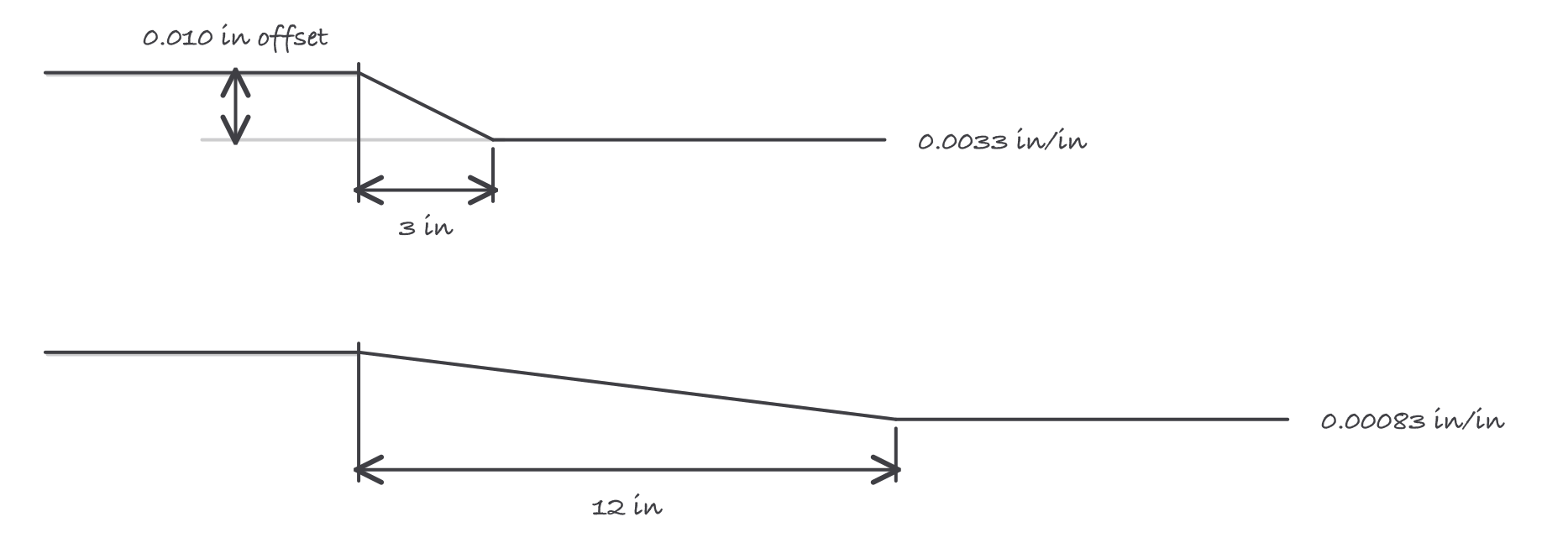
The same offset, four times the length between flex planes, a quarter of the angle at each one
Four times the length, a quarter of the angle, and roughly a quarter of the flexing strain in the element every revolution. That is the whole argument for spacer couplings on pumps, and it is also a warning: shortening the distance between flex planes to fit a job quadruples the demand you are making on the coupling without changing a single alignment reading.
Installing one
- Set the distance between shaft ends (DBSE) to the coupling’s specification, not to whatever the shafts happen to leave you. Too little and thermal growth loads the coupling axially; too much and the elements do not engage as designed.
- Fit the hubs properly. Heating a hub to slip it on beats driving it, always. A hammered hub takes the blow straight through to the bearings behind it.
- Check the key. A key should fit snug on its sides in both keyways, with clearance at the top of the key. A key tight on the top and loose on the sides transmits nothing and shears.
- Do not use the coupling bolts to pull the machines together. If the flanges do not meet freely, the alignment is not finished.
- Refit the guard. A coupling guard is power transmission guarding, and a rotating coupling is one of the classic exposed hazards in a plant.
Reading a failed coupling
- A spider chewed evenly all round is torque, shock, or heat. A spider worn on alternating faces is misalignment.
- A grid or gear coupling with a hard black paste inside has centrifuged its grease. Use the grease the coupling maker specifies, because ordinary bearing grease separates under coupling loads.
- Cracked disc packs at the bolt lugs mean the misalignment or axial displacement went past the rating. Never straighten and reuse a disc pack.
- Fretting rust between hub and shaft is a loose fit, and it means the shaft or the bore is now out of tolerance.
- Both hubs hot after a run is a coupling working harder than it should, which points back at alignment.
Where it bites
- The bearings pay for whatever the coupling forgives. Two machines aligned by feel and joined with a forgiving coupling still wear out their bearings, on schedule, every time.
- Match the element to the coupling, not to the gap it fills. Spider elements come in different durometers, and the harder one is not automatically the better one, because the softer element is what damps the shock.
- Use coupling grease, not chassis grease. Coupling grease resists centrifugal separation; general-purpose grease does not.
- Rigid couplings on separately mounted machines are almost always a mistake, and they are a common one on small pumps.
- Never run a coupling without its guard, even for a test.
Exam relevance
The NCCER Millwright program pairs coupling work with alignment in a single module, and that pairing is the point: expect to be asked to name the three flexible families and their trade-offs, to explain why a spacer reduces angular demand, to identify a failure from an element’s wear pattern, and to state why a coupling’s misalignment rating is not an alignment tolerance. The CMRT covers this as routine technician work.
Verified requirements
| Where | Expires | Renewal | Continuing education |
|---|---|---|---|
| United States (federal) | Yes | 3 years | 50 course hours per 3-year cycle, drawn from two or more of the recertification activity categories; recertification application due within 90 days of the expiration date or the exam must be retaken |
Information comes from issuing-authority sources. Confirm current rules, fees and eligibility with the authority before acting.