Learn · Industrial Maintenance
Lubrication Fundamentals
Part of Maintenance Tech to CMRP · step 10 of 30 · next: Hydraulics Fundamentals
In learning paths: Maintenance Tech to CMRP
Assumes you know: Bearings: Types, Installation, Failure Modes
Lubrication puts a film of something soft between two hard surfaces so that they never touch. That is the entire mechanism. Everything else a lubricant does (carrying heat away, flushing debris out, sealing against dirt, keeping rust off) is a useful side effect of a film that is thick enough, in the right place, at the right temperature.
Why it matters on the job
Most rolling-element bearings do not die of old age. They die because the film failed first: the wrong lubricant, not enough of it, too much of it, contaminated, or applied to a fitting that was not connected to the bearing. Lubrication is a cheap task with a large effect on equipment life.
It is also the task commonly handed to the newest person, which is exactly why it deserves to be taught properly rather than demonstrated once at a grease gun.
How the film forms
Two surfaces sliding past each other pass through three conditions.
Boundary lubrication is the condition at start-up and at very low speed. There is not enough motion to build a film, so the high points on the two surfaces touch, and the only protection is a chemical layer that additives leave on the metal. Every start is a boundary event, which is why frequent starting wears machines faster than continuous running.
Mixed lubrication is the transition: part of the load is carried by a film, part by contact.
Hydrodynamic lubrication is the goal. The moving surface drags lubricant into a converging wedge, pressure builds in that wedge, and the pressure lifts the load clear. Metal never touches metal. A journal bearing running properly is riding on a film of oil it generates for itself, and stopping the shaft collapses that film every single time.
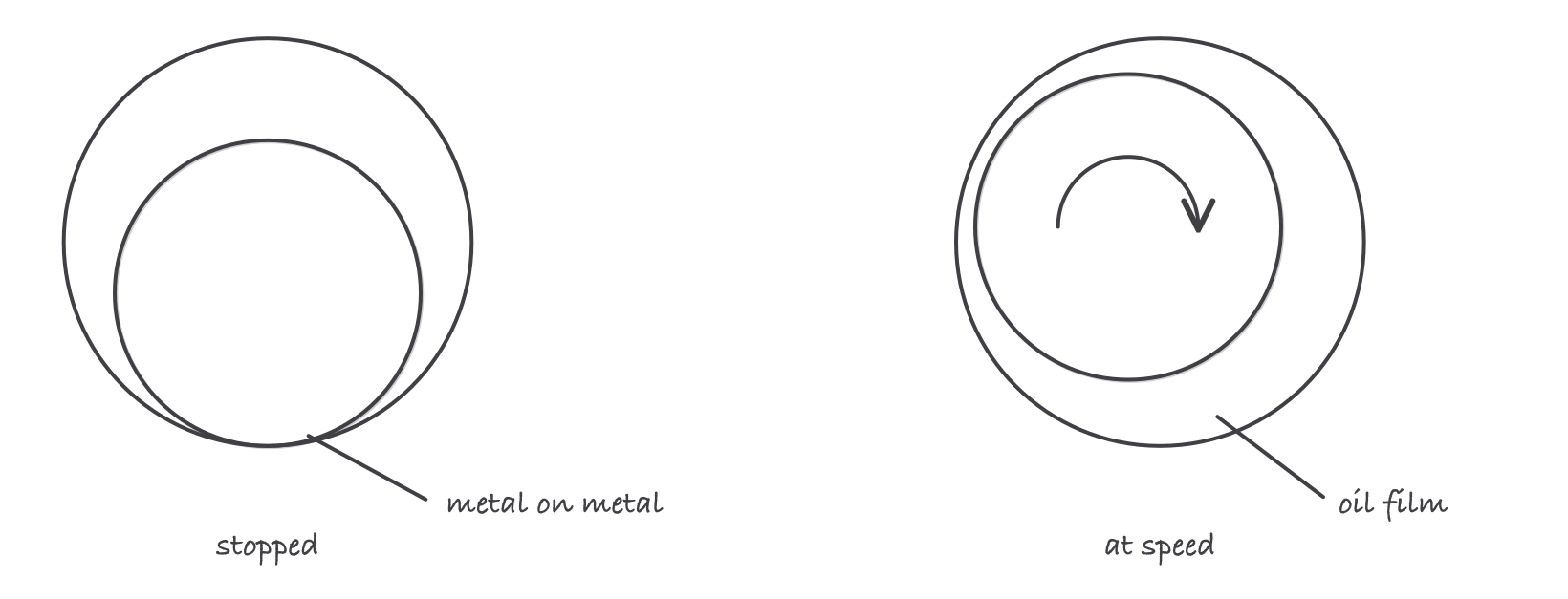
Stopped, the shaft sits on the shell; turning, it drags oil into a wedge and rides on the pressure that wedge creates
Oil, grease, and when each one belongs
Grease is oil held in a thickener, with additives, so most of a grease by weight is the base oil that does the lubricating. The thickener is a carrier that keeps the oil where you put it.
Use oil where you need heat carried away, where you can contain it (a gearbox, a circulating system, an oil-bath housing), and where speeds are high. Oil can be filtered, sampled, and analyzed while the machine runs, which makes it the better diagnostic medium as well.
Use grease where the lubricant has to stay put with no sump to hold it, where sealing against contamination matters, and where relubrication has to be quick. Most plant electric-motor and pillow-block bearings are grease lubricated for exactly those reasons.
Viscosity is the property that matters most
Viscosity is a fluid’s resistance to flowing, and it decides how thick a film the lubricant can build. Too thin and the film collapses under load. Too thick and the lubricant will not get into the contact, and the energy needed to shear it turns into heat.
Industrial oils are graded by ISO viscosity grade (VG), a number that states the oil’s kinematic viscosity in centistokes at 40 °C. ISO VG 46 is a hydraulic oil of about 46 cSt at 40 °C; ISO VG 320 is a heavy gear oil.
Viscosity falls as temperature rises, and it falls steeply. That is why a grade is only meaningful next to a temperature, and why viscosity index (a measure of how little an oil thins as it heats) is the second number worth knowing.
Grease consistency is graded separately, by NLGI number. NLGI 2 is the common plant grease, roughly the stiffness of smooth peanut butter, and it is a statement about consistency only, never about what the grease is made of or where it belongs.
Worked example: what “close enough” costs
A gearbox nameplate calls for ISO VG 320. The drum on the shelf is ISO VG 220, and someone argues it is close enough.
ISO VG numbers are viscosity at 40 °C in centistokes, so this is a comparison you can actually do.
220 cSt ÷ 320 cSt = 0.6875.
The substitute delivers about 69% of the specified viscosity, which is a 31% shortfall, at the reference temperature.
Now put it in the machine. Both oils thin further as the gearbox heats past 40 °C (which is 104 °F), so at a real running temperature both are far below their grade numbers, and the shortfall between them persists. The film that keeps the gear teeth apart is set by viscosity at operating temperature, and a third of it is not a rounding error.
Run the comparison the other way and the same logic applies. Filling that box with ISO VG 460 gives 460 ÷ 320 = 1.44, or 44% more viscosity than specified, which means more churning, more drag, and a box that runs hotter than the one the designer had in mind.
Contamination is the other half of the job
- New oil is not clean oil. Oil delivered in drums routinely needs filtering before it goes into a machine that has a cleanliness requirement.
- Water is as damaging as dirt. It attacks additive packages, promotes rust, and destroys the film. Milky oil is water.
- Breathers are the entry point most people ignore. A machine breathes as it heats and cools, and a plain vented cap breathes in whatever the room contains. Desiccant breathers exist because of this.
- Transfer containers must be dedicated and labeled. The open funnel that does every machine in the plant is a contamination distribution system.
- Filter carts do not fix a leak. Find where the dirt or water is entering, then clean up.
Regreasing without doing harm
More is not better. An over-packed bearing has to churn grease it cannot push out of the way, and churning generates heat, which cooks the grease, which stops it lubricating.
- Wipe the fitting before the gun touches it, every time.
- Check that the fitting actually feeds the bearing. A blocked fitting or a broken line means your grease went nowhere.
- Open the drain or relief plug on housings that have one, run the machine, and let the old grease purge.
- Apply slowly. Fast strokes can blow a bearing seal or a shield.
- Follow the machine’s specified quantity and interval, from its manual or the plant’s lubrication route, not from how the gun feels.
Then there is the rule that gathers all of it together: the right lubricant, in the right place, in the right amount, at the right time, by the right method. Miss any one of the five and the other four do not save you.
Where it bites
- Greases are not interchangeable. Thickener types can be incompatible, and mixing two incompatible greases can soften the mixture until it runs out of the bearing. Know what is in the housing before you add anything.
- Sealed bearings do not take grease. Pumping at a fitting near a sealed bearing pressurizes a cavity that never reaches the rolling elements.
- A grease gun develops enormous pressure. It is easy to unseat a shield or push a seal out of place with a few hard strokes.
- An oil-level sight glass reads correctly on a stopped, cooled machine. Reading a running machine gives you an answer about churn, not about level.
- Color is not a specification. Two greases of the same color can be built on different thickeners, and two of different colors can be identical.
- Lubrication failure looks like a bearing failure. The bearing gets replaced, the cause stays, and the same failure returns on the same schedule.
Exam relevance
Expect definitions to be tested precisely: viscosity against consistency, ISO VG against NLGI, boundary against hydrodynamic. The five rights show up as a list question. Beyond that, expect scenario questions where a bearing has failed and the answer lies in the lubricant (wrong grade, wrong quantity, water contamination, incompatible mixture) rather than in the bearing. The CMRT’s hands-on domains treat lubrication as core, and the NCCER Millwright curriculum places it early for the same reason it is placed early here.
Verified requirements
| Where | Expires | Renewal | Continuing education |
|---|---|---|---|
| United States (federal) | Yes | 3 years | 50 course hours per 3-year cycle, drawn from two or more of the recertification activity categories; recertification application due within 90 days of the expiration date or the exam must be retaken |
Information comes from issuing-authority sources. Confirm current rules, fees and eligibility with the authority before acting.