Qualifications · Industrial Maintenance
Vibration Analyst Certification and ISO 18436
Part of Maintenance Tech to CMRP · step 27 of 30 · next: MTBF, MTTR and Maintenance Metrics
In learning paths: Maintenance Tech to CMRP
Assumes you know: Predictive Maintenance: Vibration, Thermal, Oil
ISO 18436 is a standard, and a standard is not a certificate. ISO writes requirements; it does not assess people, sit anyone at an exam, or issue anything to a vibration analyst. Understanding that one sentence is what lets you read a certification offer accurately, and it is the thing the phrase “ISO certified vibration analyst” gets wrong.
*Learn the Trades is a free study resource. We are not a licensing body, an authorized training provider, or an exam administrator. Reading this page does not award any card, license, or certification. Always verify requirements with the issuing authority linked in the sources.*Why the structure matters
Condition monitoring is a field where the assessment of the person is the product. A vibration report is a judgment, not a measurement, and the plant acting on it has no independent way to check the judgment before it spends the outage. That is why the field standardized the requirements for competence, then standardized the bodies that assess it, rather than trying to standardize the analysts directly.
Knowing which layer you are looking at also tells you what to verify. A body’s claim about its own accreditation is checkable with the accreditation body. A phrase on a course flyer is not checkable with anyone.
Two parts, two jobs
ISO 18436-1:2021 carries the sector-specific requirements for certification bodies and for the certification process. It is the standard that governs the organization issuing your certificate: how it must be run, how it assesses candidates, and how the process has to work.
ISO 18436-2:2014 covers vibration condition monitoring and diagnostics. It specifies the training, experience and examination requirements for personnel, and it defines a four-category classification program. Conformity is certified in accordance with Part 1.
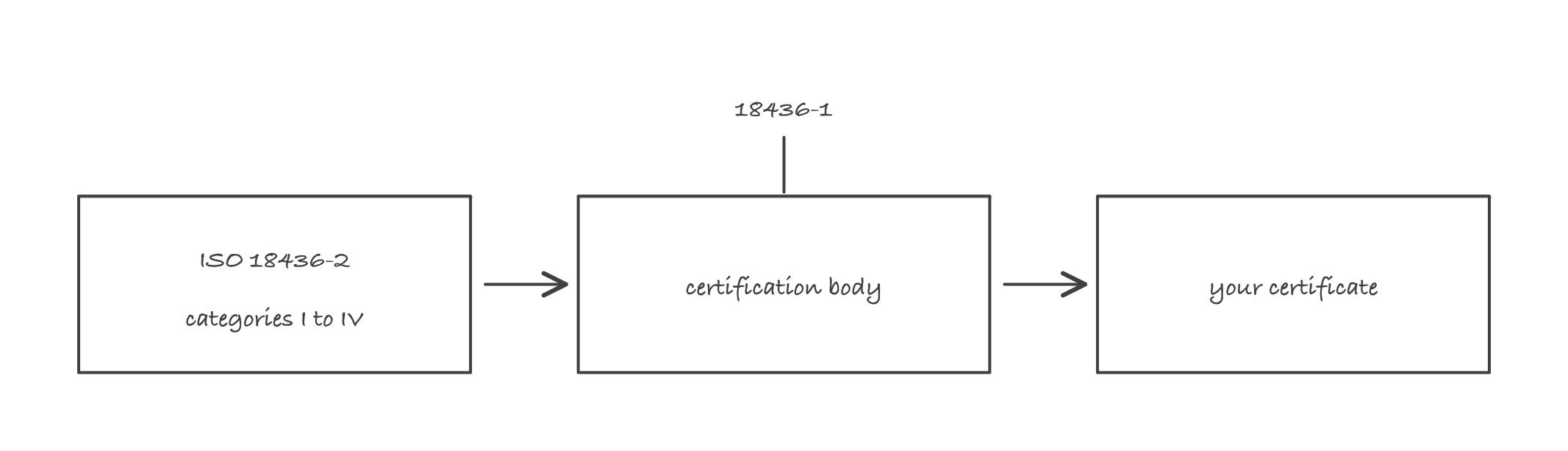
The standard defines the categories, a certification body does the certifying, and 18436-1 is the part that governs the body
The four categories
Part 2’s classification runs from Category I to Category IV, with the requirements for training, experience and examination increasing across them. Read them as assessed capability with vibration measurement and analysis, in ascending order of what the person is expected to be able to do independently.
Two cautions travel with the categories.
They are not job grades. A Category II analyst is not automatically a lead, a supervisor, or senior to a Category I colleague in the plant’s structure. The categories describe assessed capability against the standard, and your employer’s job ladder is a separate thing that may or may not reference them.
Vendor naming drifts. Training companies and certification bodies market their offerings with their own level names, some of which line up with the standard’s categories and some of which do not. When it matters (a contract requirement, a job posting, a customer specification), the question to ask is which category of ISO 18436-2 the certificate is issued against, not what the course was called.
Choosing where to certify
This page does not name certification bodies, and that is deliberate: which organizations currently hold accreditation to certify against ISO 18436-2 in the United States is not something we have verified, and an out-of-date name here would be worse than no name. Verify it yourself, in this order.
- Ask the body which standard and which category its certificate is issued against, in writing.
- Ask who accredits it, then confirm that with the accreditation body rather than with the certifier.
- Check the standard edition the certification references, because editions move.
- Check what your employer or customer actually requires. Some specifications name a category, some name a body, and some name neither and mean “someone who can do the work”.
Edition drift is live right now
Part 2 as published is ISO 18436-2:2014. A revision has been circulating as a draft international standard (ISO/DIS 18436-2:2025), which means the category requirements are under active review. Cite the edition explicitly whenever you write this down in a specification or a job description, and expect the reference to need updating. Part 1 is the 2021 edition.
Where it bites
- “ISO certified” is loose speech that fails under scrutiny. It is fine in the break room and wrong in a tender document, a resume that will be checked, or a procedure. Write “certified to ISO 18436-2, Category N, by X”.
- A training certificate is not a certification. Attending a course produces evidence of training, which is one of the inputs the standard requires. The certification is a separate assessment by a body.
- Certification does not substitute for the trend. A certified analyst reading a machine with no baseline and ragged intervals produces a certified guess. The measurement discipline in the predictive maintenance lesson is what makes the analysis worth anything.
- The categories describe vibration specifically. ISO 18436 has other parts covering other condition monitoring techniques. A vibration category says nothing about someone’s competence in thermography or oil analysis.