Learn · Industrial Maintenance
Preventive Maintenance
Part of Maintenance Tech to CMRP · step 22 of 30 · next: Predictive Maintenance: Vibration, Thermal, Oil
In learning paths: Maintenance Tech to CMRP
Preventive maintenance is work triggered by elapsed time or accumulated usage, performed whether or not anything is wrong. That last clause is the whole definition. You change the oil at 2,000 running hours because the clock said so, not because the oil told you it was finished.
*Learn the Trades is a free study resource. We are not a licensing body, an authorized training provider, or an exam administrator. Reading this page does not award any card, license, or certification. Always verify requirements with the issuing authority linked in the sources.*Why it matters on the job
PM is where most maintenance hours in a plant actually go, and it is the first reliability practice a technician owns end to end. It is also often done badly in a way nobody notices, because a PM program that is too frequent and a PM program that is too sparse both look identical on the schedule board: green.
Getting PM right is what buys the department time to do anything else. A plant that spends its week reacting to breakdowns never gets to the analysis that would stop them.
Where PM sits among the four strategies
The industry uses these words loosely. A plant that wants results cannot.
- Reactive maintenance runs the asset to failure and then repairs it. As a deliberate choice for cheap, non-critical, easily replaced equipment, this is legitimate and sometimes optimal. As a description of what keeps happening, it is a symptom.
- Preventive maintenance is triggered by time or usage. Interval-based, done on schedule, independent of condition.
- Predictive maintenance is triggered by measured condition. You change the oil because analysis says it is degrading. The next lesson covers it.
- Proactive maintenance attacks the cause rather than the symptom. If bearings keep failing, PM replaces them on a schedule, predictive catches them before they seize, and proactive finds out why they keep failing and removes the reason.
The four are layers rather than rivals. Nearly every plant runs all four at once, and the reliability question is which assets get which treatment.
What triggers a PM
Three trigger bases, and choosing between them is the first real decision in building a PM.
Calendar time. Monthly, quarterly, annually. Simple to schedule, simple to audit, and correct only when the wear that concerns you tracks the calendar rather than the work. Corrosion, seal aging, battery degradation and grease oxidation all keep calendar time.
Runtime. Operating hours, from a running-hour meter. This is the right basis for anything that wears while it runs (lubricant, bearings, belts, filters) on equipment whose duty varies.
Cycles or throughput. Strokes, starts, tons, units produced. For equipment where the damage is done by the event rather than by the running (contactors that wear per operation, press tooling, dies), the count is what matters.
Pick the trigger that tracks the damage mechanism. A gearbox on a machine that runs 12 hours some weeks and 140 others is on a runtime trigger, or it is on the wrong one.
Worked example: the same interval, two schedules
A conveyor gearbox has a 2,000 running-hour oil change interval.
Two shifts. The plant runs 16 hours a day, 5 days a week: 16 × 5 = 80 hours per week. The gearbox reaches 2,000 hours in 2,000 / 80 = 25 weeks. A semiannual calendar PM at 26 weeks lands one week late, close enough that nobody ever questions the calendar.
Three shifts. Demand rises and the plant goes to 24 hours a day, 6 days a week: 24 × 6 = 144 hours per week. Now 2,000 hours arrives in 2,000 / 144 = 13.9 weeks.
The calendar PM has not moved. It still comes due at week 26, by which time the gearbox has run 26 × 144 = 3,744 hours, which is 3,744 − 2,000 = 1,744 hours past the interval. The oil has served 87 percent longer than it was specified to (1,744 / 2,000 = 0.872), and the PM record shows completed on schedule for both years.
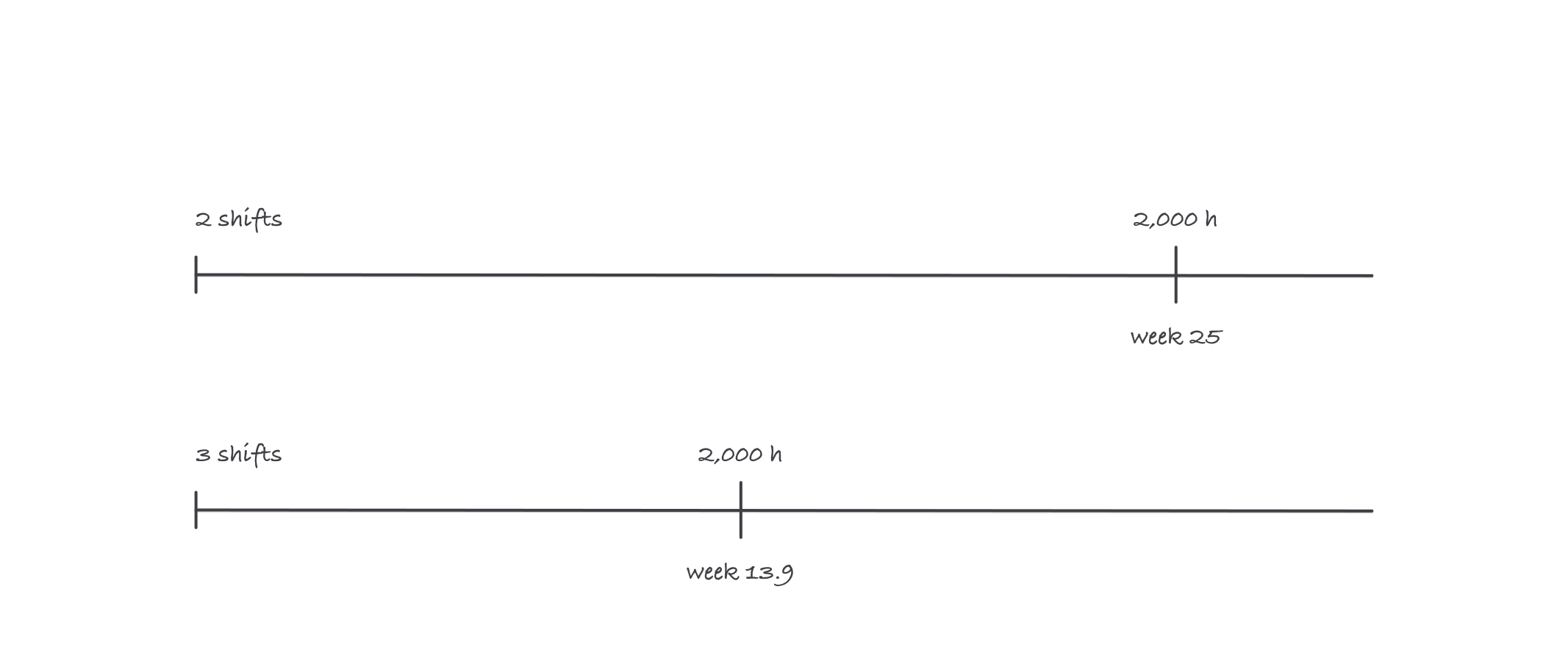
The interval never changed; the duty did, and a calendar trigger cannot see that
This is the argument for runtime triggers in one number. Nothing about the gearbox changed, nobody skipped a PM, and the oil ran almost twice the hours it was specified for.
Building a PM task list
A PM is not a visit; it is a defined list of tasks with a stated outcome for each. Write it so a technician who has never seen the machine can do it correctly and so a planner can tell afterward whether it was done.
- One task, one line, one verb. “Inspect gearbox” is not a task. “Check oil level at the sight glass, top up to the center line with ISO VG 220” is.
- Give every measurement a target and a limit. A reading with nowhere to write it is a reading nobody takes.
- Say what to do when it fails. The PM either fixes it inline (with the parts listed on the PM) or raises a corrective work order. Deciding that in the aisle wastes the finding.
- Include the safety steps. Which energy sources get isolated, which guards come off, what goes back before restart.
- Kill tasks that never find anything. A task that has been performed 40 times and never once produced a finding or an adjustment is either the wrong task or evidence the interval is far too short.
Where it bites
- Over-maintenance is a real failure mode. Every intervention is an opportunity to introduce a defect: contamination let into a clean system, a fastener under-torqued, a seal nicked on reassembly. Infant mortality after PM is common enough that “we serviced it last week” should raise suspicion rather than settle it.
- PM compliance measures the schedule, not the machine. One hundred percent compliance means the tasks were done on time. It says nothing about whether they were the right tasks.
- Intervals get inherited, not chosen. A large share of PM intervals in any plant came from an OEM manual written for an unknown duty cycle, or from someone’s judgment years ago. They are a starting point, and they are supposed to move as evidence arrives.
- PM does not suit every failure pattern. Time-based replacement helps when failure risk rises with age. Where failures arrive at random, replacing a good part on a schedule adds risk and cost without reducing failures. Knowing which pattern you face is what the reliability lessons after this one are for.
Verified requirements
| Where | Expires | Renewal | Continuing education |
|---|---|---|---|
| United States (federal) | Yes | 3 years | 50 course hours per 3-year cycle, drawn from two or more of the recertification activity categories; recertification application due within 90 days of the expiration date or the exam must be retaken |
Information comes from issuing-authority sources. Confirm current rules, fees and eligibility with the authority before acting.