Learn · Industrial Maintenance
Bearings: Types, Installation, Failure Modes
Part of Maintenance Tech to CMRP · step 5 of 30 · next: Shaft Alignment
In learning paths: Maintenance Tech to CMRP
A bearing holds a rotating shaft in position while letting it turn against as little friction as possible. That is the whole job. Every other thing about bearings (the types, the fits, the grease, the failure photographs) follows from that job and from one design decision: the bearing is the part the machine is built to wear out first, because it is the part you can change.
Why it matters on the job
Bearings are where mechanical problems announce themselves. Misalignment, unbalance, a slack belt, a flooded grease cavity, a stray current from a drive: none of those are bearing faults, and all of them kill bearings. So a bearing on your bench is two jobs at once. Fit the new one so it survives, and read the old one so you know what to fix before the new one goes the same way.
Two families
Rolling-element bearings put hardened balls or rollers between two hardened rings, so the shaft rolls rather than slides. Ball bearings suit high speed and moderate load. Roller bearings put a line of contact rather than a point on the race, so they carry more load at lower speed. Tapered rollers carry radial and thrust load together, which is why they show up in pairs on gearbox and wheel shafts.
Plain bearings (sleeve bearings, bushings, journal bearings) have no rolling parts at all. The shaft slides on a softer liner, separated by a film of oil that the shaft’s own rotation drags into the gap. They are quiet, they tolerate shock, and they have a hard requirement: the film must exist. A journal bearing with the oil off is metal on metal within seconds of the shaft turning.
Load direction picks the bearing
Radial load pushes across the shaft (belt pull, rotor weight, gear separating force). Thrust load pushes along the shaft (a fan pulling itself into the airstream, a helical gear, a pump impeller). A deep-groove ball bearing takes mostly radial load and a little thrust. A cylindrical roller bearing takes heavy radial load and essentially no thrust. A thrust bearing takes axial load and nothing else.
Almost every machine also needs one bearing to locate the shaft axially and one to float. The located bearing fixes the shaft’s position; the floating bearing lets the shaft grow as it heats. Clamp both ends and the shaft’s own thermal growth loads the bearings until they fail.
The ring that turns is the ring that grips
Which ring gets the tight fit is not preference: it follows from how the load rotates.
On a normal motor or pump, the shaft turns and the housing stands still. The load direction stays fixed relative to the housing and sweeps around the inner ring. That rotating load means the inner ring gets an interference fit on the shaft (tight enough that it will not creep) and the outer ring gets a slip fit in the housing (loose enough to float and to be pushed out). Reverse the situation (a stationary shaft with a rotating housing, like an idler pulley) and the fits reverse with it.
A ring that creeps polishes and then frets its seat. Once the shaft seat is worn undersize, no new bearing fixes it. That is a shaft repair.
Mounting without wrecking the bearing
Force must travel only through the ring being fitted. Pressing a bearing onto a shaft by pushing on the outer ring sends the whole mounting force through the balls and the races, which dents them. The dents are permanent. They are there before the machine has run a minute, and they show up later as vibration and spalling.
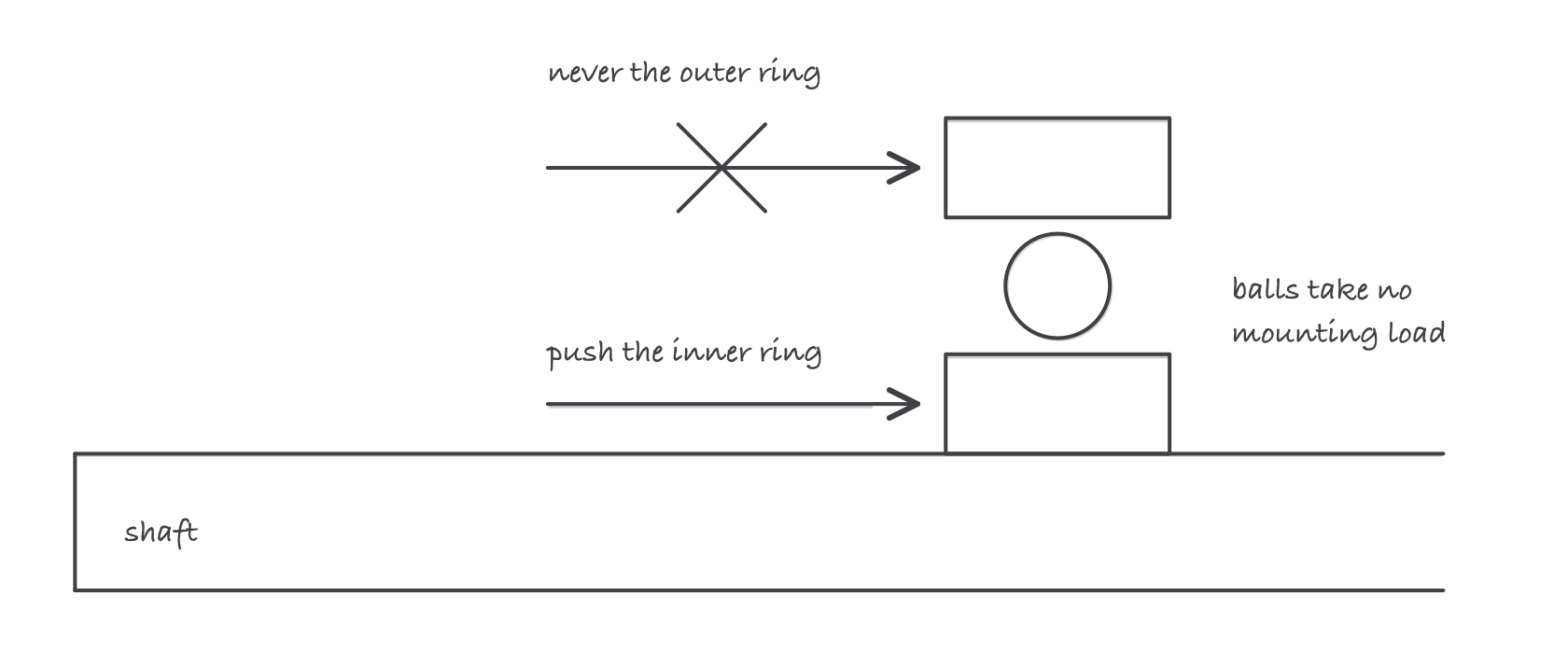
Force belongs on the ring you are fitting; anything that travels through the balls dents the races
Three ways to get a bearing on:
- Press it, using a fitting tool that bears on the inner ring face only, square to the shaft.
- Drive it with a bearing driver, never a hammer on the ring and never a drift on the seals or shields.
- Heat it, using an induction heater or an oil-free hot plate, so the bore grows and the bearing drops on with no force at all. This is the preferred method above roughly 3 in of bore, and it is the only method that puts zero load on the races.
Whatever you use, respect the bearing manufacturer’s maximum heating temperature. Above it you are changing the hardness of the rings, and a soft race fails quickly no matter how well it was fitted.
Worked example: heating a bearing onto a shaft
A bearing with a 3.500 in bore is going onto a shaft whose seat measures 3.5015 in, so the interference is 0.0015 in. You want about 0.003 in of clearance at the moment it drops on (double the interference), so it slides home before it grips.
Bearing steel expands about 0.0000065 in per inch of bore per degree F.
Growth per degree = 3.500 in × 0.0000065 = 0.00002275 in/°F.
Temperature rise needed = 0.003 in ÷ 0.00002275 in/°F = 132 °F.
The shop is at 70 °F, so the target is 70 + 132 = 202 °F. That is a real, ordinary number: comfortably inside any manufacturer’s heating limit, and reachable on an induction heater in a couple of minutes. Note what the arithmetic tells you about the other direction too. If someone heats that bearing to 400 °F “to be sure,” the extra heat buys nothing, because the bearing was already loose at 202 °F, and it may cost the ring its hardness.
Work the same numbers on a 1.000 in bore and the rise needed is 0.003 ÷ (1.000 × 0.0000065) = 462 °F, which is past any sensible limit. That is why small bearings get pressed and large ones get heated: the growth you can buy with heat scales with the bore.
Reading a failed bearing
Keep the failed bearing. Wipe it, do not wire-brush it, and look at the races under good light.
- Spalling (flakes lifting out of the race in a patch) is subsurface fatigue. Spread evenly around the race, it is a bearing that reached the end of its life. Concentrated in one band, it points at a load the bearing was not chosen for.
- Brinelling is evenly spaced dents at ball pitch. It comes from force driven through the rolling elements: a bad mounting press, or a shock load like a machine dropped off a forklift.
- False brinelling looks similar but is polished or rust-colored rather than dented, and it comes from tiny movements while the shaft is not turning (a spare motor sat on a vibrating floor, a machine trucked across the country).
- Fluting is a washboard pattern of fine parallel marks across the race, made by current passing through the bearing to ground. It is an electrical fault, not a mechanical one, and on a drive-fed motor it points straight at bearing currents.
- Discoloration (straw, blue, then black) is heat. Trace it to lubrication, load, or a fit so tight the internal clearance closed up.
- Scoring and dull, sanded-looking races are contamination. The grease did its job and carried grit through the contact.
Where it bites
- Most bearing failures start as lubrication failures. Wrong grease, wrong quantity, wrong interval, or mixed incompatible greases. Diagnose lubrication first.
- More grease is not more protection. An over-packed rolling-element bearing churns grease it cannot push aside, and churning makes heat. A cavity roughly one third to one half full is the usual target unless the manufacturer says otherwise.
- Never spin a bearing with shop air. It reaches speeds the unloaded bearing was never rated for, and it drives grit into the races.
- Internal clearance is a spec, not a feeling. A bearing that feels “nice and tight” in your hand may be a clearance class the machine was not built for, and clearance disappears again once the interference fit squeezes the inner ring.
- A new bearing on a worn shaft seat fails fast. Measure the seat and the housing bore before you order anything.
Exam relevance
Bearings sit in the hands-on domains of the CMRT and in the mechanical levels of the NCCER Millwright program, which carries separate modules for introducing bearings and for removing and installing them. Expect to be asked which ring takes the interference fit and why, which method suits which bearing size, and to name a failure pattern from a description or a photograph.
Verified requirements
| Where | Expires | Renewal | Continuing education |
|---|---|---|---|
| United States (federal) | Yes | 3 years | 50 course hours per 3-year cycle, drawn from two or more of the recertification activity categories; recertification application due within 90 days of the expiration date or the exam must be retaken |
Information comes from issuing-authority sources. Confirm current rules, fees and eligibility with the authority before acting.