Learn · Industrial Maintenance
Hydraulics Fundamentals
Part of Maintenance Tech to CMRP · step 11 of 30 · next: Hydraulic Components and Circuits
In learning paths: Maintenance Tech to CMRP
Hydraulics moves power by pushing on a confined liquid. Two quantities describe everything the system does: flow decides how fast the actuator moves, and pressure decides how hard it pushes. Keep those two separate in your head and hydraulic troubleshooting stops being mysterious.
Why it matters on the job
A hydraulic system is the highest energy density power transmission most plants have. A hose no thicker than your thumb can carry enough power to move a press platen, and it holds that energy whether or not the machine is running. That is what makes hydraulics both useful and dangerous, and it is why the people who work on it are expected to reason from principles rather than swap parts.
Pascal’s law and the two quantities
Pressure applied to a confined fluid is transmitted undiminished in every direction and acts with equal force on equal areas. That is Pascal’s law, and the whole trade is built on it.
From it comes the relationship you will use constantly:
Force = pressure × area
Rearranged, pressure = force ÷ area. A small piston at high pressure and a large piston at low pressure can produce the same force, and that trade is what a hydraulic system does for a living.
Now the sentence that matters: a pump does not make pressure; it makes flow. Pressure appears only when something resists that flow. Deadhead a pump against a closed valve and pressure climbs until the relief valve opens or something breaks. Let the same pump discharge to an open tank and the gauge reads almost nothing while the pump works exactly as hard at moving oil.
So: flow sets speed, resistance sets pressure. A cylinder that moves too slowly is a flow problem. A cylinder that will not push hard enough is a pressure problem. They are almost never the same fault.
The cylinder is where it becomes visible
A cylinder has two different working areas, and this is the first thing that surprises people.
Push oil into the cap end and it acts on the full bore area. Push oil into the rod end and it acts on the bore area minus the rod area, because the rod occupies part of the piston face. So the same cylinder at the same pressure pushes harder extending than it pulls retracting, and it moves faster retracting than extending, because a smaller area needs less oil to fill.
Worked example: a 3 in cylinder at 2,000 psi and 10 gpm
Bore 3.00 in, rod 1.50 in, system pressure 2,000 psi, flow 10 gpm.
Bore area. π ÷ 4 × 3.00² = 0.7854 × 9.00 = 7.07 in².
Rod area. π ÷ 4 × 1.50² = 0.7854 × 2.25 = 1.77 in². Annulus area = 7.07 − 1.77 = 5.30 in².
Extend force. 2,000 psi × 7.0686 in² = 14,137 lbf.
Retract force. 2,000 psi × 5.3014 in² = 10,603 lbf.
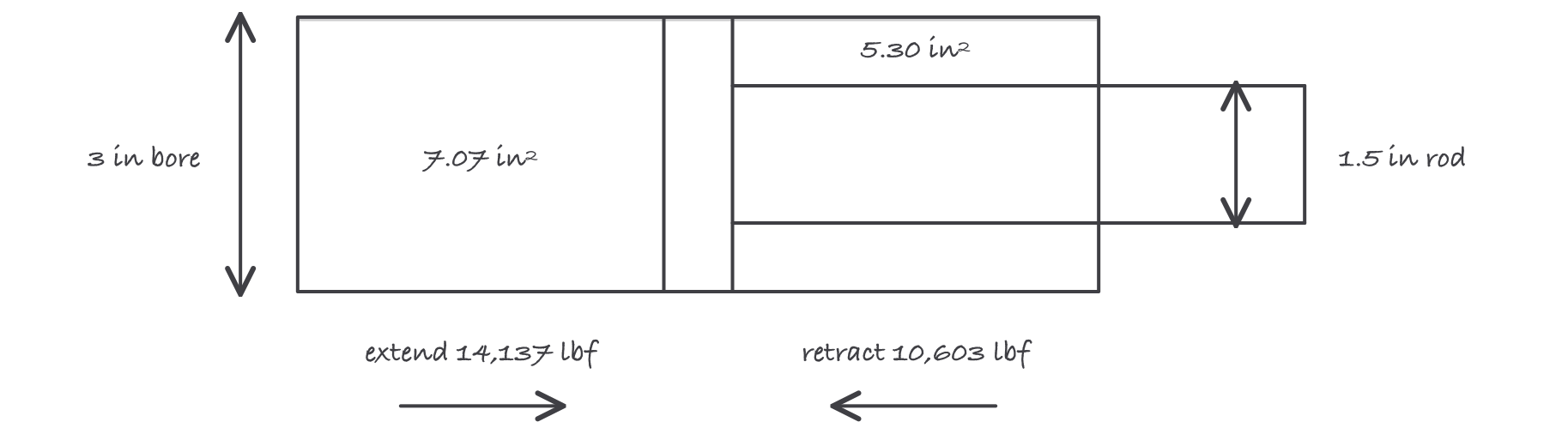
One cylinder, two working areas: the rod steals area on the way back, so retract is weaker and faster
Speeds. One US gallon is 231 in³, so 10 gpm is 10 × 231 = 2,310 in³/min.
Extend: 2,310 ÷ 7.0686 = 326.8 in/min, which is 326.8 ÷ 60 = 5.45 in/s.
Retract: 2,310 ÷ 5.3014 = 435.7 in/min, which is 7.26 in/s.
Check the ratios. 7.0686 ÷ 5.3014 = 1.333, and 435.7 ÷ 326.8 = 1.333 as well. Extending gives you a third more force and retracting gives you a third more speed, from exactly the same pump and the same relief setting. That is the trade, and it never goes away.
Power. Hydraulic horsepower is gpm × psi ÷ 1,714, so 10 × 2,000 ÷ 1,714 = 11.7 hp. That is the power leaving the pump, and every bit of it that does not do useful work leaves as heat in the oil.
Pressure drop is heat
Any time oil passes from a higher pressure to a lower one without moving a load, the energy becomes heat. A relief valve dumping at setting, a throttled flow control, a partly blocked filter, a leaking cylinder seal: each one is a heater.
That is why hot oil is a diagnostic finding rather than a complaint. A system running hotter than it used to is converting more of its power into heat, and the place it converts is the place your fault is.
The reservoir does four jobs
It holds enough oil for the system’s varying demand. It gives entrained air time to separate out. It lets dirt and water settle. And it dissipates heat through its walls. A reservoir that is too small, too full, or wrongly plumbed (return line dumping straight into the pump inlet) fails at all four at once.
Where it bites
- Pinhole leaks inject. Fluid at working pressure escaping through a tiny hole will pass through skin without a sound, and an injection injury is a surgical emergency that looks like a small puncture for the first hour. Never run a hand or a finger along a hose looking for a leak. Use cardboard, and use it on a system you have depressurized where you can.
- The system holds energy with the pump off. Accumulators, raised loads, and trapped pressure between a closed valve and a cylinder are all stored energy, and relieving stored energy is an explicit step in a hazardous energy control procedure for good reason.
- Contamination causes most hydraulic failures. Particles score pump surfaces, jam valve spools, and cut seals. Filtration and clean work practice are not housekeeping; they are the maintenance.
- Air is not oil. Entrained air makes a system spongy, noisy, and hot, and it damages pumps by imploding on the pressure side. A spongy cylinder is usually air, not a worn seal.
- A gauge reading tells you about resistance, not about the pump. A low gauge with a working pump can mean an open path to tank, not a failed pump.
- Never adjust a relief valve to fix a symptom. The relief setting is a protection limit set to the weakest component in the circuit.
Exam relevance
Expect Pascal’s law stated and applied, force from pressure and area, the cap-versus-rod area difference and its consequences for force and speed, the 231 in³ per gallon conversion, and the gpm × psi ÷ 1,714 horsepower relationship. Expect at least one question that hinges on the pump making flow rather than pressure. The NCCER Millwright and Industrial Maintenance programs both teach fluid power at this level before any component or circuit work.