Learn · Industrial Maintenance
Industrial Electrical for Mechanics
Part of Maintenance Tech to CMRP · step 17 of 30 · next: Motor Control Circuits
In learning paths: Maintenance Tech to CMRP
A mechanic needs enough electrical knowledge to stay alive around plant equipment, to prove a circuit is dead before touching the machine, to describe a fault accurately, and to know exactly where the work stops being theirs. That is the scope of this lesson, and the last item is as important as the first three.
Why it matters on the job
Almost no industrial machine is purely mechanical any more. The gearbox you came to fix is started by a contactor, protected by an overload, sequenced by a controller, and fed by a drive. You will open panels, follow conductors, and be asked whether the machine is safe to work on.
The knowledge here does not make you an electrician. It makes you a mechanic who does not get hurt, does not destroy evidence, and hands off cleanly with information the electrician can use.
The four quantities
Voltage is electrical pressure, in volts. Current is the rate of charge flow, in amperes. Resistance opposes current, in ohms. They are tied together by Ohm’s law:
E = I × R, voltage equals current times resistance.
Power in a resistive circuit is voltage times current, in watts. The consequence worth carrying is that power dissipated in an unwanted resistance (a corroded contact, a loose lug, a damaged conductor) shows up as heat exactly where the resistance is.
Plant power in the United States is usually three-phase alternating current, commonly 480 V for motor loads, with control circuits run at a lower voltage (often 120 V) from a control transformer inside the same enclosure. Three phase matters to you because it is what motors run on, and because losing one of the three phases is a specific and destructive fault called single phasing.
Worked example: what a bad contact costs
A 120 V control circuit carries 5.0 A through a contactor’s auxiliary contact. The contact is dirty and pitted, and you measure 3.2 V across it while it is closed and carrying current.
Contact resistance. R = E ÷ I = 3.2 V ÷ 5.0 A = 0.64 Ω. A healthy contact measures in the thousandths of an ohm, so this is hundreds of times what it should be.
Power dissipated in the contact. P = E × I = 3.2 V × 5.0 A = 16 W, all of it inside a part the size of a fingernail, with nowhere to go but into the contact and the surrounding plastic.
What the load sees. 120 V − 3.2 V = 116.8 V, which is a 2.7% shortfall (3.2 ÷ 120 = 0.0267).
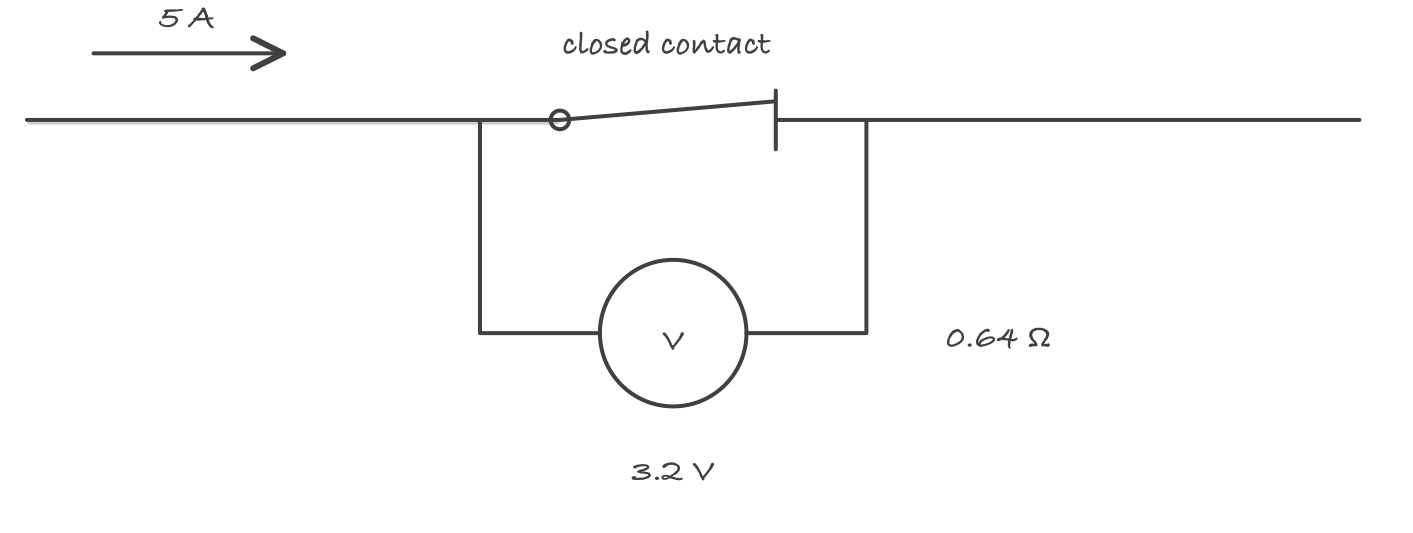
A voltmeter across a closed contact should read close to zero; whatever it does read is heat being made right there
That is the whole method in one measurement. A closed contact, a closed switch, a good connection, a healthy conductor: all of them should show near zero volts across them while carrying current. Any voltage you find across something that is supposed to be a connection is telling you where the circuit is failing, and it gets worse as the heat oxidizes the surfaces further.
Notice also that the fault is invisible with the circuit off. Measure resistance on a dead circuit and 0.64 Ω against a low-resistance meter range can look like nothing. Voltage drop under load is what finds it.
Verification is the skill that matters most
OSHA’s energy control standard, 29 CFR 1910.147, requires the authorized employee to verify that isolation and de-energization of the machine have actually been accomplished before servicing begins. Verify means test, not look.
The way it is done with a meter is the live-dead-live check.
- Live. Test your meter on a source you know is energized, at a similar voltage. This proves the meter, the leads, and the battery.
- Dead. Test the conductors you are about to work on, every conductor to ground and every conductor to every other conductor. All should read zero.
- Live again. Return to the known source. If the meter still reads it, your dead reading was real. If the meter has failed between steps, this is where you find out.
A non-contact voltage tester is a helpful indicator, not proof. It can be fooled by induced voltage and it can fail silently. Use it to find where to look, then prove it with a meter.
Authorized, affected, and the line you do not cross
1910.147 draws a distinction that decides who does what. An authorized employee is one who locks or tags out equipment in order to perform servicing or maintenance on it. An affected employee is one whose job requires operating or using the machine that is being serviced, or working in the area where it is.
The operator who runs the line is an affected employee. They are instructed in the purpose and use of the procedure; they do not apply locks. Being generally trained in lockout does not make someone authorized for a given machine’s procedure.
Separately from that, energized electrical work has its own qualification rules, its own written safety program, and its own personal protective equipment, and those are set by your employer’s electrical safety program. Testing for voltage on an energized conductor is energized work. If you are not qualified for it under your plant’s program, the correct action is to stop and get someone who is.
What a mechanic should be able to read
- A motor nameplate. Voltage and phase, full-load amps, horsepower, rpm, frame size, service factor, insulation class, and enclosure type. Every one of those matters for a replacement, and full-load amps is the number you compare a clamp-meter reading against.
- A disconnect and its lockout point. Which device isolates which machine, whether the control circuit is fed from the same source or from somewhere else, and where the lock goes.
- An overload relay’s setting and whether it matches the motor’s nameplate.
- A simple ladder diagram, well enough to say which rung is not making up. The next lesson takes that further.
Where it bites
- A machine can have more than one energy source. A control circuit fed from a separate panel stays live when the motor disconnect is open. Stored energy in a capacitor bank or a drive’s DC bus stays live after the disconnect opens. Neither is found by assumption.
- Zero volts on a meter set to the wrong function is meaningless. Check the function and the range before you trust a zero.
- Use a meter rated for the environment. Meter category ratings exist because a meter that survives a bench cannot necessarily survive a fault at a plant service, and the failure mode is an arc in your hand.
- Never defeat an interlock to test something. The interlock is there because the manufacturer or the plant identified a hazard you are about to stand in.
- Do not troubleshoot by replacing fuses. A fuse that blows again is a fault report, and the second fuse tells you nothing the first did not.
- Record what you found before you change it. Contact positions, switch settings, and terminal numbers get forgotten in the ten minutes it takes to fetch a part.
Exam relevance
Expect Ohm’s law applied to practical circuits, voltage-drop reasoning, the live-dead-live verification sequence, and the authorized-versus-affected distinction as 1910.147 defines it. The NCCER Industrial Maintenance program builds its electrical levels on exactly this foundation before motor controls and PLCs. The question that catches people is the verification one, because “I opened the disconnect” is not a verification and the standard says so.