Learn · Industrial Maintenance
Rigging for Machinery Installation
Part of Maintenance Tech to CMRP · step 15 of 30 · next: Pumps, Mechanical Seals and Packing
In learning paths: Maintenance Tech to CMRP
Rigging is how a machine that weighs more than a car gets from the truck to its foundation without hurting anyone or damaging itself. Alongside precision alignment it is the skill that defines the millwright trade, and it is the one where the mathematics is unforgiving: a sling angle that looks fine can be carrying twice the load you assumed.
Why it matters on the job
Everything this trade installs has to be lifted, and much of what it repairs has to be lifted twice. Gearboxes come out and go back, motors get changed, pump casings get split, and turbine covers get removed to the floor and returned.
Rigging is also the part of the work where a mistake is immediate and public. There is no partial failure of a lift. That is why the discipline is procedural rather than intuitive: you calculate, you inspect, you plan the path, and only then do you take the strain.
Know the weight before anything else
Every lift starts with a number, and the number comes from a source rather than from an estimate.
- The nameplate or the general arrangement drawing is the first place to look. Machine weights are usually published.
- Calculate it from material and dimensions when nothing is published, and account for what is inside: a gearbox full of oil, a tank with residual product, a casing packed with scale.
- Add the rigging. Slings, spreader beams, shackles and below-the-hook devices all hang from the same hook and all count against its capacity.
A load nobody weighed is a load nobody rigged. If the weight cannot be established, that is a finding to escalate rather than a reason to try it gently.
Center of gravity decides the behavior
The hook has to end up over the load’s center of gravity, or the load will rotate until it is. That rotation happens the instant the load leaves the ground, which is why the first inch of a lift is where the information is.
Machines are rarely symmetrical. A motor on one end, a gearbox on the other, a flange on one side: the center of gravity sits toward the heavy end and rarely at the geometric middle. Sling lengths get adjusted so the load hangs level, and a trial lift of an inch or two tells you whether you got it right while the consequences are still small.
Attachment points are not negotiable either. Use the lifting lugs the manufacturer provided. Lugs on a component (a motor’s own eyebolt, a gearbox cover’s lifting point) are frequently rated for that component alone and not for the assembly it is bolted to.
Sling angle is the one that catches people
Two slings from one hook down to two points on a load form a triangle, and each leg carries more than its share of the weight. The flatter the angle, the more it carries, and it rises fast.
The reason is geometry. Each leg supports its share of the vertical load, but the leg is not vertical. Only the vertical component of the leg’s tension holds the load up, so the tension has to grow to keep that component the same. With the angle measured from horizontal, the leg tension is the vertical share divided by the sine of that angle.
Worked example: 4,000 pounds on two legs
A 4,000 lb gearbox, lifted on a two-leg bridle with both legs the same length and the load hanging level. Each leg carries a vertical share of 4,000 / 2 = 2,000 lb.
At 60 degrees from horizontal. sin 60° = 0.8660, so each leg carries 2,000 / 0.8660 = 2,309 lb. That is already 15 percent more than the vertical share.
At 45 degrees. sin 45° = 0.7071, so each leg carries 2,000 / 0.7071 = 2,828 lb.
At 30 degrees. sin 30° = 0.5000, so each leg carries 2,000 / 0.5000 = 4,000 lb. Each sling is now carrying the entire weight of the load, on its own.
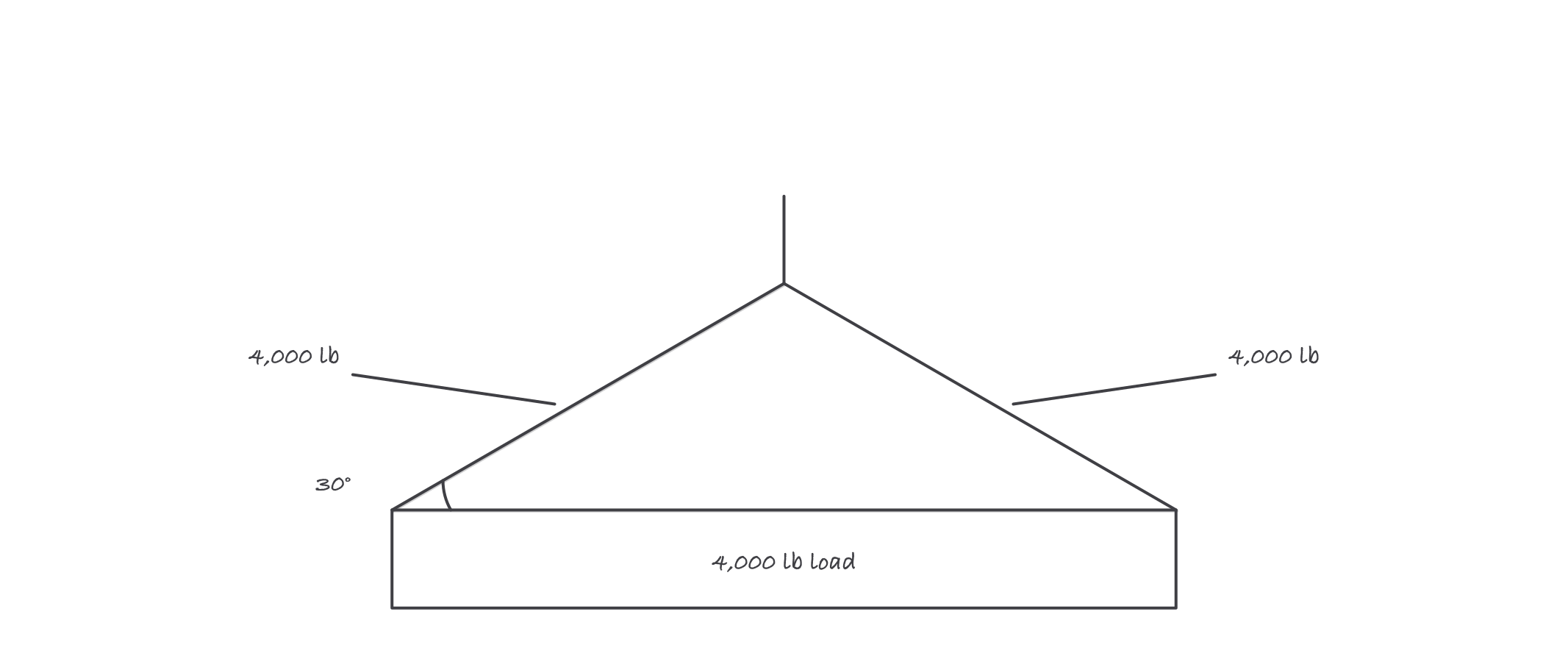
At 30 degrees each leg carries the whole load, and nothing about the lift looks different from the floor
Compare the ends: 4,000 / 2,309 = 1.73, so going from a 60 degree angle to a 30 degree angle multiplies the tension in every leg by 1.73 without adding an ounce to the load. Two slings rated comfortably for the job at 60 degrees can be overloaded at 30, and the only visible difference is that the legs look flatter.
The fix is longer slings, or a spreader beam that brings the legs back toward vertical. Both cost more headroom, which is why the shortcut is tempting and why this is the calculation to do before the crane arrives rather than under it.
Slings and hitches
Three basic hitches, and the choice changes the sling’s rated capacity.
Vertical hitch: the sling runs straight from hook to attachment point. Simplest, and the reference case for the sling’s rating.
Choker hitch: the sling passes around the load and back through itself, gripping it. Useful for anything without lifting points, and it reduces the sling’s rated capacity because of the bend at the choke. The reduction is printed on the sling tag and in the manufacturer’s chart, so read it there rather than remembering a figure.
Basket hitch: the sling cradles the load with both eyes on the hook. Capacity depends on the angle of the legs, which puts you back in the calculation above.
Whatever the hitch, protect the sling from the load. Sharp corners cut synthetic slings and damage wire rope, so softeners or corner protectors go on before the strain, not after someone notices the fibers.
Where it bites
- The angle is measured from horizontal, and people quote it from vertical. Two riggers can describe the same sling as 30 degrees and 60 degrees and both believe they agree. State the reference every time.
- Slings get inspected before every use, not periodically. Cuts, abrasion, broken wires, heat damage, distorted or illegible tags. A sling with no readable tag has no rated capacity and comes out of service.
- Nobody stands under the load or in the swing path. Use tag lines to control rotation from outside, and plan the route before the lift so nobody has to walk under it to reach the controls.
- Shock loading multiplies everything. Snatching a load, or letting it drop and catch, produces forces well above the static weight. Take up the slack slowly and take the strain smoothly.
- The lift plan includes setting it down. Where the load lands, what it lands on, whether the floor takes the point load, and how the slings come out from under it once it is down. Loads have been damaged by a rigger who thought the job ended at the top of the lift.