Learn · Industrial Maintenance
Confined Space Entry for Maintenance
Part of Maintenance Tech to CMRP · step 4 of 30 · next: Bearings: Types, Installation, Failure Modes
In learning paths: Maintenance Tech to CMRP
Assumes you know: Lockout/Tagout: Controlling Hazardous Energy
Confined space entry is governed by two separate findings, and getting the order right is most of the skill. First: is this a confined space at all? Second, and only if the answer is yes: is it a permit-required confined space? OSHA sets both tests in 29 CFR 1910.146, and collapsing them into one question is how crews end up either treating a tool crib like a reactor vessel or walking into a tank on a hunch.
Why it matters on the job
Maintenance is the reason people enter these spaces. Nobody climbs into a mixing tank to make product. They climb in to change an agitator seal, chase a leak, replace liner plates, or clean out what the process left behind.
Confined space incidents also have a signature that every technician should know: the rescuer dies too. A worker goes down inside, a colleague goes in after them without air, and the count of casualties rises. That is the reason the roles in this standard are written as duties rather than suggestions.
Gate one: is it a confined space
A space is a confined space when all three of these are true.
- It is large enough and so configured that an employee can bodily enter and perform assigned work.
- It has limited or restricted means of entry or exit, such as a manway, a hatch, a top opening reached by ladder, or a narrow crawl.
- It is not designed for continuous employee occupancy.
All three, together. A room with a normal door that people work in all day fails the second and third tests, whatever else is wrong with it.
Gate two: does it require a permit
A confined space becomes a permit-required confined space when it has one or more of these characteristics.
- It contains or has the potential to contain a hazardous atmosphere.
- It contains a material with the potential for engulfing an entrant.
- It has an internal configuration that could trap or asphyxiate an entrant, such as inwardly converging walls or a floor that slopes down and tapers into a smaller cross section.
- It contains any other recognized serious safety or health hazard.
One is enough. And the word to hold on to in the first characteristic is potential: a tank that is clean and open today still has the potential to contain a hazardous atmosphere if the process that fills it can be lined up to it.
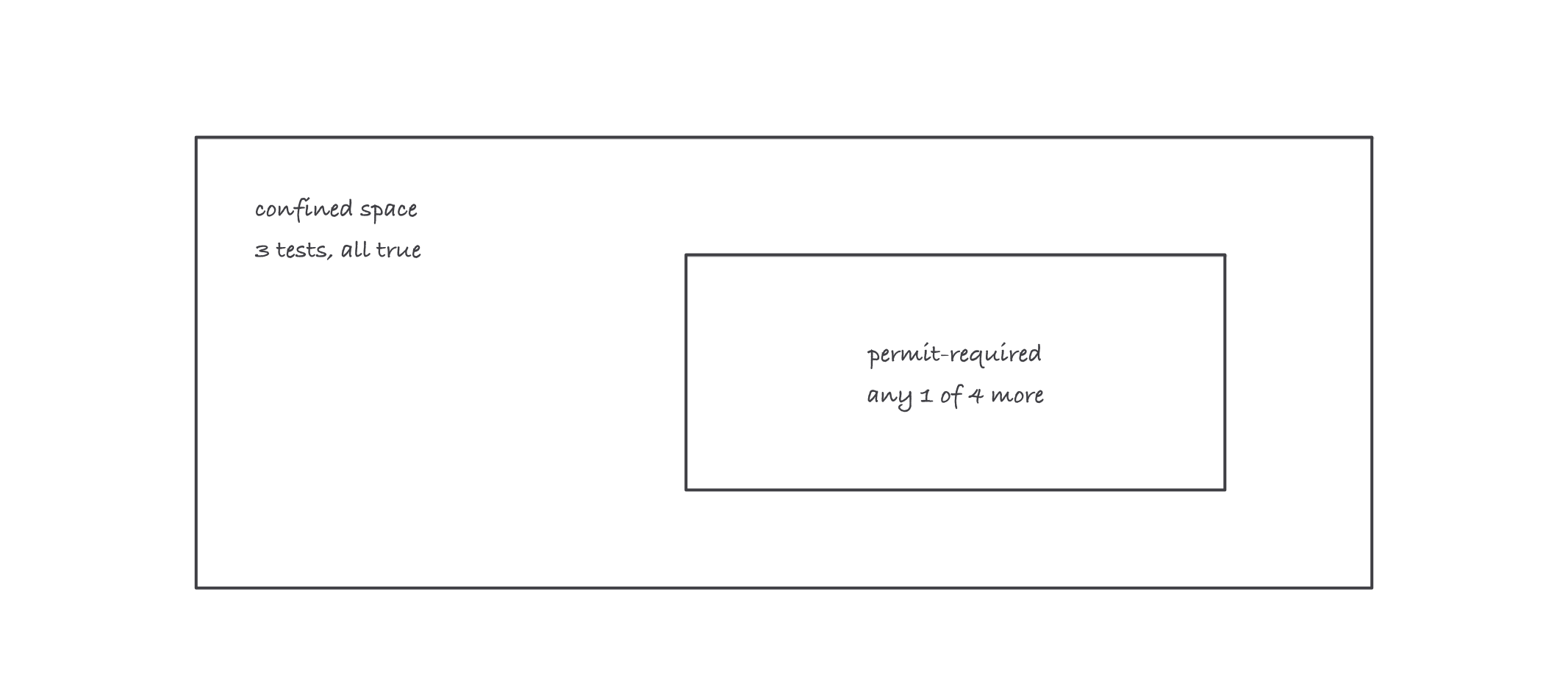
Every permit-required space is a confined space; not every confined space needs a permit
Worked example: three spaces on one shift
Walk three real maintenance locations through both gates and watch the answers diverge.
A 12,000 gallon mixing tank, entered through a top manway. Gate one: big enough to enter, restricted access through the manway, not designed for occupancy. Yes on all three, so it is a confined space. Gate two: residual product in the bottom is an engulfment hazard, the discharge cone tapers to a smaller cross section, and the vessel can be lined up to process piping that could deliver a hazardous atmosphere. Three of the four characteristics, and any one would have been enough. This is a permit-required confined space.
A below-grade pump pit, 5 feet deep, fixed ladder. Gate one: yes on all three. Gate two now depends on evaluation rather than on the shape of the hole. Heavier-than-air vapors collect in low spots, and any process line that can leak into the pit brings atmospheric potential with it. If the evaluation finds that potential, or finds another recognized serious hazard, it is permit-required. If the evaluation genuinely finds none of the four, it is a confined space that is not permit-required, which is a real category with its own lighter requirements.
A walk-in electrical room. Gate one fails: it has a standard door, and people occupy it. It is not a confined space, and none of this standard applies. It is still a room full of ways to be hurt, governed by the electrical safety rules instead.
The lesson from the three: the pit is the one that gets people, because it is shallow, familiar, and looks like a hole rather than a hazard.
The three roles
Authorized entrants go in. They know the hazards, use the assigned equipment, communicate with the attendant, and exit immediately on an order to evacuate, on recognizing a warning sign, or on any alarm.
The attendant stays outside, monitors the entrants and conditions, keeps an accurate count of who is inside, orders evacuation when required, and summons rescue. The attendant does not leave the post, does not enter the space to attempt rescue, and is not a spare pair of hands for the job. Someone standing nearby watching the work is not an attendant.
The entry supervisor authorizes the entry, verifies that the permit is complete and the tests have been done, and terminates the entry when the work is finished or conditions change.
The employer’s written permit space program is what makes those roles real: it identifies the spaces, sets the entry procedures, and defines the permit that authorizes each entry.
Testing has an order
Atmospheric testing is done in a fixed sequence, and the order is technical rather than administrative.
- Oxygen first. Most combustible gas sensors need oxygen to read correctly, so an oxygen-deficient atmosphere can make the next reading meaningless.
- Combustible gases and vapors second.
- Toxic contaminants third.
Test before entry, and continue or repeat testing as conditions require. The standard defines the acceptable ranges; read them from the standard and from your instrument’s calibration rather than from memory.
Where it bites
- The two gates get collapsed. Crews who treat every confined space as permit-required drown in paperwork and start cutting corners; crews who treat none of them that way lose people. Make both findings, in order, and write down the second one.
- Lockout is a prerequisite, not an alternative. Everything that can move, fill, heat or pressurize the space gets isolated before anyone enters, and a line that feeds the space usually needs blanking or blinding rather than a closed valve. A valve can be opened.
- Non-entry rescue is the plan that works. Retrieval systems (a full-body harness, a line, and a mechanical device at the opening) let an attendant get someone out without entering. Rig it before entry, because it cannot be rigged during.
- Conditions change while you are inside. Welding, solvent cleaning, coating and grinding all alter the atmosphere the entry was approved against. The permit covers the work described on it.
- The space is permit-required because of what it can contain. An empty, clean, dry tank is still a permit-required confined space if the process can put something in it. Emptiness on a Tuesday is not a reclassification.