Learn · Industrial Maintenance
Machine Guarding
Part of Maintenance Tech to CMRP · step 3 of 30 · next: Confined Space Entry for Maintenance
In learning paths: Maintenance Tech to CMRP
Assumes you know: Lockout/Tagout: Controlling Hazardous Energy
A machine guard is a physical barrier between a person and a machine part that can injure them. OSHA states the principle plainly: any machine part, function, or process that may cause injury must be safeguarded. The general requirement lives at 29 CFR 1910.212, and the specific hazard behind it is amputation, which is why OSHA runs a National Emphasis Program on amputations in manufacturing.
Guarding sits downstream of lockout/tagout in this curriculum for a reason. Guards protect people from a running machine. Lockout protects you from a machine you have opened up. Confuse the two and you will rely on a guard while working inside one.
Why it matters on the job
Maintenance is the trade that removes guards. Operators work outside them, engineers specify them, and technicians take them off to reach the thing that needs fixing. That makes the maintenance department the last hands on nearly every guard in the building, and the reinstalled guard is the one that either goes back correctly or does not go back at all.
A machine that ran for six years with a guard and now runs without one has not become slightly less safe. It has become an unguarded machine.
What has to be guarded
1910.212 puts the point of operation first: the point of operation of machines whose operation exposes an employee to injury shall be guarded. The standard names methods rather than products, including barrier guards, two-hand tripping devices, and electronic safety devices, and it requires that the guarding be in conformity with any appropriate standards or, absent those, be designed and constructed to prevent the operator having any part of the body in the danger zone during the operating cycle.
Two structural rules follow, and both bear directly on maintenance work.
Guards are affixed to the machine where possible. A guard that leans against the frame, or hangs from a zip tie, or sits on the floor beside the machine, is not affixed. Where attaching to the machine is not possible, the guard is secured elsewhere, but the default is that it is fastened to the equipment it protects.
Fixed machinery is anchored. Machines designed for a fixed location are secured to prevent them walking or moving in service. A machine that creeps across the floor takes its guarding geometry with it.
The standard also carries two specific cases worth memorizing, because they come up constantly and both are easy to check with a tape measure. Revolving drums, barrels, and containers have to be guarded by an enclosure interlocked with the drive, so the machine cannot revolve unless the enclosure is in place. And where a fan blade is less than 7 feet above the floor or working level, the guard openings are limited to a half inch.
Point of operation and power transmission are different hazards
“Guard the moving parts” is advice that says nothing. The standard separates two hazard classes, and each has its own rules and its own guarding logic.
The point of operation is where the machine does work on the material: the die closing, the blade cutting, the rolls pinching, the auger conveying. It is hazardous by design, it has to stay accessible for the process to run, and the guarding problem is how to admit material while excluding hands.
Power transmission apparatus is everything that gets power from the driver to the point of operation: shafts, couplings, belts, chains, sprockets, gears, flywheels. It does not need to be accessible at all in normal operation, so the guarding answer is usually an enclosure that stays shut.
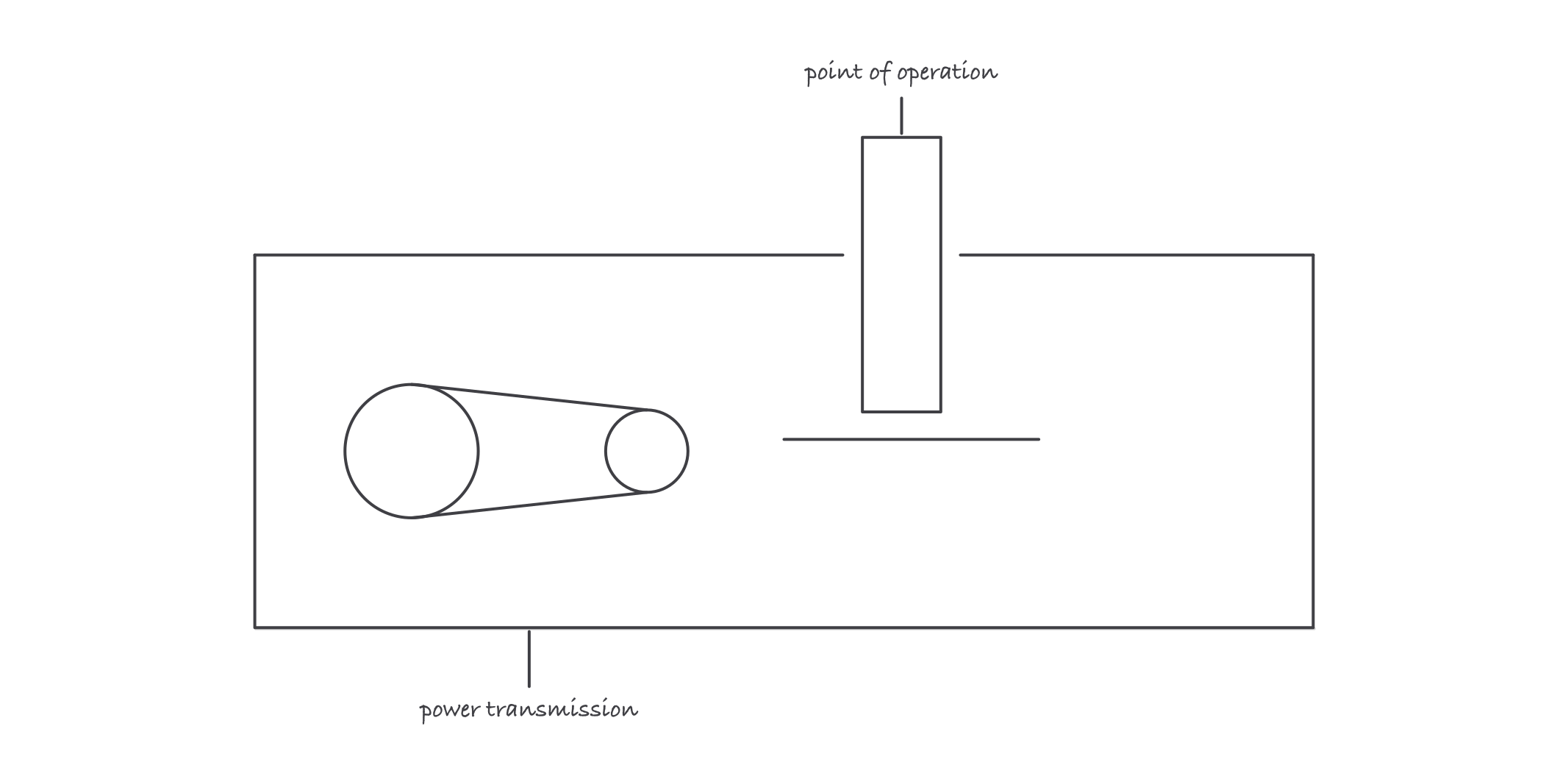
One machine, two hazard classes: the drive that delivers power, and the place the machine does its work
The distinction matters when you are diagnosing a gap. A missing belt guard and an inadequate point-of-operation guard are both violations, and they get fixed in completely different ways.
Worked example: checking a fan guard
A floor-mounted pedestal fan blows across an assembly bench. Measure the height of the blade centerline above the working level: 5 ft 6 in, which is 66 in. The threshold in the standard is 7 ft, which is 84 in. At 66 in the blade sits 18 in below the threshold, so the half-inch opening limit applies.
Now measure the guard. The wire cage has a 3/4 in mesh. Converted to a decimal, 0.75 in against a limit of 0.50 in: the openings are 50 percent larger than the standard allows, so this guard does not comply at this mounting height. Two ways out: fit a guard with openings of a half inch or less, or raise the fan so the blade sits at or above 7 ft. Raising it is often the cheaper fix, and it is the one that survives someone swapping the cage later.
Note what the check did not depend on: how fast the fan turns, how long it has been there, or whether anyone has been hurt by it.
Restoring a guard after service
The reinstallation is part of the job, not the cleanup after it. Work it as a sequence while your locks are still on.
- Reinstall the guard with the original fasteners, in every hole the design provides.
- Confirm any interlock actually functions, meaning the machine will not run with the guard open, tested rather than assumed.
- Check the clearances the guard was designed to hold, because a guard refitted 10 mm out of position can leave a reach-in gap that was not there before.
- Remove locks and return the machine to service only after the guard is on and proved.
If a guard cannot go back (broken, missing, does not fit after a repair), the machine does not run. Escalating that is part of the work.
Where it bites
- The guard removed for service is this trade’s signature failure. It comes off with the right intentions, the job runs long, the shift changes, and the machine goes back to production naked. Track guards on the work order.
- A guard is a state, not a purchase. The plant that bought guards for every machine three years ago does not therefore have guarded machines today. Only a look at the equipment answers that question.
- A guard is not a substitute for lockout. An interlocked enclosure stops the machine when you open it. It does not isolate the machine, relieve stored energy, or stop someone restarting it. Inside the machine, the lock protects you.
- Improvised guards fail the fastening rule. Sheet metal wired across an opening may block a hand and still be a violation, because it is not affixed and it is not designed for the duty.
- Guarding gaps cluster where two machines meet. Conveyor-to-machine transfers, in-running nips between rolls, and the space behind a machine nobody walks into are where the unguarded parts survive audits.