Learn · Industrial Maintenance
Belt and Chain Drives
Part of Maintenance Tech to CMRP · step 7 of 30 · next: Gearboxes
In learning paths: Maintenance Tech to CMRP
Assumes you know: Bearings: Types, Installation, Failure Modes
A belt drive moves power by friction, a chain drive moves it by positive engagement, and every difference between the two comes from that one distinction. A belt can slip, so it protects the machine and loses speed accuracy. A chain cannot slip, so it holds exact ratio and passes every shock straight through.
Why it matters on the job
Belt and chain drives are everywhere in a plant, because they are cheap, exposed, and adjustable, which means anyone with a wrench can get at them. Three settings decide how long they last (tension, alignment, and the condition of the sheave grooves or sprocket teeth), and each one leaves a distinct mark on the failed belt. Learn to read those marks and a two-minute look at the old belt tells you what to fix before you fit the new one.
Belt types
V-belts wedge into a groove, and the wedging is what multiplies friction. Classical sections (A, B, C, D) and narrow sections (3V, 5V, 8V) cover most plant drives; narrow sections carry more power for the same width. A banded belt is several V-belts joined by a common top, used where single belts jump out of the grooves.
Synchronous belts (also called timing belts) have molded teeth that engage matching grooves in the pulley. They cannot slip, so they hold ratio like a chain while running clean and quiet. They also have no tolerance for misalignment and no forgiveness for shock.
Flat belts survive on conveyors and a few old line-shaft drives, where the belt itself is the conveying surface.
The critical fact about a V-belt is where it grips. It rides on the two side walls of the groove, never on the bottom. A belt sitting down on the groove bottom has either worn or the sheave has, and in both cases the drive is slipping and there is nothing to adjust.
Chain drives
Roller chain runs on sprocket teeth, so speed ratio is exact and there is no slip to lose. ANSI standard chain is numbered by pitch: the first digits give the pitch in eighths of an inch, so a #40 chain is 1/2 in pitch, #60 is 3/4 in, and #80 is 1 in. That single rule lets you identify chain from the number stamped on the side plate.
Chain does not stretch. What people call stretch is wear in the pin and bushing joints, which lengthens the effective pitch and makes the chain climb the sprocket teeth. Measure a length of the worn chain against the same number of pitches new. Manufacturers set a wear limit (commonly around 3% elongation for a chain running on a sprocket with many teeth, less for large sprockets), and past it the chain rides high, jumps, and destroys the sprockets.
Lubrication has to reach inside the joints, not only the outside of the plates. A chain shining with oil on the outside and dry between pin and bushing is an unlubricated chain.
Tension: the number most people guess
Too loose and a V-belt slips, and slipping generates heat, which glazes the belt sidewalls, which lowers friction, which makes it slip more. Too tight and the belt pulls both shafts toward each other with a load the bearings carry every second the machine runs, which is a direct route to premature bearing failure.
The measurable method is force deflection. Push at the center of the belt span with the force the belt manufacturer specifies for that section and size, and measure how far the belt moves. The target deflection is 1/64 in for every inch of span length.
That is a rule you can carry in your head, and it turns tension from an opinion into a measurement.
Worked example: a 2:1 belt drive
A 1,750 rpm motor with a 6.0 in sheave drives a 12.0 in sheave, at a center distance of 24.0 in.
Driven speed. Speed is inversely proportional to sheave diameter: 1,750 rpm × (6.0 in ÷ 12.0 in) = 875 rpm. The ratio is 2:1.
Belt speed. One turn of the 6.0 in sheave pays out π × 6.0 = 18.85 in of belt. At 1,750 rpm that is 18.85 × 1,750 = 32,987 in/min, which is 32,987 ÷ 12 = 2,749 ft/min. Hold that number the next time someone reaches past a guard: the belt is moving at about 31 miles per hour.
Span length. The straight span between sheaves is shorter than the center distance because the sheaves differ in size. Span = √(24.0² − ((12.0 − 6.0) ÷ 2)²) = √(576 − 9) = √567 = 23.81 in.
Deflection target. 23.81 in ÷ 64 = 0.372 in, call it 3/8 in at the manufacturer’s specified force.
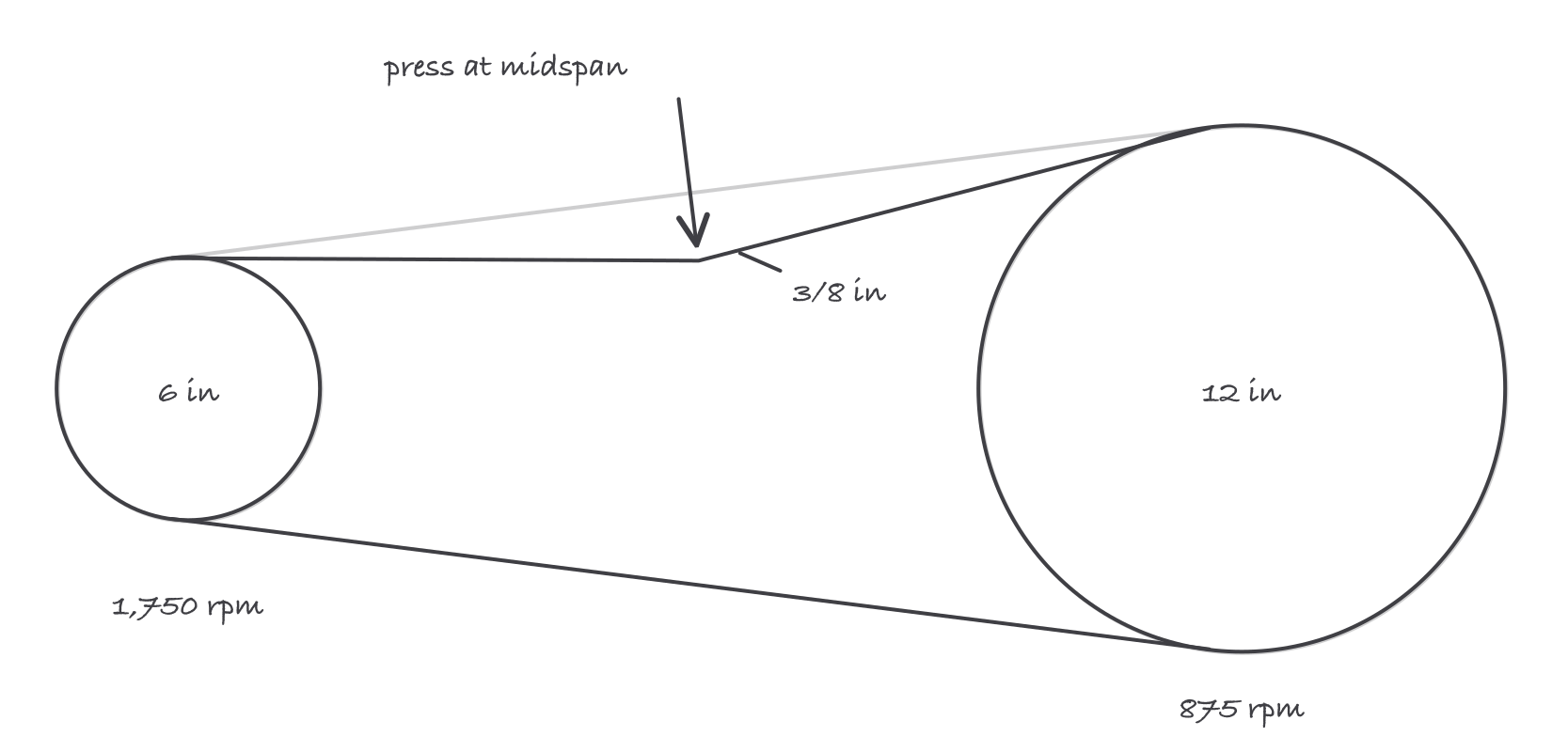
Tension is a measurement: the right force at midspan should move the belt 1/64 in for every inch of span
Notice the span is 23.81 in and the center distance is 24.0 in, so on a drive this close the two are nearly the same. Put a 6 in sheave against a 24 in sheave at the same centers and span = √(576 − 81) = √495 = 22.25 in, and the deflection target drops to 22.25 ÷ 64 = 0.348 in. The gap widens as the sheaves diverge, which is why the arithmetic is worth doing rather than reusing last week’s number.
Alignment of sheaves and sprockets
Two errors, same as with shafts. Angular misalignment means the sheave faces are not parallel. Offset misalignment means they are parallel but not in the same plane. A straightedge laid across both sheave faces finds gross errors; a laser sheave tool finds the rest.
Synchronous belts and chains are far less tolerant than V-belts. A V-belt on a slightly misaligned drive wears fast; a synchronous belt on the same drive climbs and shreds a flange.
Where it bites
- Replace belts as a matched set. A new belt beside a worn one carries almost all of the load, because the worn one has stretched and sits deeper. Never top up a set.
- Never pry a belt onto a sheave. Shorten the center distance, fit it by hand, then tension. Prying breaks the tensile cords inside the belt, and the belt fails later for no visible reason.
- Retension after a break-in run. New belts seat into the grooves and lose tension in the first few hours, so a check after roughly 24 hours of running is part of the installation, not a separate job.
- A shiny belt sidewall is a slipping belt. Glazing is a symptom of tension or of a worn groove, not a condition of the belt.
- Replace sprockets with chain. A new chain on worn sprockets wears at the new chain’s expense and the money is gone in weeks.
- Belts and chains are power transmission apparatus, not points of operation. They belong to a different guarding rule than the place where the machine works on the material, and the guard that came off for a belt change is the guard that gets forgotten.
Exam relevance
Expect the ratio arithmetic, the 1/64-in-per-inch-of-span deflection rule, the ANSI chain pitch numbering, and the wear-pattern questions (glazed sidewall, belt riding on the groove bottom, one-sided wear). The CMRT’s hands-on domains treat belt and chain work as core technician skill. Be ready to explain why a V-belt must not touch the bottom of its groove.
Verified requirements
| Where | Expires | Renewal | Continuing education |
|---|---|---|---|
| United States (federal) | Yes | 3 years | 50 course hours per 3-year cycle, drawn from two or more of the recertification activity categories; recertification application due within 90 days of the expiration date or the exam must be retaken |
Information comes from issuing-authority sources. Confirm current rules, fees and eligibility with the authority before acting.