Learn · Industrial Maintenance
Lockout/Tagout: Controlling Hazardous Energy
Part of Maintenance Tech to CMRP · step 1 of 30 · next: LOTO Procedures and the Annual Periodic Inspection
In learning paths: Maintenance Tech to CMRP
Lockout/tagout is the practice of isolating a machine from every source of energy that could hurt you, then locking that isolation in place so nobody can undo it while your hands are inside. OSHA writes the rule at 29 CFR 1910.147, “The control of hazardous energy”. It governs almost every maintenance job you will do on powered equipment, and it is the standard the rest of this trade is built around.
Why it matters on the job
Maintenance work puts you where the machine does its work: inside the guard, under the ram, between the rolls. Production runs the machine from outside. You go inside it. The energy that moves product also moves whatever part of you is in the way, and it moves faster than a reaction.
The rule exists because stopping a machine and de-energizing a machine are different acts, and the gap between them is where people are caught. Learn this lesson properly and every other safety topic in the trade slots underneath it.
Hazardous energy is not only electrical
The standard covers energy in whatever form the machine stores or receives. Electrical is the obvious one. It is rarely the one that catches people, because it is the one everyone remembers.
- Mechanical, including rotating flywheels, springs under compression or tension, and belt or chain drives that can be turned by hand.
- Hydraulic and pneumatic, including pressure trapped in an accumulator, a cylinder, or a receiver long after the pump stops.
- Gravity, meaning any raised load, ram, platen, or elevated tool that will come down when its support is disturbed.
- Thermal and chemical, meaning steam, hot fluids, and process material that can be released into the space you are working in.
- Stored electrical energy, meaning capacitors that hold a charge after the disconnect is open.
Two of these (springs and gravity) are invisible on a dead machine and account for a large share of the machine that “moved by itself.”
Authorized and affected are different people
This is the pair to get right on day one, because casual speech runs them together and the standard does not.
An authorized employee is the one who locks out or tags out equipment in order to perform servicing or maintenance on it. That is you when you are doing the work. You apply your own lock, you keep the key, and you are the one who verifies isolation.
An affected employee is one whose job requires operating or using the machine that is being serviced. That is the operator who runs the line. Affected employees are instructed in the purpose and use of the energy control procedure, and they do not apply locks. The operator who reaches over and hits the disconnect for you has not locked out, and you are not protected.
Nobody removes another person’s lock as a matter of routine. The standard treats lock removal by anyone other than the person who applied it as an exception with its own conditions, not as a convenience for the end of a shift.
The six steps
The standard sets out a sequence for applying energy control, and the order is the safety.
- Prepare for shutdown. Know the machine, know its energy sources, know the type and magnitude of what you are about to isolate.
- Shut the machine down. Use the normal stopping procedure (stop button, controlled sequence, orderly shutdown).
- Isolate the energy. Operate the energy isolating device (the disconnect, the valve, the breaker) so the machine is separated from its supply.
- Apply the lockout or tagout devices. Your lock goes on the isolating device, and the key stays with you.
- Relieve stored energy. Bleed, block, drain, discharge or restrain everything the machine is still holding: accumulators, springs, raised parts, capacitors.
- Verify isolation. Confirm that isolation and de-energization have actually been accomplished before any work begins.
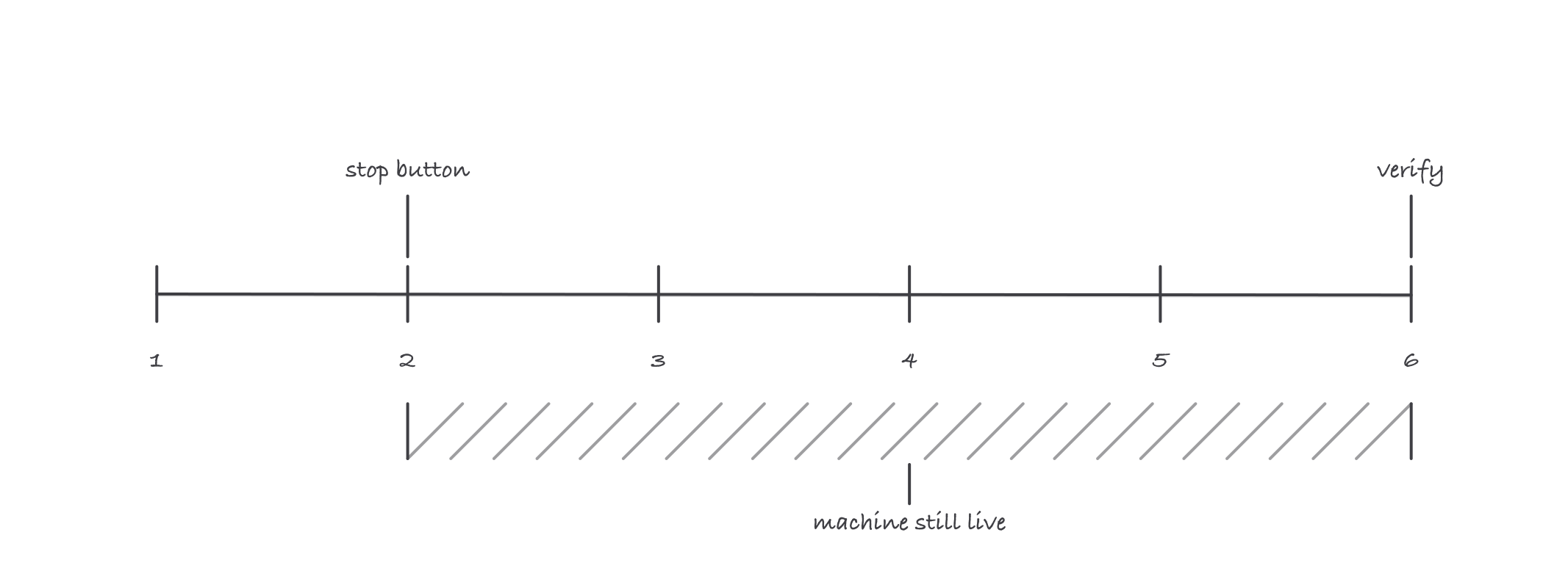
Pressing stop is step 2 of 6; the machine is not safe until step 6 says so
Verify means try to start it
Step 6 is the one learners misread. Verification is not looking at the lock and confirming it is on. It is testing that the machine cannot move: operate the normal controls, confirm nothing happens, and then return those controls to the neutral or off position. Where an electrical hazard is in play, verification means testing for absence of voltage with an instrument you have proved on a known live source.
A lock hanging on an open disconnect proves that a disconnect is open. It does not prove that the disconnect feeds the motor you are about to reach into, and machines fed from two panels are common.
Lockout and tagout are not the same tool
A lock is a physical restraint: it prevents the isolating device from being operated. A tag is a warning: it tells a person not to operate the device, and a person can ignore it. The standard permits tagout in defined circumstances, and it treats a tagout-only program as requiring additional measures to reach a level of protection equivalent to lockout. Where an isolating device can accept a lock, the expectation is that it gets one.
Where it bites
- Stopping is not isolating. A machine sitting at the end of its cycle with the stop button pressed is fully energized. Every step from 3 onward still has to happen.
- The minor servicing exception is narrow. The standard’s exception for work that is routine, repetitive, and integral to the use of the equipment during normal production is conditional on effective alternative protection. It is not a general permission to skip lockout on quick jobs.
- One machine can have several isolating devices. Control power and motor power often come from different places, and a second feed is exactly what a single lock will miss. Trace them, do not assume them.
- Your lock protects you, not the crew. Where several people work on one machine, each person applies a personal lock (group lockout hardware exists for this). A lock applied on someone else’s behalf leaves them depending on your memory.
- Stored energy outlives the disconnect. Accumulators hold pressure, capacitors hold charge, and a raised platen holds itself up on hydraulic pressure that will bleed away while you work under it.
The next lesson covers what happens above the individual lock: the written machine-specific procedures the standard requires, and the annual inspection that has to be run on every one of them.