Learn · Industrial Maintenance
Hydraulic Troubleshooting
Part of Maintenance Tech to CMRP · step 14 of 30 · next: Rigging for Machinery Installation
In learning paths: Maintenance Tech to CMRP
Assumes you know: Hydraulic Components and Circuits
Hydraulic troubleshooting is the discipline of measuring instead of guessing. Two instruments answer nearly every question: a pressure gauge, which tells you about resistance, and a flow meter, which tells you about delivery. Everything else is knowing where to put them.
Why it matters on the job
Hydraulic components are expensive and they look identical whether they work or not, so a parts-swapping approach on a big system can consume a week and thousands of dollars without touching the fault. Worse, it teaches nothing, so the same machine gets the same treatment next time.
A measured approach usually converges in under an hour, and it leaves a record: readings written on the schematic at named test points that the next person can use.
Sort the symptom first
Almost every hydraulic complaint lands in one of five buckets, and the bucket tells you which instrument to reach for.
- No motion at all. Either no flow is arriving or nothing is resisting it. Pressure gauge first.
- Motion too slow. Flow is being lost somewhere between the pump and the actuator. Flow meter.
- Not enough force. Pressure is limited somewhere. Pressure gauge, at more than one point.
- Erratic, jerky, or noisy motion. Air in the fluid, a sticking spool, or a pump on the edge of cavitation.
- Overheating. Power is going to heat instead of work, and the pressure drop that makes the heat is your fault.
The reasoning behind the first two is the whole subject in miniature. Flow makes things move; resistance makes pressure. So a slow actuator with normal pressure is a flow problem, and a weak actuator at full speed is a pressure problem. They are rarely the same fault and almost never fixed by the same part.
The measurements that settle it
Pressure at the pump outlet with the system deadheaded tells you what the pump and the relief valve can do together. Low pressure here with the pump turning means an open path to tank: a relief valve stuck open, a directional valve in an open or tandem center, or a sheared pump coupling.
Pressure across a component tells you whether it is restricting. A filter, a hose, or a partly shifted valve shows up as a pressure difference that has nowhere useful to go.
Flow at the pump outlet under load is the definitive pump test. A pump can look fine at zero pressure and lose half its output at working pressure, because internal leakage rises with pressure. Testing a pump unloaded proves nothing.
Cylinder bypass test. Drive the cylinder to the end of its stroke and hold it there, then open the line on the opposite side. Oil should stop coming out once the trapped volume is expelled. Continuous flow means the piston seal is passing, which is the classic cause of a cylinder that is slow, weak, and hot all at once.
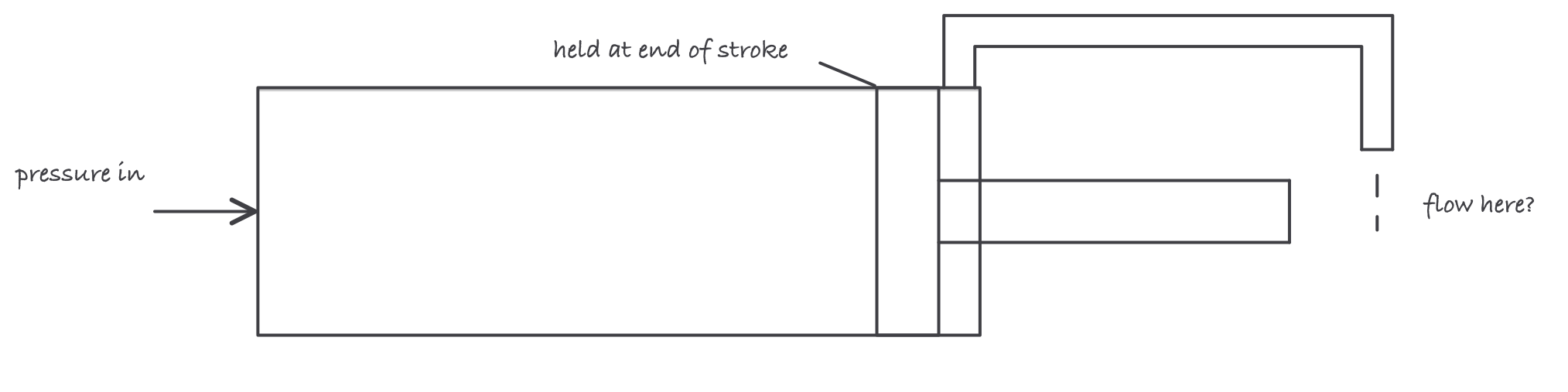
At the end of stroke the rod side should go quiet; oil that keeps coming has crossed the piston
Worked example: a cylinder that got slow
A 4.00 in bore cylinder with a 24 in stroke runs from a 10 gpm supply at 2,000 psi. It used to be quick and now it is not, so time it.
What it should do. Bore area is π ÷ 4 × 4.00² = 12.566 in². Flow is 10 gpm × 231 = 2,310 in³/min, so extend speed should be 2,310 ÷ 12.566 = 183.8 in/min. A 24 in stroke should take 24 ÷ 183.8 = 0.1306 min, which is 7.8 seconds.
What it does. Timed with a stopwatch: 13.0 seconds.
What that means in flow. 13.0 s is 0.2167 min, so the rod is moving 24 ÷ 0.2167 = 110.8 in/min. The flow actually filling the cylinder is 110.8 × 12.566 = 1,392 in³/min, which is 1,392 ÷ 231 = 6.03 gpm.
The missing flow. 10.00 − 6.03 = 3.97 gpm is going somewhere other than into the cylinder.
Now the diagnosis splits cleanly, and one measurement decides it. Put a flow meter on the pump outlet under load.
- Pump delivers about 10 gpm. The pump is fine and the loss is downstream: a bypassing piston seal, a leaking directional valve spool, or a partly open relief.
- Pump delivers about 6 gpm. The pump is worn, and the missing flow is slipping internally inside it.
Either way, quantify what the loss is costing. That 3.97 gpm crossing a 2,000 psi drop is 3.97 × 2,000 ÷ 1,714 = 4.63 hp, and 4.63 hp of waste is 4.63 × 2,545 = about 11,800 BTU/hr going into the oil. That is why this machine is hot, and it is the same fault, not a second one.
Work the circuit, not the parts list
- Half-split. Find a point roughly halfway along the suspect path and measure there. Each measurement should halve the remaining circuit, not add one more possibility.
- Mark the schematic. Write the actual readings at the actual test points. A marked-up print is worth more than a memory of “it seemed low.”
- Change one thing at a time. Two adjustments made together give you no information about either.
- Verify the simple things before the clever ones. Fluid level, filter indicator, coupling intact, solenoid actually energized, valve manual override tried.
- Trust the pattern of the readings over any single number. Gauges lie, especially old ones, and a reading that contradicts three others deserves a second gauge before it deserves a theory.
Where it bites
- Never crack a fitting to check for pressure. Relieve stored pressure first, verify it at a gauge, and use a proper test point. Fluid injection injuries begin with exactly this shortcut.
- Do not adjust the relief valve to speed up a slow actuator. Speed comes from flow. Raising the relief setting raises the pressure on every component instead.
- A hot system has a location. Heat is made where pressure drops without work being done, so walk the circuit with an infrared thermometer and find the component that is hotter than its neighbors.
- Cavitation and aeration are different faults with similar noise. Cavitation is vapor forming at a starved pump inlet (a plugged suction strainer, a closed inlet valve, oil too cold and too thick). Aeration is outside air pulled in through a suction-side leak or churned in by a return line above the oil level.
- An intermittent fault is usually thermal or electrical. A machine that works cold and quits hot points at clearances or at a solenoid coil, not at a mechanical blockage.
- The last person’s adjustment is a real cause. Compensator settings, relief settings, and flow control needles get moved during other people’s troubleshooting, and nobody writes it down.
Exam relevance
Expect symptom-to-cause questions built on the flow-versus-pressure distinction, the cylinder bypass test, and the requirement that a pump be tested under load. Expect the arithmetic that turns an observed cycle time into a flow rate, because it is the calculation that makes the diagnosis quantitative. The CMRT’s hands-on domains treat systematic troubleshooting as a technician competence in its own right, separate from knowing what each component does.
Verified requirements
| Where | Expires | Renewal | Continuing education |
|---|---|---|---|
| United States (federal) | Yes | 3 years | 50 course hours per 3-year cycle, drawn from two or more of the recertification activity categories; recertification application due within 90 days of the expiration date or the exam must be retaken |
Information comes from issuing-authority sources. Confirm current rules, fees and eligibility with the authority before acting.