Qualifications · Industrial Maintenance
The CMRP Certification
Part of Maintenance Tech to CMRP · step 25 of 30 · next: The CMRT Certification
In learning paths: Maintenance Tech to CMRP
Assumes you know: Predictive Maintenance: Vibration, Thermal, Oil
The Certified Maintenance and Reliability Professional is the Society for Maintenance and Reliability Professionals’ credential for people who run maintenance rather than perform it. It is one exam, 110 multiple-choice questions in 2.5 hours, built on the five pillars of the SMRP Body of Knowledge, and it is the recognized professional certification in the reliability side of this trade.
*Learn the Trades is a free study resource. We are not a licensing body, an authorized training provider, or an exam administrator. Reading this page does not award any card, license, or certification. Always verify requirements with the issuing authority linked in the sources.*Who it is for
The CMRP is aimed at the maintenance and reliability professional: the planner, the supervisor, the reliability engineer, the maintenance manager, and the lead technician moving toward those roles. Its content sits at the level of managing the maintenance function rather than executing a repair.
Because SMRP sets no eligibility gate, the question of when to take it is yours to answer. The exam assumes working familiarity with how a maintenance organization operates, so it rewards people who have lived through budgets, outages, work management systems and the argument about what gets shut down. A technician who has never planned work can pass it with study; a planner with several years behind them will find much of it recognizable.
The technician-level counterpart is the CMRT, covered in its own lesson, and the two are aimed at different jobs rather than arranged as steps on a ladder.
What it covers
The exam is built on the five pillars of the SMRP Body of Knowledge. SMRP publishes the pillars on its Body of Knowledge page, and that page is the authority on what they are called. The detailed sub-topics under each pillar are not published there; they sit inside SMRP’s Body of Knowledge guide, which is a paid publication. Anyone selling you a definitive free list of the sub-topics is reconstructing it.
The practical consequence for study is that the pillar structure tells you the shape of the exam, and the guide tells you the detail. Plan for both a management-and-business dimension and a technical-reliability dimension, because the credential spans the whole function rather than the shop floor.
Sitting the exam
The exam is 110 multiple-choice questions with a 2.5 hour time limit, delivered at Pearson VUE. That works out to roughly 82 seconds per question if you use the full window, so the exam rewards recognition over derivation.
Two administrative details cause more trouble than the content does.
Your application expires. Once your application is approved, you have six months to take the exam. Miss that window and the application is forfeited, which means applying again rather than rescheduling.
Your name has to match. Pearson VUE requires the name on your registration to match your government-issued identification. A middle initial that appears in one place and not the other is enough to be turned away at the test center door, having paid for the seat.
Keeping it
The CMRP runs on a three-year cycle. Recertification requires 50 course hours across that cycle, and those hours must come from two or more of SMRP’s activity categories, so a single conference or a single class will not carry a whole cycle on its own. Plan the mix at the start of the cycle rather than in the last quarter.
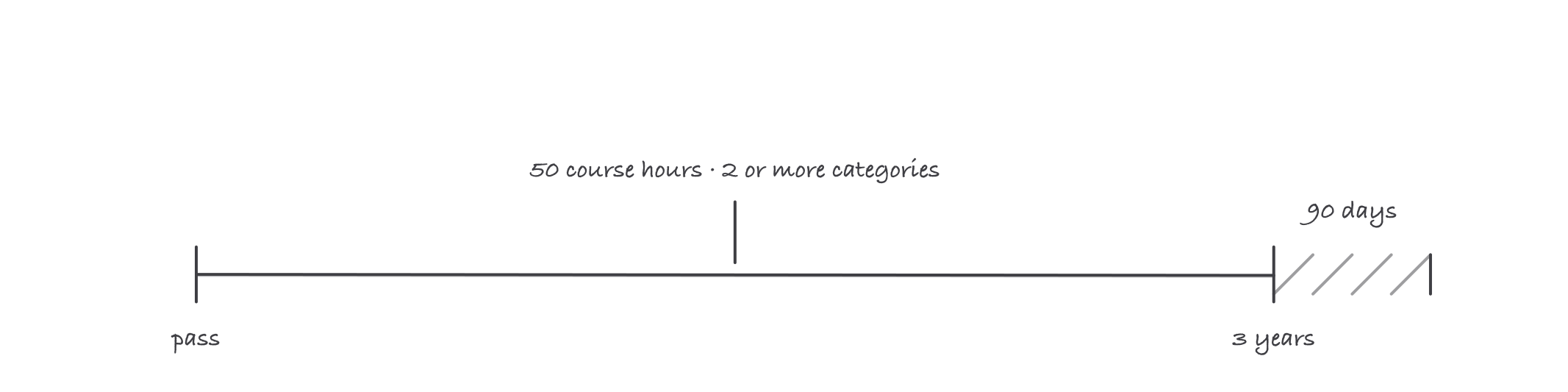
Three years, 50 hours from two or more categories, and a 90 day tail that is a grace period rather than an extension
If the certification lapses, SMRP allows a 90-day window after expiry in which recertification is still possible. After that window closes, getting the credential back means sitting the examination again. Two accommodations exist within the program: SMRP provides a waiver for certificants aged 65 and over, and an extension of up to six months for extenuating circumstances. Both are decisions SMRP makes, so ask before you need them rather than after.
Where it bites
- No prerequisite is not the same as no preparation. Open eligibility surprises people into treating the exam as a formality. It covers the whole management function, including the parts of it you have never done.
- Recertification is the part people lose. Passing is a single effort with a date on it. Fifty hours over three years is a habit, and the certificants who lapse are almost never the ones who failed anything.
- Two categories, not one. The requirement that hours come from two or more activity categories is easy to read past, and it is the detail that invalidates a cycle’s worth of hours at the moment of application.
- The credential is not a license. It does not authorize work, it is not required to do maintenance anywhere in the United States, and no jurisdiction issues it. It is a professional certification that employers recognize, which is a different kind of thing entirely.
- Verify every number against SMRP before you rely on it. Fees in particular move, and this page deliberately does not quote them. The application and certification pages linked in the sources are the current word.
Exam relevance
Everything in this trade’s reliability subject is CMRP territory: preventive and predictive maintenance, root cause analysis, and the metrics lesson in particular, since interpreting MTBF, MTTR and availability is exactly the kind of applied judgment the exam asks for. The safety subject matters too, because energy control and machine guarding are part of managing a maintenance function rather than a separate topic.
Verified requirements
| Where | Expires | Renewal | Continuing education |
|---|---|---|---|
| United States (federal) | Yes | 3 years | 50 course hours per 3-year cycle, drawn from two or more of the recertification activity categories; recertification application due within 90 days of the expiration date or the exam must be retaken |
Information comes from issuing-authority sources. Confirm current rules, fees and eligibility with the authority before acting.