Learn · Industrial Maintenance
Shaft Alignment
Part of Maintenance Tech to CMRP · step 6 of 30 · next: Belt and Chain Drives
In learning paths: Maintenance Tech to CMRP
Assumes you know: Bearings: Types, Installation, Failure Modes
Shaft alignment is the job of putting two rotating shafts on the same straight line, so that at operating temperature their centerlines are collinear where the coupling joins them. It is a relationship between two machines, not a property of either one.
Why it matters on the job
A misaligned coupling does not fail. It transmits the fault instead, into the bearings and seals on both sides, every revolution, for as long as the machine runs. That is why a pump that keeps eating bearings is an alignment problem far more often than it is a bearing problem, and why a shop that aligns properly buys fewer bearings.
The classic vibration signature helps you separate causes before you touch a tool. Misalignment tends to show at twice running speed with axial vibration present, while unbalance shows at running speed and is mostly radial. Balancing a misaligned machine cures nothing, because balance is a property of one rotor and alignment is a relationship between two.
Four numbers, not one
“Out of alignment” is not a diagnosis. Two shafts can be wrong in two distinct ways, and each way exists in two planes.
Offset misalignment (also called parallel misalignment) means the two centerlines run parallel but on different lines. Angular misalignment means the centerlines meet at an angle. Real machines have both at once.
Each of those exists in the vertical plane (corrected with shims under the feet) and in the horizontal plane (corrected by moving the machine sideways with jackscrews). So a finished alignment is four corrections, and it is normal for the vertical and horizontal work to happen in separate passes.
By convention the machine you do not move is the stationary machine (usually the driver bolted to a grouted base or the machine with piping attached), and the machine you shim and slide is the movable machine.
Nothing means anything until soft foot is gone
Soft foot is the condition where a machine’s four feet do not sit in one plane, so tightening the hold-down bolts distorts the frame. It is not a loose bolt. It is nearly the opposite: the bolt pulls a foot down onto a surface it was never touching, twisting the housing and moving the bearing bores while you watch your readings drift.
Find it by putting a dial indicator on each foot in turn, loosening only that bolt, and watching how far the foot lifts. Correct it with shims until every foot lifts within tolerance. Only then do alignment readings mean anything.
While you are down there, deal with the other pre-alignment items: lockout and verify the machine is dead, check the base for cracks and rust build-up between shims, use clean full-size stainless shims rather than a stack of scrap, check for pipe strain by loosening a flange and watching whether the machine moves, and check shaft and coupling runout so you are not chasing a bent shaft with shims.
Measuring the misalignment
Straightedge and feeler gauge is a rough method, good for getting a new machine close before precision work starts. It is not an alignment.
Rim and face puts a dial indicator on the coupling rim (reading offset) and another on the coupling face (reading angle), and sweeps both together through 360 degrees. It is the traditional method and the one most exams describe.
Reverse dial puts an indicator on each shaft reading the opposite coupling hub, and sweeps both. It measures offset at two points, which gives you the angle by arithmetic and avoids the errors that shaft float introduces into face readings.
Laser alignment replaces the indicators with a transmitter and detector, does the arithmetic itself, and displays live corrections while you move the machine. It is faster and it removes sag and reading errors. It does not remove soft foot, pipe strain, or the need to understand what the numbers mean, which is why alignment is still taught with dial indicators first.
One number that catches everybody: a rim indicator sweeps the full diameter, so its total indicator reading (TIR) is twice the actual centerline offset. A TIR of 0.010 in on the rim means the shafts are 0.005 in apart.
Worked example: how much shim under each foot
Readings on a motor driving a pump work out to this. At the coupling the motor shaft centerline sits 0.005 in below the pump shaft centerline, and it slopes further down as you move back toward the motor’s tail, by 0.001 in for every inch of length.
Measure from the coupling plane to the feet: the front (inboard) feet are 10 in back, the rear (outboard) feet are 28 in back.
Correction is the offset at the coupling plus the angular drop over the distance to each foot.
Front feet: 0.005 in + (0.001 in/in × 10 in) = 0.005 + 0.010 = 0.015 in of shim.
Rear feet: 0.005 in + (0.001 in/in × 28 in) = 0.005 + 0.028 = 0.033 in of shim.
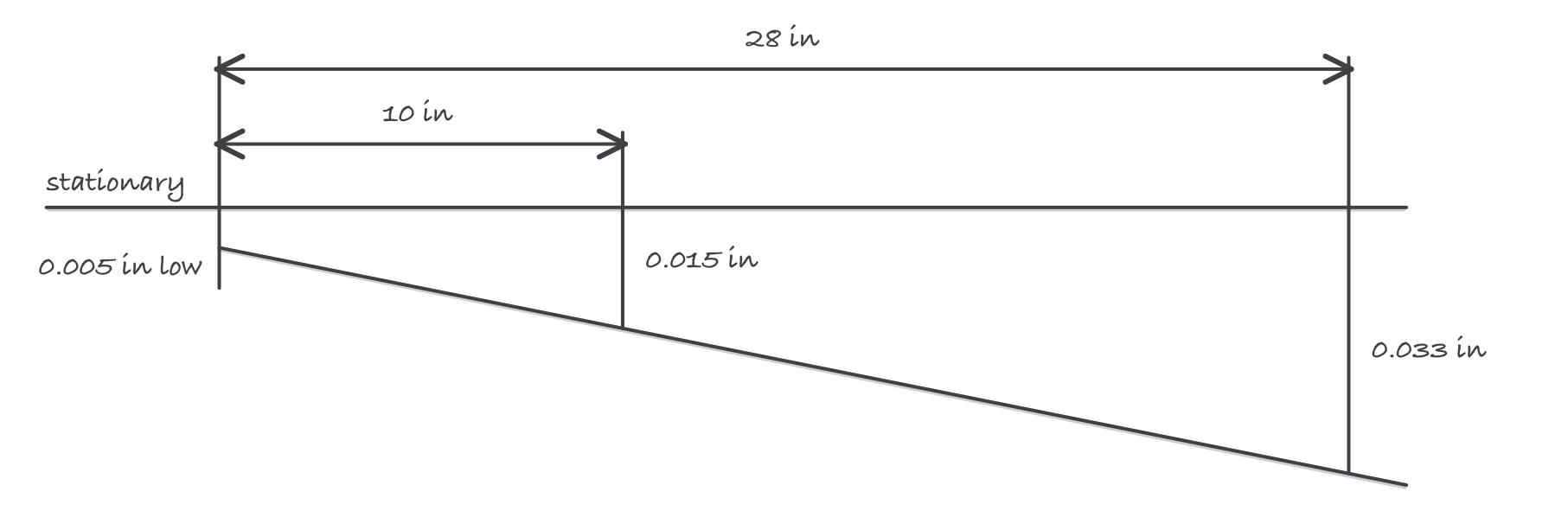
The angular error multiplies with distance, which is why the far feet always take more shim
Notice the shape of that result. The rear feet take more than twice the shim of the front feet, from an angle you could not see with your eye. Move the feet an inch farther apart and the numbers change again. This is why measuring the foot distances accurately matters as much as reading the indicators, and why a laser tool asks you for those distances before it will give you a correction.
Then repeat the whole exercise horizontally, where the same arithmetic produces a lateral move instead of a shim.
Thermal growth is part of the target
You align a cold machine. It runs hot. A steam turbine, a hot pump, or a large motor grows at the feet as it heats, and the growth is not the same on both machines.
That means the alignment target at rest is often deliberately offset, so the shafts come into line at operating temperature. Those target values come from the equipment manufacturer or from a measured growth check, never from a rule of thumb. Aligning a hot pump dead-on cold guarantees it is misaligned every hour it runs.
Where it bites
- Tolerance tightens as speed rises. An alignment that is fine on a 900 rpm gearbox drive is loose on a 3,600 rpm pump. Use the tolerance table for the actual running speed, not one number for the whole plant.
- The coupling’s misalignment rating is not your alignment tolerance. A flexible coupling survives the residual; the reaction load it creates still lands on the bearings.
- Do not correct with a stack of thin shims. Many thin shims compress and behave like a spring under the bolt. Use the fewest, largest, cleanest shims that reach the number.
- Bolts have to end up tight, and readings change when they do. Take final readings with the machine bolted down at working torque, then confirm.
- Rim TIR is double the offset. Forgetting to halve that reading silently doubles every correction you make, and the machine never comes into tolerance no matter how carefully you shim.
- Runout has to be ruled out first. A bent shaft or a coupling hub bored off-center produces sweep readings that no amount of shimming will resolve.
Exam relevance
Alignment sits at the center of millwright training. The NCCER Millwright program devotes separate modules to coupling and alignment fundamentals, prealignment and shim fabrication, dial indicator alignment, and laser alignment, in that order, and that order tells you what gets tested. Expect to be asked to distinguish offset from angular misalignment, to explain why soft foot is corrected first, to convert a rim TIR into an actual offset, and to run the similar-triangle arithmetic that turns a measured angle into a shim thickness at a stated foot distance. The CMRT’s hands-on domains cover this material as everyday technician work.
Verified requirements
| Where | Expires | Renewal | Continuing education |
|---|---|---|---|
| United States (federal) | Yes | 3 years | 50 course hours per 3-year cycle, drawn from two or more of the recertification activity categories; recertification application due within 90 days of the expiration date or the exam must be retaken |
Information comes from issuing-authority sources. Confirm current rules, fees and eligibility with the authority before acting.