Learn · Roofing
Underlayment and Flashing
Part of Roofer to Licensed Contractor · step 9 of 28 · next: Metal Roofing
In learning paths: Roofer to Licensed Contractor
Assumes you know: Roof Anatomy and Terminology
Most leaks are not in the field of the roof. They are at the joints: where the roof runs into a wall, a chimney, a pipe, a skylight, or into itself in a valley. The covering handles the open field by overlap. Everything else is handled by the underlayment and the flashing, and that is where the craft in this trade actually lives.
Why it matters on the job
Field shingles are laid competently by most people inside a week. Flashing is the part that gets judged. And when a roof leaks in year three, the money and the argument land on a flashing detail, because that is nearly always where the water got in.
Underlayment, felt and ice barrier are three different things
Underlayment is the category: the sheet material between the deck and the roof covering. It is the second line of defense behind the covering, and during a tear-off it is also the temporary roof between the moment the old covering comes off and the moment the new one goes on.
Felt is one member of that category, asphalt-saturated sheet sold historically as 15 lb and 30 lb. “Felt” gets used as though it named the whole category, which is exactly how a spec calling for synthetic underlayment ends up filled with felt.
Synthetic underlayment is woven or spun polymer sheet. Different material, different handling, and not a grade of felt.
Ice barrier sits in the same layer and does a different job. It is a self-adhering polymer-modified bitumen membrane, and its distinguishing property is that it seals around fasteners driven through it, which ordinary underlayment does not. It goes at eaves, valleys and penetrations in regions that get ice damming. Where it is required, and how far up the slope, are provisions of the code adopted in your jurisdiction. Read them there.
Your crew will call it ice and water shield, after a family of brand names. Say what the crew says on the roof, write “ice barrier” or “self-adhering underlayment” in a spec, and know which is which.
The flashing family
Flashing is any material closing a joint against water. The members do different jobs at different geometries and they do not substitute for one another.
- Step flashing: individual pieces, one per course, woven into the courses where a slope runs up against a vertical wall.
- Apron flashing: closes a horizontal wall-to-roof junction, such as the low side of a chimney.
- Counterflashing: laps down over a base flashing so the two can move independently and the water path never depends on a sealed joint.
- Valley flashing: handles the internal angle where two slopes meet and their water combines.
- Drip edge: runs at the eave and at the rake, and takes water off the edge rather than behind it.
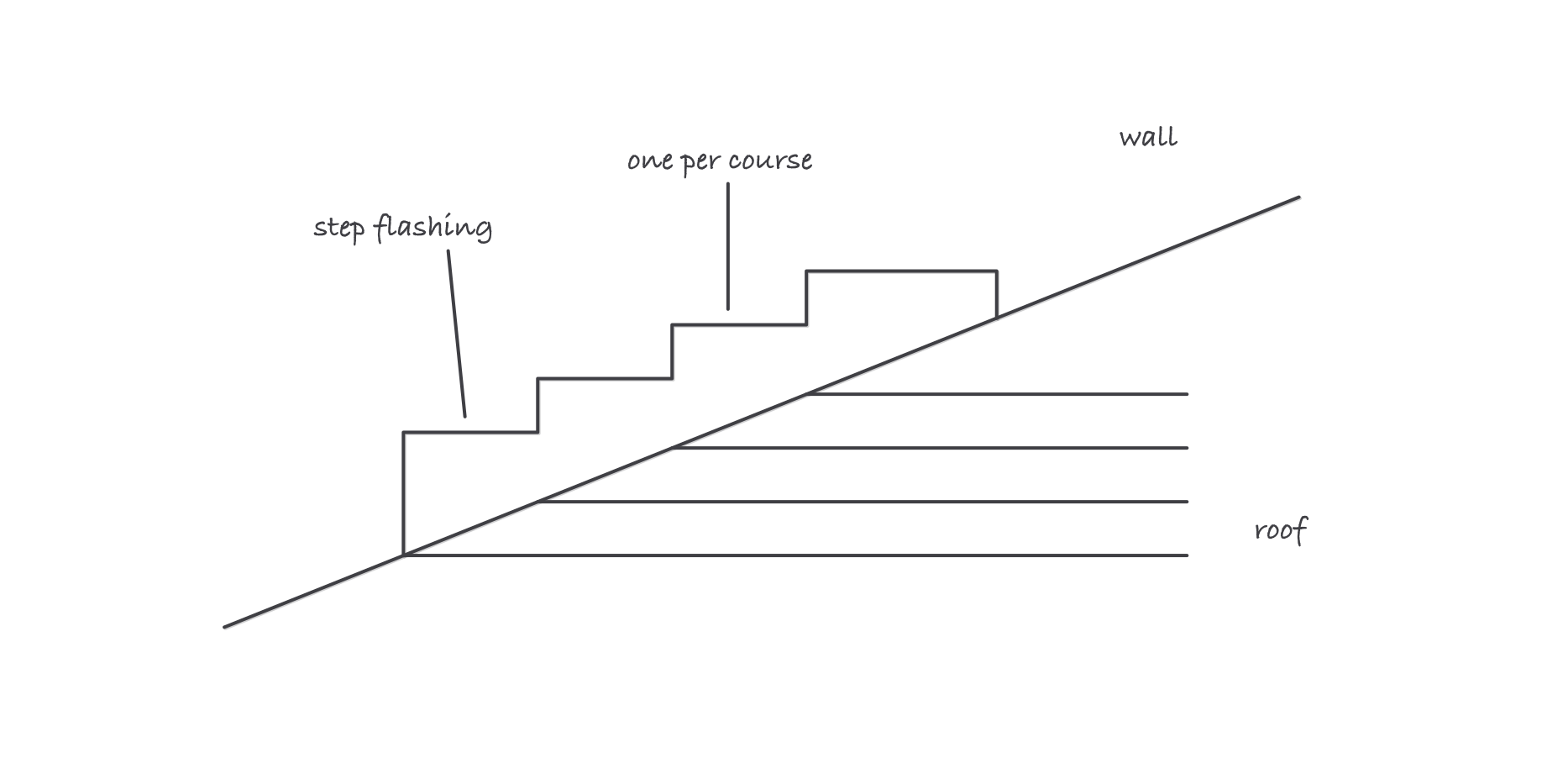
Step flashing at a wall: one piece per course, each lapped by the course above, which is why the tops step instead of running straight
How a flashing detail actually works
A working detail relies on two things and nothing else: overlap and gravity. Each piece laps over the piece below it in the direction the water travels, so water arriving at the joint is handed downhill from piece to piece and never has to pass through anything.
That is why step flashing is one piece per course rather than one long piece up the wall. A continuous piece gives water a single long seam to find and one place to fail. Stepped pieces give it a series of short overlaps, each one covered by the course above.
Caulk is not flashing. A flashing detail works because of geometry, and geometry does not age. A sealed joint works only until the sealant fails, and sealant always fails. Sealant belongs in a detail as a secondary measure at a termination; it does not belong as the thing holding the water out.
Where it bites
- Continuous flashing substituted for step flashing is the classic failure. It goes faster, it looks neater from the ground, and it is one long seam waiting for one failure.
- Base flashing caulked to a wall ties the roof to the wall. Any differential movement then opens the joint. Counterflashing lapping down over the base lets the two move separately, which is the entire reason the detail has two pieces.
- Ice barrier is a second line under the first. It does not turn a bad detail into a good one, and it is not a reason to skip the flashing.
- Exposed underlayment is a temporary roof. How long a given product may be left exposed is a figure published for that product, and the weather does not grant extensions.
Exam relevance
NRCA’s PROCertification program includes an Asphalt Shingle Systems Installer certification and, separately, an Architectural Metal Flashings and Accessories Installer certification. Flashing has a credential of its own, which is the trade recording it as a competency in its own right.
Both belong to individual workers, and both are assessed the same way: an online eligibility exam, then a hands-on performance assessment watched by an assessor. For flashing that assessment is unusually direct, because what an assessor can watch is exactly what leaks: which way the laps run, whether the pieces are placed one per course, and whether the detail is held together by geometry or by a bead of sealant. Experience minimums, fees and renewal terms come from NRCA.
Verified requirements
| Where | Expires | Renewal | Continuing education |
|---|---|---|---|
| United States (federal) | Yes | 3 years | Training completed within the 3-year renewal cycle, delivered in classroom, real-world or online environments |
Information comes from issuing-authority sources. Confirm current rules, fees and eligibility with the authority before acting.