Learn · Roofing
Residential Roofing and OSHA's Residential Rule
Part of Roofer to Licensed Contractor · step 4 of 28 · next: Fall Protection Training and the Competent Person
In learning paths: Roofer to Licensed Contractor
Assumes you know: Fall Protection on Steep Roofs
“Residential construction” is not a description of the building. It is a defined regulatory category with two tests, and a structure has to pass both of them before 1926.501(b)(13) governs the work.
OSHA’s directive STD 03-11-002 states the test plainly. First, “the end-use of the structure being built must be as a home, i.e., a dwelling.” Second, “the structure being built must be constructed using traditional wood frame construction materials and methods.” Both elements, or the category does not apply.
Why it matters on the job
A foreman who assumes “it’s a house, so the residential rule applies” can be wrong twice over. Wrong about which paragraph governs, and wrong about what that paragraph allows. The second error is the one that hurts people, because the folklore around residential roofing is that the rules are softer there. They are not, and they have not been since 2011.
What changed in 2011
OSHA issued STD 03-11-002 on 16 December 2010 with an effective date of 16 June 2011. It rescinded STD 03-00-001, the interim guidance that had been in place since 18 June 1999.
The old interim guidance permitted alternative procedures for certain residential work without the employer having to demonstrate anything first. The directive that replaced it removed that shortcut. Under 1926.501(b)(13), conventional fall protection at 6 feet is the requirement. Guardrails, safety nets, or personal fall arrest.
The only route around conventional fall protection is a narrow one: the employer must be able to demonstrate that conventional systems are infeasible or that using them would create a greater hazard. Where that demonstration holds, the employer must develop and follow a written, site-specific fall protection plan meeting the criteria in 1926.502(k).
Note the three words that carry the weight. Written. Site-specific. Demonstrate. A plan drafted for a different address, or a belief that harnesses are inconvenient on a cut-up roof, satisfies none of them.
The two-element test, applied
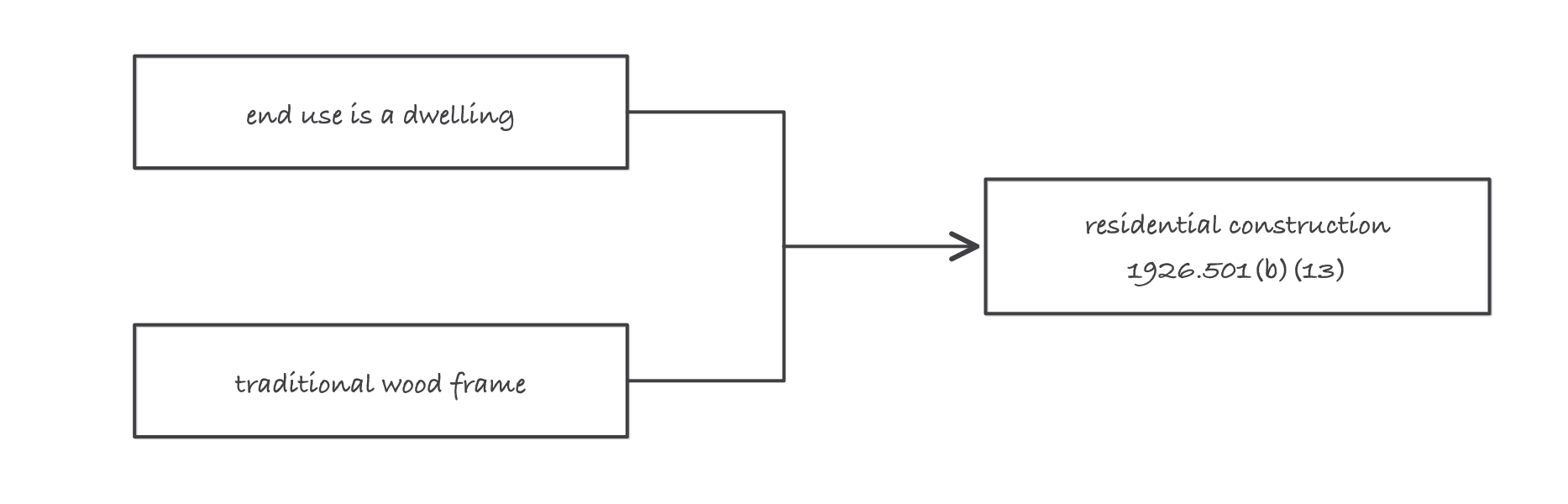
Both elements or neither: a dwelling that is not wood framed is not residential construction for this purpose
Take three structures and run the test on each.
A two-story single-family house, conventionally wood framed. End use is a dwelling, so element one passes. Traditional wood frame materials and methods, so element two passes. This is residential construction, and 1926.501(b)(13) applies to the roofing crew.
A four-story apartment building with a structural steel frame. End use is unquestionably a dwelling, so element one passes. The primary structure is steel rather than traditional wood frame, so element two fails. This is not residential construction under the directive, whatever the marketing brochure calls it. The roofing work falls under the ordinary paragraphs of 1926.501, chosen by the roof’s slope.
A single-story wood-framed strip retail building. Traditional wood frame construction, so element two passes. Its end use is retail rather than a dwelling, so element one fails. Not residential construction either.
Two of those three buildings would be called “residential-looking work” by most crews, and only one of them is residential construction in the sense the standard means.
Slide guards
OSHA addressed a common substitution directly in its residential fall protection guidance: “Slideguards cannot simply be used in lieu of conventional fall protection methods under 1926.501(b)(13).”
That sentence closes the loop on the folklore. Roof brackets and slide guards may have a role inside a properly developed written plan where infeasibility or greater hazard has actually been demonstrated. They are not a standing alternative that a crew can elect on arrival because the roof looks manageable.
Where it bites
- Passing element one does not carry element two. The dwelling test and the wood frame test are independent, and steel or concrete primary framing fails the second no matter who lives in the finished building.
- The 1999 guidance is gone. Anyone citing practice they learned before 2011 is quoting a rescinded document. Check the date on whatever you were taught.
- Infeasibility is a demonstration, not an opinion. The burden sits with the employer, before the work starts, in writing.
- A written plan is a per-site document. Copying last month’s plan across and changing the address is how a paper defense becomes a paper citation.
- Falling outside the residential category is not a reprieve. If the two-element test fails, you are back in the general fall protection paragraphs at the same 6 foot trigger. Nothing about failing the test lowers the duty.