Learn · Roofing
Roofing Estimating
Part of Roofer to Licensed Contractor · step 20 of 28 · next: Insurance and Restoration Work
In learning paths: Roofer to Licensed Contractor
A roof is measured and sold in squares of roof surface, and almost every estimating mistake in this trade is a mistake about which area got measured. The plan area, the footprint and the roof surface are three different numbers, and only one of them buys shingles.
Why it matters on the job
The estimate is the only part of a roofing job that is finished before the work starts and wrong for the entire rest of it. Material shortfalls stop a crew with the deck open. Material overages come out of the margin. And a tear-off priced as one layer when it is two costs a day of labor and a second dumpster nobody charged for.
The square, and the area it measures
A square is 100 square feet of roof surface. Not of floor. Not of footprint. Of the sloping surface a person would walk on.
A plan, a satellite measurement or a tape across the ground gives you the horizontal projected area, which is the roof’s shadow at noon. Every sloping roof has more surface than its shadow, and the steeper it is, the bigger the difference.
The slope factor
The conversion is straight geometry. For a run of 12 inches, a roof rising R inches travels the hypotenuse of a right triangle, so:
slope factor = √(R² + 12²) / 12
For a 6 in 12 roof: √(6² + 12²) / 12 = √180 / 12 = 13.4164 / 12 = 1.1180
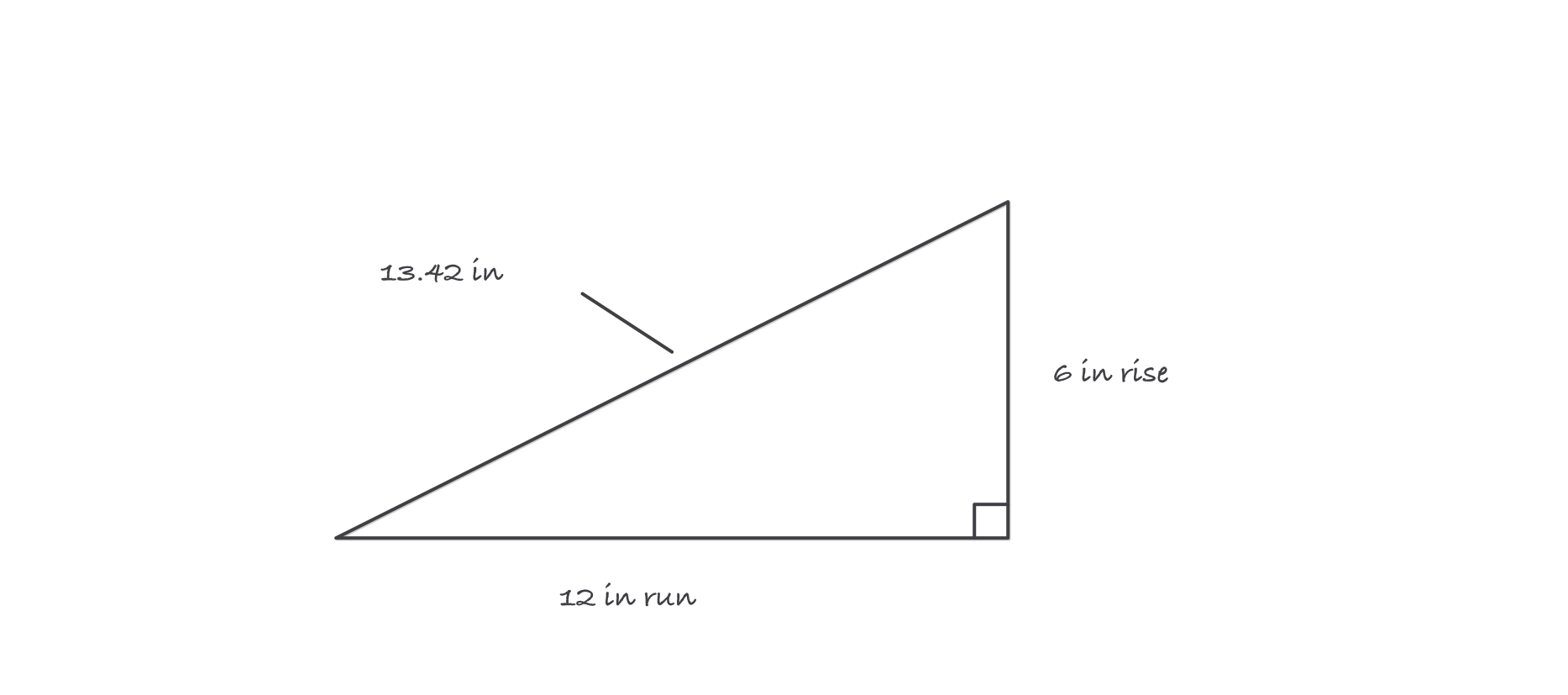
A 6 in 12 roof travels 13.42 inches of surface for every 12 inches of run, which is a factor of 1.118
Multiply the horizontal projected area by that factor and you have roof surface. A 4 in 12 comes out at 1.0541, a 6 in 12 at 1.1180, and a 12 in 12 at 1.4142, which is 41 percent more roof than the footprint suggests.
Worked example
A hip roof measures 1,800 sq ft in horizontal projected area, uniformly 6 in 12, with two valleys.
Slope factor: √(6² + 12²) / 12 = √180 / 12 = 13.4164 / 12 = 1.1180
Roof surface: 1,800 × 1.1180 = 2,012.4 sq ft
Squares: 2,012.4 / 100 = 20.12 squares
Then waste, which is counted rather than assumed. Cutting waste comes from hips, valleys and rakes, because every cut throws away part of a shingle. A plain gable has almost none. This roof is a hip with two valleys, so the estimator walks the cut lines and allows 10 percent for this roof:
2,012.4 × 1.10 = 2,213.64 sq ft, which is 22.14 squares
Bundles, at the wrapper’s printed 25.0 sq ft per bundle:
2,213.64 / 25.0 = 88.5456, so 89 bundles
Now price the error nobody sees. An estimator who used the 1,800 sq ft footprint as the roof area is short by 2,012.4 − 1,800 = 212.4 sq ft, which is 2.12 squares, or 8.5 bundles’ worth of material, before a single allowance for waste.
What is not in the squares
Squares buy field shingles. Everything else is its own line, and most of it is measured in linear feet or in each:
- Starter, and hip and ridge, by the linear foot from the plan.
- Underlayment and ice barrier, by area and by the locations the adopted code requires them.
- Drip edge, by the linear foot at eaves and at rakes, counted separately because they are different edges.
- Valley material, by the linear foot.
- Step flashing, apron, counterflashing and pipe boots, by the each.
- Ventilation, intake and exhaust, both.
- Fasteners, and the dumpster.
Price tear-off separately
Tear-off is labor, disposal and time, and it scales with the number of existing layers rather than with the squares of new roofing. Two layers is roughly twice the tear-off, not twice the roof, and the dumpster fills at a rate the shingle count does not predict.
Establish the layer count before you price, at a rake, an eave or a penetration.
The deck you cannot see
You cannot know the deck’s condition until the covering is off, and pretending otherwise is how estimates turn into arguments on day two.
The honest way is a stated unit rate for deck replacement plus a disclosed allowance, both in the contract and both explained to the customer before they sign. The customer who was told about it at the kitchen table is annoyed; the customer who is told about it standing in the driveway on Tuesday is an ex-customer.
Where it bites
- A remembered bundles-per-square ratio is not an input. Coverage per bundle is printed on the wrapper and it varies with the product. Read it.
- Waste is not a fixed percentage. It is a function of how cut-up the roof is. A number carried from the last job is a coin flip.
- Measure the roof, not the aerial’s guess at the slope. Slope drives the factor, and a report that got the slope wrong got the area wrong by the same proportion.
- Every penetration is a line item and a labor item. A roof with fourteen pipes is not the same job as a roof with three, at identical squares.
- The contingency belongs in the contract, not in the margin. Burying deck repair in the price means you eat it when there is more than expected and nobody thanks you when there is less.