Learn · Roofing
Low-Slope Systems: BUR, Mod-Bit, Single-Ply
Part of Roofer to Licensed Contractor · step 12 of 28 · next: Membrane Details and Terminations
In learning paths: Roofer to Licensed Contractor
Assumes you know: Roof Anatomy and Terminology
On a low-slope roof, water does not leave in a hurry. It moves slowly, it stands in places, and it gets blown uphill by wind. So the covering cannot be a field of overlapping units relying on gravity. It has to be a continuous waterproof membrane, joined at its seams into one sheet.
Why it matters on the job
Three families of membrane cover almost all of it: built-up roofing, modified bitumen, and single-ply. They are not variants of one product. They are built differently, joined differently, repaired differently, and they carry different hazards while they go down.
NRCA’s certification list makes the same point structurally: Thermoplastic Systems Installer, EPDM Systems Installer and Modified Bitumen Systems Installer are three separate certifications, because installing one competently does not make you competent at the others.
Built-up roofing
BUR is a membrane built in place from alternating layers of bitumen and reinforcing sheet. A ply is one reinforcing sheet embedded in the bitumen, so a four-ply BUR carries four reinforcing sheets, applied one at a time with bitumen between them, plus a surfacing on top.
Keep the word “ply” straight, because it is a count of reinforcement inside one membrane. It has nothing to do with a layer, which is a whole previous roof left in place under a new one. A four-ply BUR is one roof, correctly built. A roof with three layers is three roofs, stacked.
Modified bitumen
Mod-bit is bitumen modified with polymers and manufactured into sheets, usually applied as a base sheet plus a cap sheet, which the trade calls a two-ply system.
Mod-bit names the chemistry, not the application method. The same category goes down by torch, by hot asphalt mopping, by cold-applied adhesive, or as a self-adhering peel-and-stick sheet. Those are four different jobs with four different tool lists, four different crew skills and, above all, four different fire exposures. Torch work and hot kettle work carry hazards that a self-adhering sheet does not.
Treat the application method as part of the system name, every time. “Mod-bit” on its own leaves the application method unspecified.
Single-ply, and the split that runs through it
A single-ply membrane is one sheet, and “single-ply” is a family rather than a product. The line that matters inside it is chemical.
TPO and PVC are thermoplastics. They soften when heated and re-harden when they cool, reversibly, which is why their seams are made by hot-air welding: the two sheets are melted into each other and become one material at the seam.
EPDM is a thermoset rubber. It cures irreversibly. Heat does not soften it back, so it cannot be heat-welded, and its seams are made with adhesives or with seam tape.
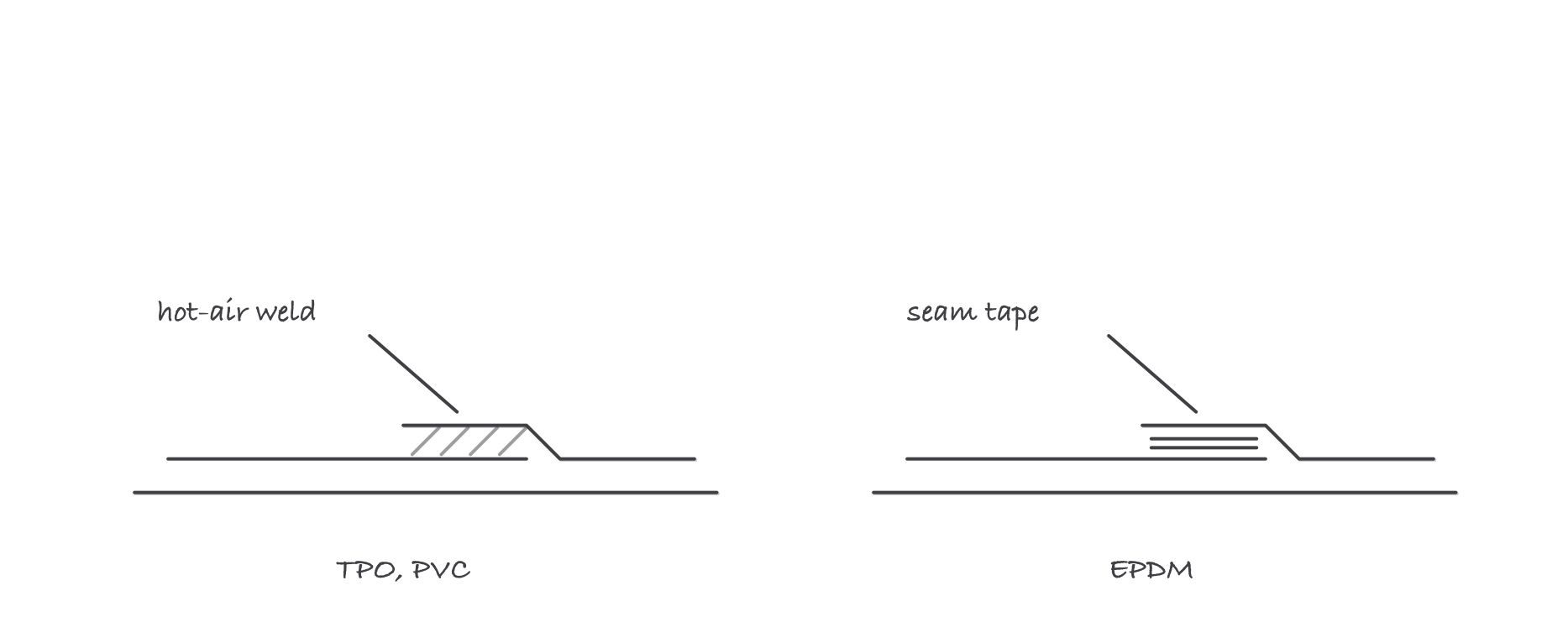
The chemistry decides the seam: thermoplastics weld into one another, thermoset rubber has to be stuck
That is chemistry, not preference, and it dictates the tooling, the crew skill, the detailing and the repair method. It is also why NRCA runs a Thermoplastic Systems Installer certification and a separate EPDM Systems Installer certification instead of one single-ply credential.
One more distinction inside the thermoplastic half: TPO and PVC are both thermoplastic and they are still different materials with different compatibilities. Thermoplastic is the family. It is not the product name.
Where it bites
- “Single-ply” on a purchase order specifies almost nothing. It names a family that contains at least two incompatible chemistries and several products.
- A repair has to match the membrane. A thermoplastic patch welded onto EPDM does not weld, and tape intended for one system is not automatically right for another. Identify the membrane before you carry a patch onto the roof.
- Slope still exists. A low-slope roof is not a flat roof: it is drained, and where the drainage goes is covered in Roof Drainage. A membrane is a waterproofing layer, not a permission to let water sit.
- The fire exposure travels with the application method, not with the product name on the submittal. A hot kettle or a torch on a roof is a hot work operation and gets treated as one.
Exam relevance
Three of NRCA’s PROCertification credentials sit in this material: Thermoplastic Systems Installer, EPDM Systems Installer and Modified Bitumen Systems Installer. Each belongs to an individual worker rather than to a company, and each is earned through an online eligibility exam followed by a hands-on performance assessment in front of an assessor.
For membrane work the performance half is unusually revealing, because a seam either holds or it does not, and an assessor can watch it being made and then test it. Expect the written half to reach the distinctions in this lesson: which membranes weld, which are adhered, what a ply is, and what the application method changes. Experience minimums differ by certification (NRCA publishes 24 months for the thermoplastic credential, for example), and fees and renewal terms come from NRCA.
Verified requirements
| Where | Expires | Renewal | Continuing education |
|---|---|---|---|
| United States (federal) | Yes | 3 years | Training completed within the 3-year renewal cycle |
Information comes from issuing-authority sources. Confirm current rules, fees and eligibility with the authority before acting.