Learn · Roofing
Insurance and Restoration Work
Part of Roofer to Licensed Contractor · step 21 of 28 · next: Roofing Licensing by State
In learning paths: Roofer to Licensed Contractor
Assumes you know: Storm Damage Assessment, Roofing Estimating
Insurance-funded roof replacement is ordinary work in this trade, and it carries legal exposure that a straight retail replacement does not. The reason is structural: the money comes out of a contract you are not a party to, and almost every way this work goes wrong starts with somebody forgetting that.
Three parties, two contracts
The homeowner has a contract with their insurer. That is the policy, and it sets what is covered, what the deductible is, and how a settlement is calculated.
The homeowner has a contract with you. That is the roofing contract, and it sets a scope and a price.
You have no contract with the insurer. None. You are not owed anything by them, not bound by their estimating software, and not authorized by the roofing contract to act for the homeowner in their dealings with the carrier.
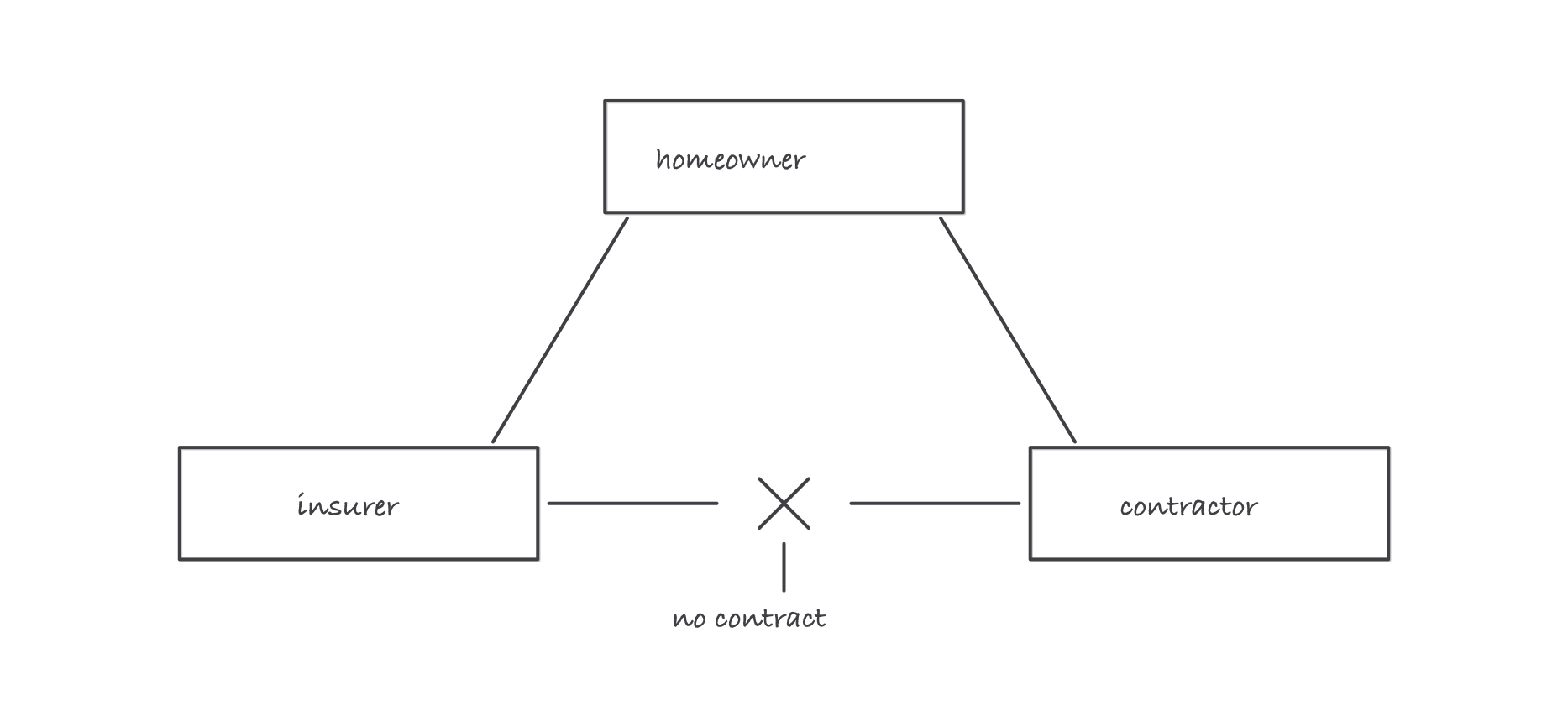
Two contracts exist and the third relationship does not, which is the fact the whole subject turns on
How the sequence normally runs
- The loss happens. Storm, tree, fire, whatever the policy covers.
- The homeowner reports a claim. It is theirs to report, and the reporting decision is theirs to make.
- The carrier assigns an adjuster, who inspects and writes a scope and an estimate.
- The homeowner decides what to do, including whether to proceed and who to hire.
- The homeowner contracts with a roofing contractor for a stated scope at a stated price.
- The work is done. Anything found during the work that was not in the original scope is documented, photographed, and submitted as a supplement, through the homeowner.
- Payment flows under the policy, with the homeowner responsible for their deductible.
Your job sits at steps 5 and 6. Steps 2, 3, 4 and 7 belong to the homeowner and the carrier, and standing in the middle of them is where contractors get into trouble.
The deductible is not yours to move
The deductible is the homeowner’s obligation under their own policy. State law decides whether a contractor may absorb it, waive it, rebate it, discount around it or quietly leave it out of the price. In a number of states, doing so is an offense rather than a favor.
Work the arithmetic once and you can see why regulators care. Say a policy carries a $2,500 deductible and the adjuster’s scope totals $18,400. The carrier’s share is 18,400 − 2,500 = $15,900, and the homeowner owes the remaining $2,500 toward the work.
If your contract price is $18,400, the numbers line up with what everyone believes is happening. If your contract price is $15,900 because you “took care of” the deductible, then the real price of the work was $15,900 all along, and the document the carrier settled against says something different. Real settlements are more complicated than one subtraction, and the mechanics are set out in the policy itself, which is the only authority on its own terms. The principle survives the complication.
Before you offer a customer anything that touches their deductible, find out what your state says. Do not carry the answer from another state, and do not take it from a competitor’s marketing.
Where the licensing line sits
Writing your own estimate, explaining your own scope, and documenting what you found are your work. Negotiating, adjusting or otherwise handling somebody else’s insurance claim on their behalf is regulated activity in many states, often requiring a license held by public adjusters and not by contractors.
Assignment of benefits, where a homeowner assigns their rights under the claim to the contractor, is regulated too, sharply restricted in some states, and hedged with formal requirements where it is permitted. It is not a form to download.
The two authorities that answer these questions are the state’s insurance regulator and the state’s contractor licensing board, for the state the roof is in. Ask them, in that order, before you build a business process on the answer.
Contract hygiene
Write a scope and a price. A contract whose price is “whatever the insurance company pays” is a contract with no price in it, and it hands the definition of your own work to a third party who has never met you.
If you intend to adjust the price when the carrier’s scope changes, say so explicitly, say how, and say what happens if the two never agree. Vagueness here reads as convenience while everything is going well and as a trap the moment it is not.
The reputation problem
This segment of the trade has a bad name, earned by operators who arrive after a storm, sell aggressively, subcontract to whoever is available, and are unreachable by the time anything goes wrong. That reputation is now attached to every contractor who knocks on a door after weather.
The practical answer is to be verifiable. A local address that predates the storm, a license number the customer can check with the state, insurance certificates that come from the carrier rather than from you, references from work in that county, and a workmanship warranty that means something because you are still going to be there. None of that is marketing. It is what tells a customer you are not the operator who caused the suspicion.
Where it bites
- Never state what a carrier will pay. It is somebody else’s contract and you have not read it. Say what your scope is and what it costs.
- Document at the time, not afterward. Photographs located on the roof and dated, taken before and during the work, are what a supplement rests on. Reconstructed evidence is not evidence.
- A supplement is a request, not a bill. It goes through the homeowner, with the documentation attached, and it may be declined.
- Licensed, bonded and insured are three separate things, and the one that matters when a roofer falls is workers’ compensation. If you subcontract, verify the sub’s coverage directly with the carrier rather than accepting a printout.
- Being right about the damage does not make you right about the claim. Those are two different arguments in front of two different audiences.