Learn · Roofing
Fall Protection Training and the Competent Person
Part of Roofer to Licensed Contractor · step 5 of 28 · next: Tear-Off Safety and Debris Handling
In learning paths: Roofer to Licensed Contractor
Assumes you know: Fall Protection on Roofs: the Six-Foot Rule
1926.503 is the standard that says the employer must teach the crew what 1926.501 requires of them, and it ranks seventh on OSHA’s FY2025 top ten cited standards. Its companion, 1926.501, ranks first. Roofing is the trade where both of the country’s headline fall protection standards land on the same crew, and .503 is the one that lands on you when you start running work.
Why it matters on the job
Equipment on the roof does not satisfy .503. The standard is about knowledge, and it is enforced through paper. An inspector who finds harnesses on every worker and no certification records has found a violation, and the violation belongs to the employer, not the crew.
The duty at 1926.503(a)(1) is short: “The employer shall provide a training program for each employee who might be exposed to fall hazards.” Note the reach of “might be exposed.” This is not limited to the workers you expect to be near an edge.
Who delivers it
The training must be delivered by a competent person qualified in the areas the standard lists. Competent person is a defined term in OSHA’s world, and 1926.500(b) uses it again in the definition of a safety monitoring system: “a safety system in which a competent person is responsible for recognizing and warning employees of fall hazards.”
The word does real work. A competent person is not whoever has been in the trade longest and not whoever happens to be free that morning. If the training is delivered by someone who does not meet the definition, the training requirement has not been met even though the training happened.
The eight subjects
1926.503(a)(2) lists eight areas the training must cover. Read them in the standard rather than from a summary, but the shape is worth knowing before you open it:
- The nature of the fall hazards in the work area.
- Correct procedures for erecting, maintaining, disassembling and inspecting the fall protection systems in use.
- The use and operation of the systems themselves: guardrails, personal fall arrest, safety nets, warning lines, safety monitoring, controlled access zones and other protection.
- The employee’s role in a safety monitoring system.
- The limitations on the use of mechanical equipment during roofing work on low-sloped roofs.
- Correct procedures for handling and storing equipment and materials, and for erecting overhead protection.
- The employee’s role in a fall protection plan.
- The standards contained in Subpart M.
Item 3 is the one that is easiest to shortchange. Handing a worker a harness and showing him how to buckle it covers wearing equipment. The standard asks for the use and operation of the system, which means the anchorage, the clearance below, the connector, and why a warning line is not a guardrail. “I’m tied off” is a sentence a trained worker should be unable to say without also knowing what he is tied to.
What the record has to contain
Training that leaves no trace is training you cannot prove. 1926.503(b)(1) sets the record out in one sentence: “The written certification record shall contain the name or other identity of the employee trained, the date(s) of the training, and the signature of the person who conducted the training or the signature of the employer.”
Three items. Nothing more elaborate is required, and nothing less is acceptable. 1926.503(b)(2) adds the maintenance rule: “The latest training certification shall be maintained.”
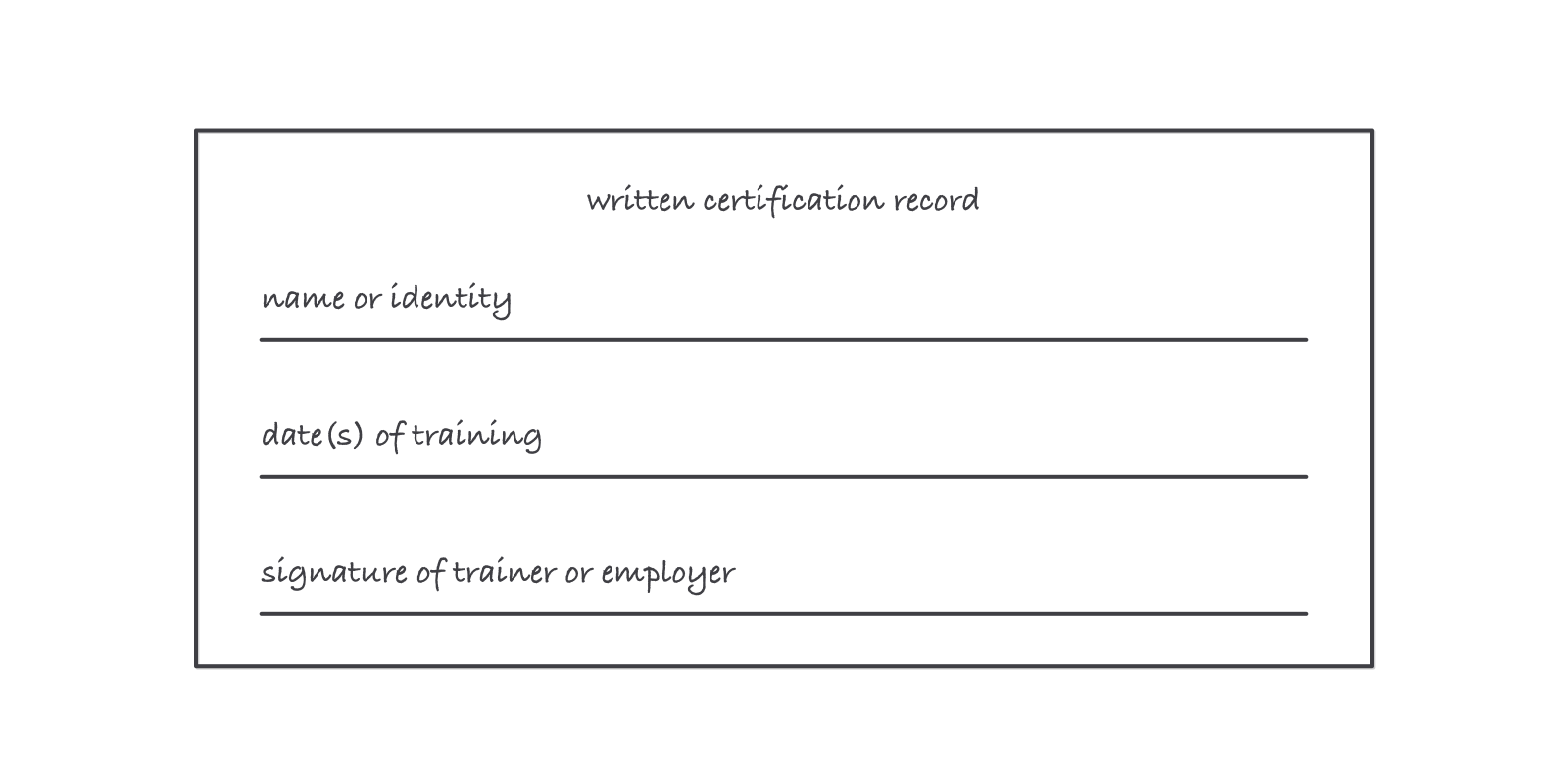
Three fields is the whole legal requirement, and a roof full of trained workers with none of these on file is an undocumented crew
Worked example: one crew, one season
A five-person shingle crew is trained on 3 March. The foreman, a competent person, delivers the eight subjects and signs one certification record per worker: name, 3 March, his signature. Five records go in the file. The requirement is met, and “the latest training certification” for each of those five workers is now that March record.
In June the company takes on its first low-slope membrane job. The crew moves from personal fall arrest on steep shingle roofs to a warning line paired with a safety monitor under 1926.501(b)(10). That is a change in the types of fall protection systems in use, which is one of the retraining triggers at 1926.503(c). The March training did not cover warning lines or the monitor’s role in operation, so it is now obsolete for this work.
Retraining happens in June. New records are written and signed, and those June certifications become the latest for each worker. The March records are no longer the current proof.
The trigger was not the calendar. Nothing in .503 sets an expiry date. The trigger was that the work changed.
What triggers retraining
1926.503(c) requires retraining when circumstances make prior training obsolete, in three situations:
- The workplace changed in a way that makes the earlier training obsolete.
- The fall protection systems or equipment changed types.
- The employee’s knowledge or use shows inadequacies, which is to say the training did not take.
The third trigger is the one foremen have to act on themselves. If you watch a worker clip a lanyard to a gutter, you have observed a retraining trigger. Correcting him on the spot is supervision. Retraining him is compliance.
Where it bites
- There is no annual refresher requirement in .503. The retraining triggers are event-based. A company running a yearly toolbox session and nothing else is meeting a schedule it invented while potentially missing a trigger the standard actually names.
- The record proves training happened, not that it was adequate. A signed card next to a worker who cannot explain his anchorage is trigger three in written form.
- Training the crew does not train the subcontractor. The duty attaches to the employer of the exposed employee. On a roof with two companies on it, there are two training duties.
- A competent person is a defined term, not a compliment. Check the definition before you designate anyone, because the designation is what the certification record is signed against.