Learn · Roofing
Tear-Off Safety and Debris Handling
Part of Roofer to Licensed Contractor · step 6 of 28 · next: Roof Anatomy and Terminology
In learning paths: Roofer to Licensed Contractor
Assumes you know: Fall Protection on Roofs: the Six-Foot Rule
Tear-off is roofing work, and OSHA says so by name. The definition at 1926.500(b) reads “the hoisting, storage, application, and removal of roofing materials and equipment,” so Subpart M governs the crew stripping a roof exactly as it governs the crew installing one. Nobody is in a preparation phase with softer rules.
Why it matters on the job
Tear-off is the part of the job where three hazards run at once. The walking surface is unstable, because it is covered in the roof you are removing. Openings appear that were not there an hour ago, or were there all along under a layer of old material. And everything you pry loose has to travel somewhere, usually down, often past people.
Installation has one of those problems. Tear-off has all three, on the same roof, at the same time.
The surface you are standing on is not the deck
During tear-off the walking surface is loose material: broken shingles, granules, old fasteners, torn felt. Granules on a sloped deck behave like ball bearings, and a scrap of underlayment slides under a boot the way ice does.
Worse, the debris hides the deck. Rot around a chimney, a soft patch where a leak has run for two seasons, a badly repaired opening: none of it is visible until the material over it comes off, and by then someone is standing on it. Clear as you go rather than stripping wide and cleaning later. A swept deck is a deck you can inspect and a surface you can trust.
Holes carry three separate duties
The paragraph people underuse is 1926.501(b)(4), and the reason to read it closely is that it is three duties, not one.
(b)(4)(i): “Each employee on walking/working surfaces shall be protected from falling through holes (including skylights) more than 6 feet (1.8 m) above lower levels, by personal fall arrest systems, covers, or guardrail systems erected around such holes.”
(b)(4)(ii): “Each employee on a walking/working surface shall be protected from tripping in or stepping into or through holes (including skylights) by covers.”
(b)(4)(iii): “Each employee on a walking/working surface shall be protected from objects falling through holes (including skylights) by covers.”
Now look at what appears in all three. Personal fall arrest and guardrails are named once, in (i). Covers are named in all three. A cover is the only single measure the standard offers against falling through, stepping into, and dropping something through the same opening.
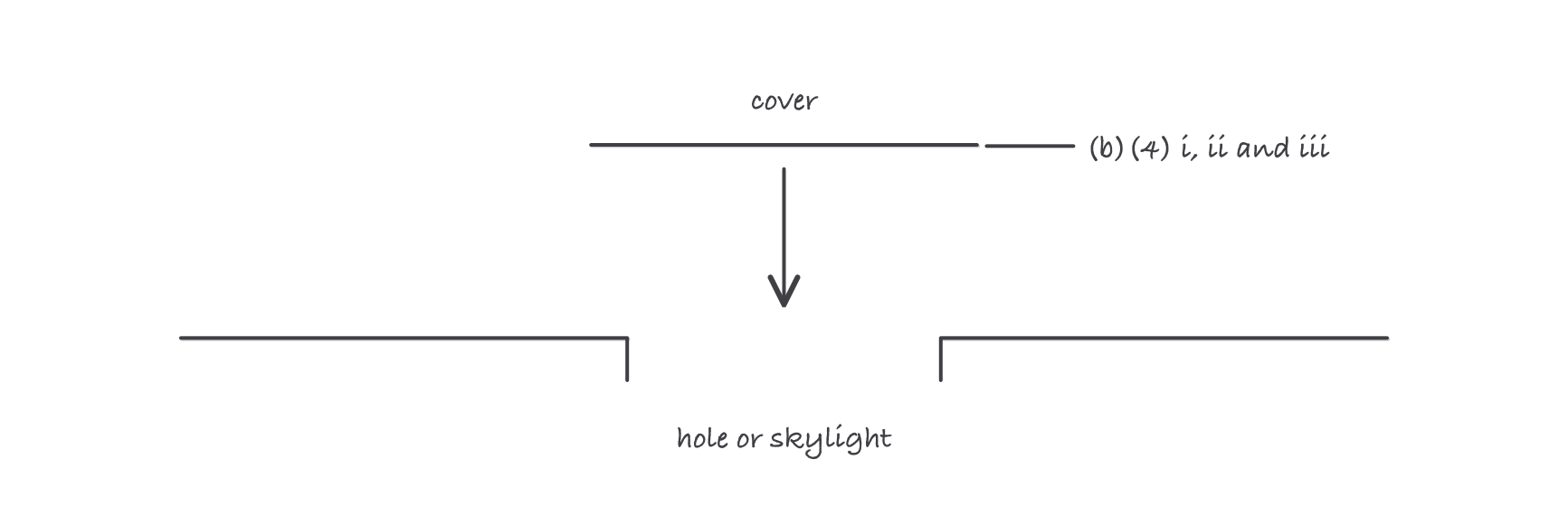
Covers are the one measure named in all three parts of (b)(4), and a cover has to be wider than the hole it closes
Note that “hole” includes skylights in every one of the three, and that a skylight in an old roof is a hole with something breakable over it. Treating a skylight as a surface has killed roofers who never went anywhere near an edge.
What goes down, and who is under it
1926.501(c) covers protection from falling objects, and its measures are the familiar ones: hard hats, plus toeboards, screens, guardrails, canopy structures or barricades to keep objects from reaching people below.
On a tear-off the practical control is usually the barricade. Chutes and dumpsters concentrate the debris path, and the ground under that path stops being a place where anybody stands, parks or walks a homeowner. Set that ground control before the first shingle moves, because the debris starts falling within minutes of the crew reaching the roof.
Worked example: a two-layer commercial tear-off
A low-slope roof, 30 ft by 45 ft, 18 ft to grade, slope 1/4 in 12, carrying two stacked roof systems. Four curbed skylights sit in the field of the roof.
Quantify the work. The surface is 30 × 45 = 1,350 sq ft, which at 100 sq ft to the square is 13.5 squares. Two existing systems means 2 × 13.5 = 27 squares of material to remove before a single square of new roof goes down. That is the number that fills the dumpster, and it is the number of squares of debris on the walking surface during the strip.
Pick the edge protection. 18 ft is more than 6 ft, so 1926.501(b)(1) is triggered. The slope of 1/4 in 12 is less than or equal to 4 in 12, so this is a low-slope roof under 1926.500(b) and 1926.501(b)(10) governs the edges.
Now handle the skylights separately. Nothing chosen in the previous step touches them. A warning line at the perimeter, a guardrail at the perimeter, even a full personal fall arrest setup rigged for edge work: none of it satisfies (b)(4) for four openings in the middle of the field. Those four skylights need their own protection, and covers answer all three duties in one move.
Four openings, four covers, each one wider than the hole it closes and secured so it cannot slide off under a boot. Then the roof is protected, and not before.
Where it bites
- Perimeter protection is not roof protection. A roof where the edges were done properly and the middle was forgotten is a treacherous one.
- A cover nobody marked is a trap you built. An unmarked sheet of plywood on a debris-covered roof reads as scrap, and the next worker moves it. Secure it and mark it.
- The deck under the old roof is an unknown until you see it. Never load a roof, stage bundles, or walk a strip you have not swept and looked at.
- Layers are not plies. Two layers means two complete previous roofs stacked, which is a structural and code question as well as a disposal one. Two plies means one built-up membrane correctly constructed. Confusing them changes both the estimate and the load calculation.
- Tear-off is roofing work, so the roofing paragraphs apply from the first pry bar. The crew is not exempt while nothing new has been installed yet.