Learn · Roofing
Tile and Slate
Part of Roofer to Licensed Contractor · step 11 of 28 · next: Low-Slope Systems: BUR, Mod-Bit, Single-Ply
In learning paths: Roofer to Licensed Contractor
Assumes you know: Underlayment and Flashing
Tile and slate are the two steep-slope systems where the covering weighs enough to become a structural question before it is a roofing question. Everything else about them follows from that, and from a second property they share: the units are hard, and hard things break.
Why it matters on the job
These are long-life systems. A tile or slate roof outlasts several asphalt roofs, which means the decision to put one on a building is a decision about the building rather than about the covering, and it means most of the tile and slate work you will do is on roofs somebody else installed.
NRCA certifies Clay and Concrete Tile Systems and Slate Systems as two separate installer competencies, alongside the shingle and metal certifications. That separation is the trade recording something real: the units, the fastening, the handling and the repair sequence are different enough that experience on one does not transfer whole to the other.
Weight is the first question
The covering is dead load, permanently carried by the deck, the rafters or trusses, the walls and the foundation below them. On a new building that load is known at design time and the structure is sized for it.
A re-roof is where it gets interesting, because changing the covering changes the load on a structure that was designed for something else. Going from a light covering to a heavy one is not a materials swap. It is a change to what the existing framing is being asked to carry, and whether it can carry it is answered before the order is placed, by the structural provisions of the code adopted in your jurisdiction and, where the code calls for it, by an engineer.
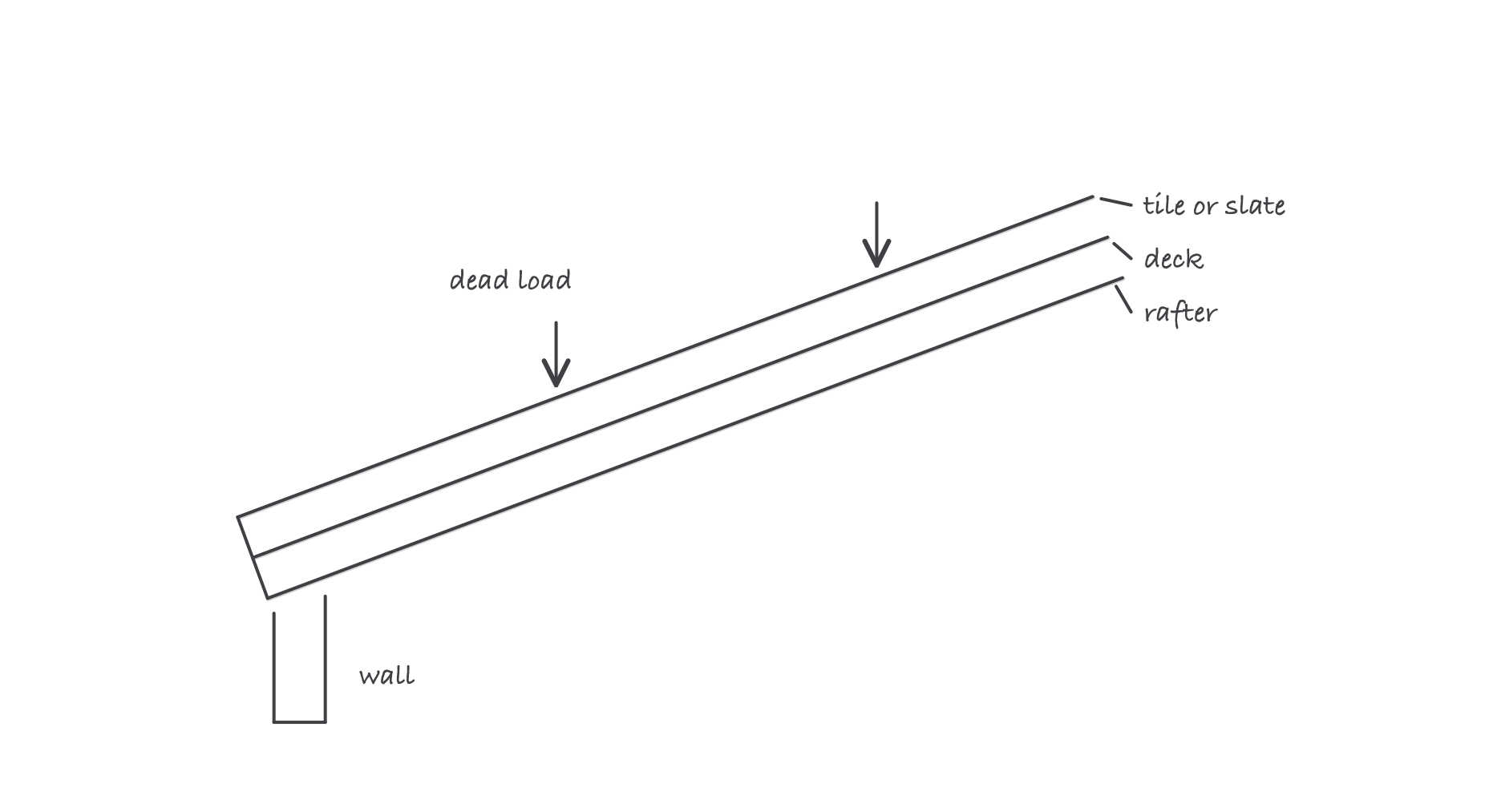
The covering is permanent load, and every pound of it is carried by the framing that is already there
Never quote a change of covering weight from memory or from what the last house took. The number belongs to the specific product and the specific structure.
Handling is the second question
Tile and slate arrive brittle and stay brittle. Units break in transit, in the lift, in the stacking, and under a boot, and every broken unit in the field is either replaced or is a leak.
Two consequences follow. First, loading the roof concentrates weight during the job as well as after it, so where the bundles are set down and how they are spread is a decision, not a habit. Second, where a person may step on a finished tile or slate roof is a system-specific technique, and getting it wrong costs units, time and eventually water.
Repairs are a sequence, not a patch
A cracked unit in the middle of a field is replaceable, and that replaceability is a large part of why these roofs last. But every unit is held by the ones above and beside it, so replacing one means lifting or releasing its neighbors, working from the top down, and putting the whole sequence back. Approaching it as a patch breaks more units than it fixes.
This is also why an old tile or slate roof with a bad reputation is often a roof with bad repairs rather than a bad roof.
What the code decides and what the product decides
Two authorities govern any tile or slate installation and they answer different questions.
The adopted code, in its roof assemblies chapter, sets what is required: the underlayment and where it is required, the fastening and wind resistance requirements, minimum slopes, and the structural provisions above. It varies by jurisdiction and by edition.
The manufacturer’s instructions for that specific tile or slate set what the product requires: the headlap, the fastening pattern, the batten or direct-to-deck method, and the accessories. These vary by product.
Neither one answers for the other, and neither one is a figure to be carried across from the last job.
Worked example: pricing a re-roof from shingles to concrete tile
The homeowner wants tile. Work the questions in this order, because each one can end the job.
- What is up there now, and how many layers? A tear-off is almost certainly required, and the number of existing layers is both a code question and a labor number.
- What is the deck and what condition is it in? Tile fastening depends on the deck, and the tear-off is the only chance to see it.
- What does the specified tile weigh, and what does the existing framing carry? This is the question that decides whether the job exists. The tile weight comes from the manufacturer’s data for that product. The structure’s capacity comes from the original design or from an engineer’s assessment, and framing reinforcement, if it is needed, may cost more than the roof.
- What does the adopted code require here? Underlayment, fastening and wind resistance for tile in your jurisdiction, read from the code in force, not from the last county you worked in.
- Only now, measure and price. Squares from the roof surface, waste from the cuts at hips, valleys and rakes, plus the breakage allowance that tile carries and shingles do not.
Any estimator can do step 5. Steps 1 through 4 are what separates a bid from a guess.
Where it bites
- “It held the old tile, so it holds the new tile” is not an argument. Products differ in weight, and a roof that has carried a load for forty years may have been carrying it with deflection nobody measured.
- Underlayment matters more here. The units are the outer layer and they are not sealed to one another, so what the code requires under them, and where, is a provision to read rather than an assumption to make.
- Broken units hide. A unit cracked during loading looks fine from the ground for a season, then shows up as a stain on a ceiling. Cull as you go.
- A re-cover over tile or slate is rarely the simple answer it sounds like. All the usual re-cover questions apply, plus the fact that the existing covering is heavy and staying.
Exam relevance
NRCA’s PROCertification list includes Clay and Concrete Tile Systems Installer and Slate Systems Installer as separate certifications, each held by an individual worker rather than by a company.
Both follow the same structure as the other installer certifications: an online eligibility exam, then a hands-on performance assessment carried out in front of an assessor. For heavy units the assessment reaches the things that show up years later, which are fastening, headlap, the detailing at hips, valleys and penetrations, and whether the candidate can work a repair sequence without destroying the units around it. Experience minimums, fees and renewal terms come from NRCA for each certification.