Qualifications · Roofing
Roofing Licensing by State
Part of Roofer to Licensed Contractor · step 22 of 28 · next: Manufacturer Certification Programs
In learning paths: Roofer to Licensed Contractor
There is no national roofing contractor license. Roofing is licensed state by state, sometimes city by city inside a state, and the states do not agree with one another about whether roofing is licensed separately at all, at what level of government, under what name, or with what gates in front of it.
*Learn the Trades is a free study resource. We are not a licensing body, an authorized training provider, or an exam administrator. Reading this page does not award any card, license, or certification. Always verify requirements with the issuing authority linked in the sources.*Why it matters on the job
The moment you contract for roofing work in your own name, you are inside somebody’s licensing scheme, and “I did not know this state required it” is not a defense anywhere. Working across a state line (or across a county line inside one state) is the situation that catches competent contractors out, because the rules changed and nothing on the ground looked different.
What actually varies
Six things differ between jurisdictions, and any one of them can be the thing that stops you working.
- Whether roofing is a separate classification or is only reachable inside a general or building contractor license.
- Which level of government issues it. State board, county, city, or a combination.
- The experience gate. How many years, at what level, and how recently.
- The exams. Trade knowledge, business and law, or both, and who administers them.
- The financial gates. A surety bond, proof of insurance, workers’ compensation, financial responsibility requirements.
- Renewal and continuing education. How often, how many hours, and in what subjects.
Learn that template, then fill it in for the jurisdiction you are actually standing in. It is a much more durable skill than memorizing any one state’s rules.
Florida, where the words mean the opposite of what you expect
Florida defines the roofing contractor at s. 489.105(3)(e) of the Florida Statutes and places it in the Division II classifications. It then issues that license in two categories whose names are a trap for anyone reading them cold.
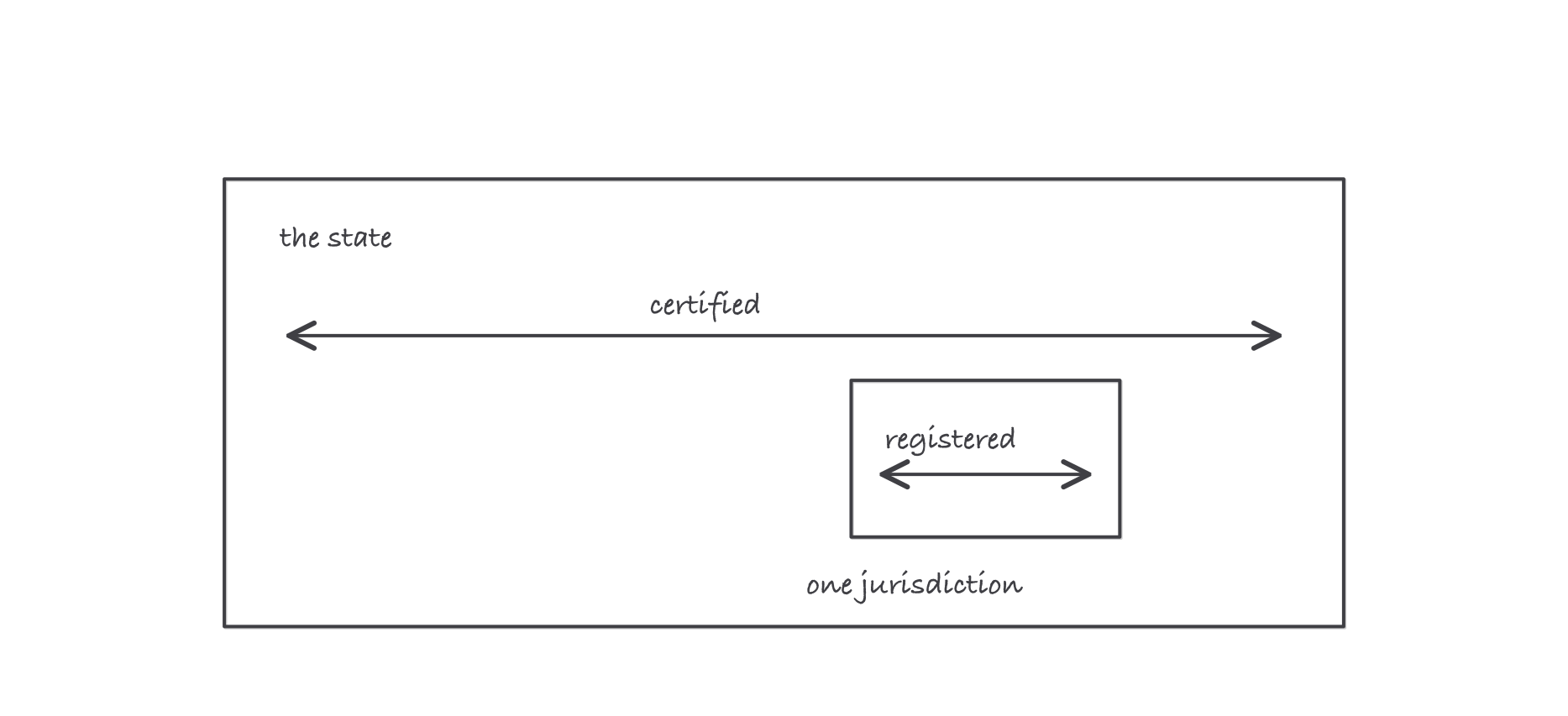
In Florida the certified license reaches the whole state and the registered license reaches only the jurisdiction whose competency requirements it satisfied
Two consequences follow for anyone working in Florida. A registered contractor who takes a job one county over may be working unlicensed without ever having done anything they thought was wrong. And a homeowner who checks that their contractor is “licensed” has learned less than they think, because the two categories mean genuinely different things about where that contractor may work.
Do not carry Florida’s meaning of these two words into any other state. They are terms of art in one statute, and elsewhere they may mean something different or nothing at all.
California, where roofing is its own specialty
California licenses roofing through the Contractors State License Board as the C-39 Roofing classification, one of the specialty classifications under 16 CCR Division 8 Article 3, authorized by Business and Professions Code sections 7058 and 7059.
CSLB’s scope description for C-39 is worth reading closely, because a scope is the legal boundary of what the license lets you do: “A roofing contractor installs products and repairs surfaces that seal, waterproof and weatherproof structures … uses asphaltum, pitch, tar, felt, glass fabric, urethane foam, metal roofing systems, flax, shakes, shingles, roof tile, slate or other roofing, waterproofing and weatherproofing materials.”
The gates CSLB publishes before applying are the pattern in its clearest form:
- Age: at least 18 years old.
- Experience: four years of journey-level experience within the last ten years.
- Bond: a $25,000 contractor’s bond.
And on the other side of the exam, CSLB’s renewal structure: an active license expires every two years, an inactive license every four, with a 90-day retroactive reinstatement period after expiry.
The state you cannot find a rule for
You search a state’s licensing agency, find that roofing is not on its list of regulated trades, and conclude the state does not license roofing. That conclusion does not follow. Authority may sit with a different agency, roofing may be reachable only inside a broader contractor classification, or licensing may be delegated to counties and cities so the state list is silent by design.
Absence from a list is weak evidence. Before you work anywhere, confirm two things positively: what the state contractor board says about roofing, and what the local jurisdiction where the roof is says about roofing. A state that does not license roofing at state level can still have a city that does, with its own exam and its own bond.
Worked example: taking the template to a new state
You have a roofing business in one state and a customer three hours away, across a line. Work the template, in this order, before you quote.
- State board first. Does this state issue a roofing or roofing-adjacent contractor license, and under what name? If yes, get the classification’s scope description and read it against the work you intend to do.
- Then the local jurisdiction. City and county. Registration, local competency requirements, permits, and whether a state license is honored locally.
- The gates. Experience, exams, bond, general liability, workers’ compensation, and whether experience from another state counts.
- Reciprocity. Some states have agreements with some other states for some classifications. Check whether one applies to you specifically rather than assuming that reciprocity in general means reciprocity for you.
- The clock. Application processing, exam scheduling, and renewal timing. A license you cannot hold until March does not help with a job in January.
- Then quote. Not before.
Where it bites
- Certified and registered are not general English in Florida. They are statutory categories, and the broader one is the one that sounds narrower.
- A state license does not always finish the job. Local registration, permitting and competency requirements sit on top of it in a lot of places.
- Licensed, bonded and insured are three separate claims, and the one that matters when somebody falls off a roof is workers’ compensation. Ask about it directly rather than inferring it from a phrase on a truck.
- Your license has a scope, and the scope is a boundary. Work outside it is unlicensed work even though you hold a license, which is a distinction that only ever gets explained to people after the fact.
- Renewal lapses are avoidable and expensive. Diary the renewal date and the continuing education hours the day the license is issued, not the month it expires.
Exam relevance
This lesson is about the license itself rather than about a single exam, so what matters is knowing which exam you face. Most jurisdictions that license roofing separately test two things: trade knowledge for the classification, and business and law. The trade portion draws on the adopted code in that jurisdiction, which is why the same candidate can pass in one state and be unprepared in the next.
Read the classification scope before you study anything. It tells you what the examiners consider to be your trade, and everything the exam asks sits inside it. Application forms, fees, exam providers and current requirements come from the issuing board, and the board is the only authority on its own license.
Verified requirements
| Where | Expires | Renewal | Continuing education |
|---|---|---|---|
| Florida | Yes | 2 years | 14 hours per renewal cycle under Fla. Admin. Code R. 61G4-18.001, including one hour each of workers' compensation, workplace safety, business practices, laws and rules, an advanced module course, and wind mitigation methodologies. Roofing is explicitly named among the categories that must take the wind mitigation hour. |
| Florida | Yes | 2 years | 14 hours per renewal cycle under Fla. Admin. Code R. 61G4-18.001, on the same terms as certified contractors, including the wind mitigation methodologies hour required of roofing licensees. |
| California | Confirm with issuer | 2 years for an active license, 4 years for an inactive license | CSLB's general renewal information page states no continuing-education requirement for renewal. A positive Tier-1 statement that no CE requirement exists for C-39 was not located, so treat 'no CE' as unconfirmed rather than established. |
Information comes from issuing-authority sources. Confirm current rules, fees and eligibility with the authority before acting.